




 Medical, Dental & Pharmacy
- Medical
- Ambulatory Surgical Services
- Children's Services
- Chiropractic
- Clinic Services
- Community First Services and Supports (CFSS)
- Early Intensive Development and Behavioral Intervention (EIDBI)
- Equipment and Supplies
- HCBS
- Hearing Services
- Home Care Services
- Hospice Services
- Hospital Services
- Housing Stabilization Services
- Immunizations and Vaccinations
- Laboratory/Pathology, Radiology, and Diagnostic Services
- Language Interpreter Services
- Long-Term Care
- Medication Reconciliation
- Mental Health Services
- Optical Services
- Personal Care Assistance (PCA) Services
- Physician and Professional Services
- Recuperative Care
- Rehabilitation Services
- Renal Dialysis
- Restricted Recipient Program
- School-Based Community Services
- Substance Use Disorder
- Telehealth Services
- Transportation
- Tribal and Federal Indian Health Services
- Dental
- Pharmacy
Covered Services
Jump To...me
- Adult Day Treatment
- Adult Rehabilitative Mental Health Services (ARMHS)
- Assertive Community Treatment (ACT)
- Behavioral Health Home (BHH) Services
- Certified Community Behavioral Health Clinic (CCBHC)
- Certified Family Peer Specialist
- Certified Peer Specialist Services (CPSS)
- Children's Day Treatment
- Children’s Intensive Behavioral Health Services (CIBHS)
- Children’s Mental Health Clinical Care Consultation
- Children’s Mental Health Residential Treatment Services
- Children’s Therapeutic Services and Supports (CTSS)
- Clinical Infrastructure Components
- Crisis Services (Adult and Children)
- Diagnostic Assessment
- Dialectical Behavioral Therapy (DBT)
- Explanation of Findings
- Family Psychoeducation
- Health Behavior Assessment/Intervention
- Inpatient Visits
- Intensive Residential Treatment Services (IRTS)
- Mental Health Medication Management
- Mental Health Provider Travel Time
- Mental Health Targeted Case Management (TCM)
- Neuropsychological Services
- Partial Hospitalization Program (PHP)
- Physician Consultation, Evaluation, and Management
- Psychiatric Consultations to Primary Care Providers
- Psychiatric Residential Treatment Facility (PRTF)
- Psychological Testing
- Psychotherapy
- Telehealth Delivery of Mental Health Services
- Youth Assertive Community Treatment (Youth ACT)/Intensive Rehabilitative Mental Health Services (IRMHS)
Adult Day Treatment
Adult Day Treatment (ADT) is a structured program of group psychotherapy and other intensive therapeutic services provided by a multidisciplinary team to stabilize a member’s mental health status while developing and improving his/her independent living and socialization skills. The goal of day treatment is to reduce or relieve the effects of mental illness and provide training to enable the member to live in the community.
Eligible ADT Providers
The following entities may apply to become ADT providers:
- Centers for Medicare and Medicaid Services (CMS)-accredited hospitals licensed under MN Stat. 144.50 – 144.55
- Community mental health centers as defined under MN Stat. sec. 256B.0625, subd. 5
- An entity that is under contract with the county board to operate a program that meets the requirements of MN Stat. sec. 245.4712, subd. 2, and MN Rules Chap. 9505.0170 – 9505.0475
Individual members of the ADT multidisciplinary team must meet, at a minimum, the standards for a mental health practitioner. Psychotherapy components of day treatment must be provided by a mental health professional unless a mental health practitioner qualifies under the provisions in the Mental Health Professional Service Billing section.
Day treatment programs follow the staffing requirements for group size as established for group psychotherapy.
If providing Children’s Day Treatment to members ages 18, 19, or 20, providers must also be Children’s Therapeutic Services and Supports (CTSS)-certified.
Clinical Supervision
ADT providers are required to follow Clinical Supervision of Outpatient Mental Health Services (Rule 47) guidelines
Eligible Members
To be eligible for ADT, a member must meet all of the following criteria:
- Be a PrimeWest Health member
- Be age 18 or over (members ages 18, 19, or 20 may receive ADT, CTSS, or both, depending on medical necessity)
- Not be residing in an institution (nursing facility, hospital, Institute for Mental Disease [IMD], Regional Treatment Center [RTC]), unless the member has an active discharge plan that indicates a move to an independent living arrangement within 180 days (refer to Members in Institutions or Residential Facilities section)
- Have a diagnosis of mental illness (primary diagnoses may not be alcohol or other drug abuse)
Members admitted to ADT programs must be in need of and have the capacity to benefit from the rehabilitative nature, the structured setting, and therapeutic components of psychotherapy and skills activities that are integral to a day treatment program. A group is defined as more than three individuals.
Members with mental illness and a developmental disability or cognitively degenerative disease, such as Alzheimer’s, must have the ability to understand and benefit from day treatment. When a member does not have or ceases to have the cognitive capacity to benefit from day treatment services, day habilitation programs or adult day care, services under a waiver program may be more appropriate. Refer member in need of these or other services to the county human service agencies or private agencies. Day treatment is distinguished from day care by the structured therapeutic program of psychotherapy and other therapeutic components.
Members in Institutions or Residential Facilities
Day treatment services are not part of inpatient or residential treatment services. Day treatment programs are rarely appropriate for members residing in institutions (nursing facilities, IMDs); however, members residing in institutions who have an active discharge plan that indicates a move to an independent living arrangement within 180 days may be considered for participation in a day treatment program. A mental health professional must deem the day treatment services medically necessary and the member’s facility plan of care must include day treatment.
Develop a treatment plan for each member with attainable, measurable goals. The primary goal for each member is independence to the degree possible. Develop the treatment plan at the time of admission, review and update until discharge with the member’s progress, and include a sound discharge plan.
Apply the following criteria to identify the appropriate situation or status for members recommended or referred for day treatment services. Members not meeting these criteria should be referred to other services appropriate to their needs.
Admission Criteria
For admission, a member must meet the following criteria:
- Have a primary diagnosis of mental illness as determined by a diagnostic assessment (DA), excluding dementia and other organic conditions
- The DA must be completed following a face-to-face evaluation of an individual’s nature, severity, and effect of behavioral difficulties, functional impairment, subjective distress, strengths, and resources
- Have a functional assessment (FA) completed before an Individual Treatment Plan (ITP) is completed
- An FA is valid for 180 days
- Update the FA when the person undergoes any significant changes in functioning, life situation, or status in any domain or life area
- A significant change in functioning calls for a reassessment of the functional domains, regardless of the due date for updating the functional assessment
- Have a completed level of care assessment or necessity of care recommendation recommending ADT
- A level of care assessment must also be completed prior to receiving services and no sooner than 30 days prior
- A level of care assessment is valid for 180 days
- Update a level of care assessment when a person undergoes any significant change in functioning or a significant life event has occurred. These changes call for a new level of care assessment.
- Complete an ITP (refer to MN Stat. 245I.10) before beginning services. The member's ITP must meet the following criteria:
- Include attainable, measurable goals as they relate to day treatment services
- Be reviewed by the provider and updated with member progress at least every 180 days until discharge, and include an available discharge plan
- Include an attainable discharge plan for the member
- Be a collaborative and person-centered process involving the member, and with the permission of the member, the member's family and others in the member's support system
- The ITP and subsequent revisions of the ITP must be approved by the member before treatment begins. ITPs are valid from the date that the member reviews the ITP and provides verbal approval. Clinicians must document the date of the member’s verbal approval in the treatment plan. Providers have up to 10 business days for both the treatment supervisor (if applicable) and member to hand or electronically sign the ITP according to MN Stat. 245I.08. If the member refuses to sign the ITP, an addendum should be added explaining why the member refused or was unable to sign the ITP.
- Be experiencing symptoms impairing thought, mood, behavior, or perception that interfere with the ability to function with a lesser level of service
- Have the cognitive capacity to engage in and benefit from this level of treatment
- Reasonably be expected to benefit in improved functioning at work, school, or social relationships
- Need a highly structured, focused treatment approach to accomplish improvement and to avoid relapse requiring higher level of treatment.
Day treatment may also be appropriate for the following:
- Members with a brain injury (BI) diagnosis that coexists with the primary mental illness diagnosis
- Court ordered treatment or for a member who is a potential danger to self, if the program provides adequate structure and sufficient support systems exist in the community
- Members residing in inpatient or residential facilities (nursing facilities, IMDs, hospitals, RTC) when an active discharge plan indicates a move to an independent living arrangement within 180 days. A mental health professional must deem the day treatment services medically necessary and the facility plan of care must include day treatment
Continuing Stay Criteria
Consider a member for continuing stay if the following criteria are met:
- Member’s condition continues to meet admission criteria as evidenced by active psychiatric symptoms and continued functional impairment
- The treatment plan contains specific goals and documented measurable progress toward goals
- Member continues to make progress toward goals but they have not yet been fully achieved
- There is documentation that an active discharge plan is in place
- There is documentation of active attempts at coordination of care and attempts to transition to other services as clinically indicated
Discharge Criteria
Consider a member for discharge if any one of the following criteria is met:
- Treatment plan goals and objectives have been met or individual no longer meets continuing stay criteria
- Mental health disorder(s) impairing thought, mood, behavior, or perception decreased to level that lesser level of service is indicated
- Member is voluntarily involved in treatment and no longer agrees to attend day treatment
- Member exhibits severe exacerbation of symptoms and/or disruptive or dangerous behaviors requiring more intensive level of service. Do not close chart if individual is expected to return to day treatment.
- Member does not participate despite multiple attempts to engage the person and address nonparticipation issues
- Member does not make progress toward treatment goals and there is no reasonable expectation that progress will be made
Covered Day Treatment Services
ADT consists of the following:
- At least one hour of group psychotherapy (maximum of two hours)
- Group time focused on rehabilitative interventions, or other intensive therapeutic services, provided by a multidisciplinary staff
- A group of at least three, but not more than 12. For a group of three to eight people, one mental health professional or practitioner is required to conduct the group. For a group of nine to 12 people, a team of at least two mental health professionals or two mental health practitioners or one mental health professional and one mental health practitioner is required to co-conduct the group.
The services must:
- Stabilize the member's mental health status
- Develop and improve the member’s independent living and socialization skills
If the member or authorized person refuses to sign the plan or a revision of the plan, the mental health professional or mental health practitioner will note on the plan the refusal to sign and the reason(s) for the refusal.
Non-Covered Services
The following services or activities may not be billed as day treatment:
- Services provided to members who reside in a nursing facility, hospital, institute of mental disease, or State-operated treatment center unless the member has an active discharge plan that indicates a move to an independent living setting within 180 days
- Primarily recreation-oriented, non-medically supervised services or activities, including, but not limited to, the following:
- Sports activities
- Exercise groups
- Craft hours
- Leisure time
- Social hours
- Meal or snack time or preparation
- Trips to community activities
- Tours
- Social or educational services that do not have therapeutic outcomes related to the member’s mental health condition
- Consultations
- Prevention or education programs provided to the community
- Services not included in the member’s treatment plan as medically necessary and appropriate
- Less intensive services, such as a “clubhouse” or social program not covered by PrimeWest Health
- Day treatment for members with a primary diagnosis of substance use disorder
- Day treatment provided in the member’s home
- Psychotherapy for more than two hours daily
- Participation in meal preparation and eating that is not part of a clinical treatment plan to address a member’s eating disorder
Billing
- Use the appropriate claim format.
- Do not use a modifier.
- Do not provide or bill for ADT for children under age 18.
| ADT | ||||
| Procedure Code | Modifier | Brief Description | Unit | Service Limitation |
| H2012 |
| Adult Behavioral Day Treatment | 1 hour | None |
Adult Rehabilitative Mental Health Services (ARMHS)
ARMHS do the following:
- Enable a member to develop and enhance psychiatric stability, social competencies, personal and emotional adjustment, and independent living and community skills, when these abilities are impaired by the symptoms of mental illness
- Enable a member to retain stability and functioning if the member is at risk of losing significant functionality or being admitted to a more restrictive service setting without these services
- Instruct, assist, and support a member in areas such as medication education and monitoring, and basic social and living skills in mental illness symptom management, household management, employment-related, or transitioning to community living
Eligible Adult Rehabilitative Mental Health Services (ARMHS) Providers
Each ARMHS provider entity must be certified to provide ARMHS. Certification ensures that the provider is capable of providing directly, or contracting for, the full array of ARMHS.
ARMHS entities must be recertified every three years by the Minnesota Department of Human Services (DHS).
The following individual providers are eligible to provide ARMHS:
- Mental health professional
- Certified rehabilitation specialist
- Mental health practitioner
- Clinical trainee
- Mental health rehabilitation worker*
- Certified peer specialist*
- Licensed occupational therapist
*Mental health rehabilitation workers (MHRW) and certified peer specialist (CPS) level 1 providers cannot develop a functional assessment (FA), level of care assessment, or individual treatment plan (ITP). MHRWs and CPS level 1 providers can implement ITP interventions and develop a progress note.
Licensed occupational therapists (OT) may administer ARMHS with the same scope of practice as a mental health practitioner. Licensed OTs providing ARMHS should not enroll with MHCP as a mental health provider. OTs should not bill for OT services within ARMHS. OTs operate under the treatment supervision of a licensed mental health professional.
The following providers are eligible to provide medication education services under ARMHS:
- Physician
- Registered nurse
- Physician assistant
- Pharmacist
Treatment Supervisor Affiliation
Effective July 1, 2026, ARMHS treatment supervisors may not be affiliated with more than 10 organizations and may only provide treatment supervision to 20 staff members total.
- A treatment supervisor must complete an attestation form in a manner provided by the commissioner (we will link to the form when it is available). The attestation must meet the following criteria:
- It must be completed at least annually
- It must be updated whenever there is a change in the number of affiliated organizations
Treatment Supervisor Requirements
All treatment supervisors providing treatment supervision required must do the following:
- Meet with staff receiving treatment supervision at least monthly to discuss treatment topics of interest and member treatment plans; and
- Meet at least monthly with the directing clinical trainee or mental health practitioner, if applicable, to do the following:
- Review the needs of the adult rehabilitative mental health services program
- Review staff on-site observations
- Evaluate mental health rehabilitation workers
- Plan staff training
- Review program evaluation and development
- Provide consultation to the directing clinical trainee or mental health practitioner
Eligible Adult Rehabilitative Mental Health Services (ARMHS) Members
Members eligible for ARMHS must meet all of the following criteria:
- Be age 18 or over
- Have a primary diagnosis of mental illness as determined by a DA
- Have a completed level of care assessment
- Have a significant impairment in functioning in three or more areas of the FA domains specified in MN Stat. sec. 245.462, subd. 26 and MN Rules part 9520.0914, subp. 2
- Be a PrimeWest Health member
Adult Rehabilitative Mental Health Services (ARMHS) Covered Services
The following services are billable as ARMHS:
- Basic living and social skills
- CPSS
- Community intervention
- Functional assessment
- Individual treatment plan
- Medication education
- Transitioning to community living services
Coordination of Services
Providers are responsible for asking PrimeWest Health members if they are currently receiving the same health care services from another provider. If the member is receiving the same services from another provider, the providers must coordinate the services and document in the member's record how the services were coordinated to ensure medical necessity and non-duplicative services.
Except for community intervention, all covered services are provided face-to-face. Documentation of activities is included in the covered service and must not be billed separately.
ARMHS can be provided in the following locations:
- A member’s home
- The home of a relative or significant other
- A member’s job site
- The community, such as the following:
- Psychosocial clubhouse
- Drop-in center
- Social setting
- Classroom
- Other place in the community
Unless a member is in the process of transitioning to independent living within 180 days and ARMHS offers the services necessary for the member to succeed, do not provide ARMHS to a member residing in any of the following:
- Regional Treatment Centers (RTCs)
- Nursing facilities
- Acute care settings (inpatient hospital)
- Sub-acute settings (IRTS program)
Basic Living and Social Skills
Basic living and social skills are activities that instruct, assist, and support a member in skill areas essential for every day, independent living. Examples of skill areas include the following:
- Interpersonal communications
- Community resource utilization and integration
- Crisis assistance
- Relapse prevention
- Budgeting, shopping, and healthy lifestyle skills and practices
- Cooking and nutrition
- Transportation
- Medication monitoring
- Mental illness symptom management
- Household management
- Employment-related skills
- Transitioning to community living
Each member’s treatment plan should identify specific skills needed, how each is being addressed, the modality (individually, group), and the medical necessity for each goal.
Provide basic living and social skills individually or in a group setting, when appropriate, to each participating member’s needs and treatment plan. A basic living and social skills group is 2 – 10 individuals, at least one of whom is a PrimeWest Health member. Up to two staff may bill PrimeWest Health for services provided to a group. Each staff person must bill for different members.
Provide basic living and social skills directly (face-to-face) to the member. Do not bill if the contact is conducted by telephone.
Certified Peer Specialist Services
CPS services include the following:
- Nonclinical, recovery-focused activities encouraging empowerment, self-determination, and decision-making, which are only provided by a CPS
- Activities that can address and contribute to the ARMHS team insights about feelings associated with stigma, social isolation, personal loss, systemic power dynamics, and restoring one’s lifestyle following hospitalization, or other acute care services
A CPS Level I cannot develop the functional assessment or the ITP.
Refer to the Certified Peer Specialist Services section of the MHCP Provider Manual for more information.
Individual Treatment Plan (ITP)
An individual treatment plan (ITP) is a written plan that documents the treatment strategy, the schedule for accomplishing the goals and objectives, and the responsible party for each treatment component. Complete an individual treatment plan after the functional assessment, and before delivery of basic living and social skills or medication education.
An ITP for ARMHS is based on a diagnostic assessment and baseline measurements, a functional assessment, and a level of care assessment. The ITP documents the plan of care and guides treatment interventions and strategies. Development of the ITP includes involvement of the member, member’s family, caregivers, or other people, which may include people authorized to consent to mental health services for the member, and includes arrangement of treatment and support activities consistent with the member’s cultural and linguistic needs.
The ITP focuses on the person’s vision of recovery, their priority treatment goals and objectives, and the interventions and strategies that will help meet those goals and objectives. The plan must be written in a way in which the person and their family have a clear understanding of the services being offered and specifically how the services will address their concerns. The person, and any family or support persons desired, must take part in the process of developing the ITP to make sure the treatment is relevant to the priorities and incorporates the member's strengths.
When completing the ITP for ARMHS, the following components must be present on the plan:
- Cultural considerations and needs of the member as related to service plan and delivery
- Measurable objectives directed toward the achievement of each one of the goals, including time frames for achievement
- Specific objectives directed towards the achievement of each one of the goals including time frames for achievement
- Treatment strategies for achieving objectives
- Individuals responsible for providing treatment services and natural supports to the member
- If a member has a history of not engaging in treatment, a treatment strategy to engage the member
- Documentation of progress (or lack thereof) as a written review that evaluates progress toward goals and objectives from the previous plan
- Documentation of participants in treatment planning
- Approval by the member or legal guardian (see Minnesota Statutes 245I.02, subdivision 2)
- Give a copy of the approved plan to the member or guardian.
- If a member or their guardian does not agree with the plan, document efforts to engage the person in his or her treatment plan and why they were not willing to approve it.
Time Frames
- Develop and approve an ITP within 30 days of the ARMHS intake or start date
- Review and update the ITP every 180 days including member’s treatment progress, new objectives and goals, or if member has not made progress, changes in ARMHS providers approach to treatment
Approval
If able, the member or their guardian may indicate approval by written signature, electronic signature, or documented oral approval. If the member or guardian is unable or unwilling to approve the ITP, document the reason.
ITP Best Practices
Best practices are only recommendations, not requirements.
- Recovery vision: Reflects the person’s aspirations regarding their life stated in their own words.
- Goal (Rehab): A measurable target for change that is achievable in a specified time frame. A goal describes a measurable target for change that will result in achieving a desired outcome. The recommendation is no more than two rehabilitative goals within a plan.
- Objectives: Ideally achievable within the time frame of an ITP. A small positive forward step describing what the person will be able to do or the result to be realized. The ITP outlines the small steps the person will take. The recommendation is no more than three objectives that can be targeted sequentially or concurrently to attain the goal.
- Objectives are measurable and observable with an identified baseline and target measure.
- Interventions and Strategies: rehabilitation techniques that ARMHS staff will use to help a person reach objectives, which lead to completing goals. Interventions can focus on using community resources or natural support networks and skill development, mastery, or generalization associated with a specific role or setting.
- The ITP should also include the following:
- Identified skills or skill set to be learned, mastered, or generalized
- Where services will take place
- Description of the type of rehabilitative intervention to be used such as demonstrating, modeling, practicing, etc.
- Type of service method (individual or group)
- Length of typical session
- Frequency of sessions
- Service categories: basic living and social skills (BLSS), medication education (ME), community intervention (CI), transition to community living (TCL), or certified peer specialist (CPS)
Functional Assessment (FA)
A comprehensive FA is a narrative that describes how the person’s mental health symptoms affect their day-to-day functioning in a variety of roles and settings. It is important to look at how factors other than mental health symptoms affect life functioning.
Refer to the Functional Assessments section of the MHCP Provider Manual for complete information.
Level of Care Assessment or Necessity of Care Service Recommendation or Referral
A level of care assessment determines the service intensity needs of the individual. Refer to the Level of Care Assessment and Necessity of Care Recommendation or Referral section of the MHCP Provider Manual for more information.
Community Intervention
Community intervention is a service of strategies provided on behalf of a member to do the following:
- Alleviate or reduce a member’s barriers to community integration or independent living
- Minimize the risk of hospitalization or placement in a more restrictive living arrangement
Community intervention may be conducted with an agency, institution, employer, landlord, or member’s family and may require the involvement of the member’s relatives, guardians, friends, employer, landlord, treatment providers, or other significant people to change situations and allow the member to function more independently.
Community intervention:
- Must be directed exclusively to the treatment of the member;
- Must be provided on an individual basis only (cannot be provided in a group);
- May be conducted in person or by telephone, if the intervention strategy warrants it (document accordingly); and
- Can be conducted without the member present when the intervention strategy warrants it (document why the strategy is more effective without the member present).
Community intervention may not be billed for any of the following:
- Routine communication between members of a treatment team, a routine staffing, or a care conference
- Telephone contacts that do not conform to the definition of this service or that are not properly documented
- Clinical supervision or consultation with other professionals
- Treatment plan development
Medication Education
The medication education service educates a member about the following:
- Mental illness and symptoms
- The role and effects of medications in treating symptoms of mental illness
- The side effects of medications
Medical education is coordinated with, but not duplicative of, medication management services. The member must be present to bill for the service.
Medication education:
- Can include activities that instruct members, families, and/or significant others in the correct procedures for maintaining a member’s prescription medication regimen
- May be provided individually or in a group setting
- Can be provided only by a physician, pharmacist, RN, or physician assistant (PA) employed by or subcontracted with a certified ARMHS provider. The ARMHS provider bills for medication education.
If medication education is provided in a pharmacy, ensure that the service is provided apart from the dispensing area. Medication education is not intended to replace any aspect of dispensing medications. Information provided to a member as part of a prescription is an aspect of dispensing medications, is reimbursed separately in the dispensing fee, and is not billable as medical education.
Transitioning to Community Living (TCL) Services
TCL services are services designed to do the following:
- Establish or re-establish contact between an ARMHS provider and the member prior to the member’s discharge from a higher level of care mental health service, including the following:
- RTC
- Community hospital
- IMD
- Intensive Residential Treatment program
- Board and care facility
- Skilled nursing home
- ACT
- Implement the discharge plan developed by the higher level of care mental health service
- Coordinate with, but do not duplicate, the discharge planning responsibilities of the higher level of care service
- Be provided within 180 days, maximum, of discharge from the higher level of care service
TCL services cannot be provided concurrently with other ARMHS services. TCL services are available only when the member is receiving a higher level of care service.
TCL services do not count toward the 300 hours/72-session limit for Basic Living and Social Skills or Community Intervention service categories.
Transitioning services are integrally coordinated with, but not duplicative of, discharge planning.
Do not provide transitioning services concurrently or in conjunction with other ARMHS. Bill transitioning services only when the facility does not have the responsibility to or cannot provide these services.
Transitioning services are claimed through basic living and social skills or community intervention procedure codes with a modifier (UD) indicating that the services are essential for successful entry or re-entry to independent living and provided to a member who is leaving or will be leaving a residential living arrangement such as a nursing facility or regional treatment center, an acute care (inpatient) setting, or sub-acute setting such as an IRTS program within 180 days.
Progress Notes
A progress note describes the rehabilitative service delivered. A progress note must be used to document each occurrence of a mental health service a staff person provides to a member.
Progress notes must include the following:
- Type of service
- Date of service
- Session start and stop times
- Service location
- Scope of service (nature of interventions or contacts, treatment modalities, phone contacts, etc.) includes these components:
- Goals and objectives targeted in the session
- Intervention delivered and methods used
- Member’s response or reaction to treatment interventions
- Plan for the next or future sessions including treatment changes to be implemented when interventions are ineffective
- Service modality (group or individual)
- Signature, printed name and credentials of the person who provided the service
- Mental health provider travel documentation requirements
- Significant observations, if applicable, include the following:
- Current risk factors the member may be experiencing
- Emergency interventions
- Consultations with or referrals to other professionals, family, or significant others
- Changes in symptoms (physical or mental)
Adult Rehabilitative Mental Health Services (ARMHS) Non-Covered Services
The following services are not covered ARMHS:
- Member transporting services
- Services provided and billed by providers not enrolled to provide ARMHS
- ARMHS performed by volunteers
- Provider performance of household tasks, chores, or related activities, such as laundering clothes, moving the member’s household, housekeeping, and grocery shopping for the member
- Time spent “on call” and not delivering services to members
- Activities primarily social or recreational in nature, rather than rehabilitative
- Job-specific skills services such as on-the-job training
- Time included in case management services
- Outreach services to potential members
- Room and board services
Billing Adult Rehabilitative Mental Health Services (ARMHS)
- Use the 837P claim format to bill for all ARMHS.
- Enter the treating provider NPI on each claim line.
- ARMHS services must be prior authorized in order to be concurrently provided with ACT or IRTS.
Effective August 1, 2024, ARMHS do not require authorization. For claims submitted prior to August 1, 2024, any units billed over the daily or monthly limit require authorization.
| Adult Rehabilitation Mental Health Services (ARMHS) Benefits | ||||
| Code | Modifier | Brief Description | Units | Service Limitations |
| H2017 | Basic living and social skills – individual; mental health professional or practitioner | 15 minutes |
| |
| HM | Basic living and social skills – individual; mental health rehabilitation worker | |||
| HQ | Basic living and social skills – group; mental health professional, practitioner, or rehabilitation worker | |||
| U3 | Basic living and social skills, transitioning to community living(TCL), mental health professional or practitioner | 15 minutes | Cannot be done concurrently with other ARMHS services | |
| U3 HM | Basic skills; TCL by a mental health rehabilitation worker; less than a bachelor’s degree level | 15 minutes | Cannot be done concurrently with other ARMHS services | |
| 90882 | Environmental or community intervention; mental health professional or practitioner | 1 session |
| |
| HM | Environmental or community intervention; mental health rehabilitation worker | |||
| U3 | Environmental or community intervention; TCL intervention | 1 session |
| |
| U3 HM | Environmental or community intervention; TCL intervention; less than a bachelor’s degree level; mental health rehabilitation level | 1 session |
| |
| H0031 |
| Mental health assessment; by non-physician | 1 session | |
| H0031 | TS | Mental health assessment; by non-physician; follow-up service (review or update) | 1 session | |
| H0032 |
| Mental health service plan development by non-physician | 1 session | |
| H0032 | TS | Mental health service plan development by non-physician; follow-up services (review or update) | ||
| H0034 | Medication education – individual; physician, RN, PA, or a pharmacist | Per 15 minutes |
| |
| H0034 | HQ | Medication education – group setting | Per 15 minutes |
|
Assertive Community Treatment (ACT)
ACT is an intensive, comprehensive, non-residential treatment and rehabilitative mental health service provided according to the assertive community treatment model. Assertive community treatment provides a single, fixed point of responsibility for the treatment, rehabilitation, and support needs of members. Services are offered 24 hours per day, seven days per week in a community-based setting.
ACT teams promptly and appropriately responds to emergent needs and makes necessary staffing adjustments to assure the health and safety of members.
Eligible ACT Programs
An ACT team must include the following:
- Team leader (licensed mental health professional)
- Psychiatrist (or provisionally, a psychiatric NP or CNS-MH)
- Licensed mental health professional
- Registered nurse
- Co-occurring disorder specialist
- Vocational specialist
- Mental health certified peer specialist
- Program administrative assistant
Based on team size, additional ACT team treatment staff may include the following:
- Mental health professional
- Clinical trainee
- Certified rehabilitation specialist
- Mental health practitioner
- Mental health rehabilitation worker
An ACT team may be classified as “small,” “midsize,” or “large” based on the composition of the team as defined in MN Stat. sec. 256B.0622, subd. 7b. ACT teams must ensure ACT staff qualifications, scope of practice, training, and treatment supervision meet the applicable standards of MN Stat. sec. 245I, Mental Health Uniform Service Standards Act.
Eligible Members
Members eligible to receive ACT services must meet the following criteria:
- Be eligible PrimeWest Health members
- Be age 18 or over (members ages 16 and 17 may be eligible upon approval by PrimeWest Health)
- Have a primary diagnosis of schizophrenia, schizoaffective disorder, major depressive disorder with psychotic features, other psychologic disorders or bipolar disorder
- Have a significant functional impairment demonstrated by at least one of the following:
- No indication that other available community-based services would be equally or more effective as evidenced by consistent and extensive efforts to treat the individual
- Written opinion of a licensed mental health professional that the recipient has a need for mental health services that cannot be met with other available community based services, or is likely to experience a mental health crisis or require a more restrictive setting if assertive community treatment is not provided
- Have a need for continuous high-intensity services as evidence by at least two of the following:
- Two or more psychiatric hospitalizations or residential crisis stabilization services in the previous 12 months
- Frequent utilization of mental health crisis services in the previous six months
- 30 or more consecutive days of psychiatric hospitalization in the previous 24 months
- Intractable, persistent, or prolonged severe psychiatric symptoms
- Coexisting mental health and substance use disorders lasting at least six months
- Recent history of involvement with the criminal justice system or demonstrated risk of future involvement
- Significant difficulty meeting basic survival needs
- Residing in standard housing, experiencing homelessness, or facing imminent risk of homelessness
- Significant impairment with social and interpersonal functioning
- Coexsisting mental health and physical health disorders lasting at least six months
- Residing in an inpatient or supervised community residence but clinically assessed to be able to live in a more independent living situation if intensive services are provided
- Requiring a residential placement if more intensive services are not available
- A difficulty effectively using office-based outpatient services
Covered ACT Services
The ACT team must offer and have the capacity to provide the following services:
- Assertive engagement
- Benefits and finance support
- Co-occurring disorder treatment
- Crisis assessment and intervention
- Employment services
- Family psychoeducation and support
- Housing access support
- Medication assistance and support
- Medication education
- Mental health certified peer specialist services
- Physical health services
- Rehabilitative mental health services
- Symptom management
- Therapeutic interventions
- Wellness self-management and prevention
- Other services based on member needs as identified in a member’s assertive community treatment individual treatment plan
ACT teams must ensure the provision of all services necessary to meet a member’s needs as identified in the member's individual treatment plan.
Billing
- PrimeWest Health reimburses ACT services:
- Based on one, all-inclusive daily rate
- To one provider, per day
- Each claim must be for a face-to-face contact (ACT team member and member).
- Only one agency may bill when team members are from more than one agency; the billing provider reimburses other contributing agencies.
- Bill ACT program services online using the 837P claim format.
- Enter one DOS per line (do not enter a span of days on a line).
- Enter POS code 21 if ACT services were provided to a member who was in an inpatient hospital.
- Do not enter a treating provider on a line item.
If PrimeWest Health denies your ACT services claim because ARMHS or day treatment claims without authorization were paid, contact PrimeWest Health to request a reversal of the ARMHS or day treatment claim. After the reversal, resubmit your ACT claim.
| Assertive Community Treatment | |||
| Code | Modifier | Description | Unit |
| H0040 | ACT | 1 daily | |
| H0040 | HK | Forensic Assertive Community Treatment Program | 1 daily |
Mental Health Provider Travel Time
Mental health provider travel time allows providers to bill for traveling to the member to provide covered mental health services in a place other than the provider’s usual place of business.
All mental health providers except case managers, CMAs, and site-based programs are eligible to bill for mental health provider travel time.
Eligible Members
All PrimeWest Health members with an ITP specifying mental health services that are medically necessary and which necessitate the provider travel to the member’s home, place of work, or other setting to provide services.
Mental Health Provider Travel Time Covered Services
PrimeWest Health covers provider travel time when:
- A member’s ITP indicates the need for mental health services to be provided outside the provider’s normal place of business; and
- The service being provided to the member is a covered mental health service.
Provider travel time covers only the time the provider is in transit to and from the member.
In the progress notes on the DOS, clearly document the need for provider travel time.
Non-Covered Services
PrimeWest Health does not cover provider travel time for any of the following:
- Member transport (even if to a covered service)
- Site-based programs (such as day treatment)
- MH-TCM travel time, which is included in the monthly rate
- No shows
Billing
- Bill mental health provider travel time electronically in MN–ITS using the 837P claim format.
- Bill the travel time on the same claim as the provided service. If the provided service was authorized, bill the travel time on a separate claim.
- Enter the treating provider ID number for each line item. If the individual provider is a mental health practitioner, mental health behavioral aide (MHBA), or mental health rehabilitation worker, bill using the NPI of the supervising mental health professional.
- Use the appropriate POS code. The POS may be a member’s home, the work place, or other setting as defined in the member’s treatment plan.
- Use procedure code H0046 without any modifiers.
- Enter the number of minutes of travel time in the units field.
| Mental Health Provider Travel Time | ||||
| Procedure Code | Modifier | Brief Description | Unit | Service Limitations |
| H0046 | Mental health provider travel time (exclude county case management and children’s day treatment). Providers are required to maintain detailed travel logs that include origination and destination information and document the time leaving for and arriving at each site. | 1 minute | None | |
Explanation of Findings
Overview
“Explanation of findings” means the explanation of a member’s DA, psychological testing, treatment program, and consultation with culturally informed mental health consultants as required under MN Rules parts 9520.0900 – 9520.0926 or other accumulated data and recommendations to the member, member’s family, primary caregiver, or other responsible persons.
The purpose of explanation of findings is to discuss the results of the DA, psychological tests, and other accumulated data and make recommendations in regard to the member’s treatment plan.
The service is provided to members, the member's family and caregivers, or to others to help them better understand the member's illness and provide professional insight needed to carry out a treatment plan.
Eligible Providers
- All mental health professionals
- All mental health practitioners under supervision and authorized to provide psychotherapy and conduct DAs
- For more information, review the Clinical Supervision of Outpatient Mental Health Services section of the Minnesota Department of Human Services (DHS) Provider Manual
Eligible Members
All PrimeWest Health members are eligible. Refer to Benefits section for coverage determination.
Covered Services
Explanation of findings is a face-to-face meeting between the mental health professional and the member’s:
- Family
- Primary caregiver
- Other responsible persons such as:
- Case manager
- Child protection worker
- Community corrections agency
- Guardian
- Health care provider
- Local education agency representative
- Qualified Developmental Disability Professional (QDDP)
- School
- Vulnerable adult worker
The mental health professional or mental health practitioner working as a clinical trainee providing the explanation of findings is required to obtain authorization from the member or the member's representative prior to release of information.
Non-Covered Services
Explanations of findings of services do not include the following:
- Providing clinical direction of employees or students who provide mental health services under the clinical supervision of the mental health professional conducting the explanation of findings
- Sharing information at regularly scheduled interagency coordination of care meetings where member care is discussed
Explanation of finding services are not paid separately when the results of the DA or psychological testing are explained as part of those services.
Billing
- Code: 90887 – Explanation of findings – 30-minute unit
- Code 90887 with modifier HN – Explanation of findings conducted by clinical trainee – 1 session
No more than one hour may be billed for the DOS unless the member meets the criteria for an extended DA.
If criteria for an extended DA exist, the provider may distribute the calendar year total of four hours in any manner necessary. PrimeWest Health covers the actual time spent, or four hours, whichever is less.
The mental health professional providing the service must obtain an authorization from the member or guardian to release member information.
Family Psychoeducation
Overview
Family psychoeducation services are planned, structured, and face-to-face interventions that involve presenting or demonstrating information. The goal of family psychoeducation is to help prevent relapse or development of comorbid disorders and to achieve optimal mental health and long-term resilience. It supports the member and family in understanding the following factors:
- The member’s symptoms of mental illness
- The effect on the member's development
- Needed components of treatment
- Skill development
In addition to the information in this section, refer to the Family Psychoeducation Frequently Asked Questions.
Eligible Providers
PrimeWest Health enrolled mental health professionals or their clinical trainee may provide family psychoeducation.
The following mental health professionals may enroll with PrimeWest Health:
- Clinical nurse specialists (CNS) in mental health
- Licensed independent clinical social workers (LICSW)
- Licensed marriage and family therapists (LMFT)
- Licensed professional clinical counselors (LPCC)
- Licensed psychologists (LP)
- Psychiatric nurse practitioners (NP)
- Psychiatrists
- Tribal mental health professionals
- Mental Health practitioners under the treatment supervision of a mental health professional
The following providers are not eligible to enroll as PrimeWest Health providers:
- Mental health practitioners who qualify as clinical trainees
- Clinical supervisors
Providers must follow Clinical Supervision of Outpatient Mental Health Services (Rule 47) guidelines.
Eligible Recipients
Eligible members of family psychoeducation must have a diagnosis of emotional disturbance or mental illness as determined by a diagnostic assessment and be under age 21.
Covered Services
PrimeWest Health covers family psychoeducation services for any of the following in outpatient settings when directed toward meeting the identified treatment needs of each participating recipient as indicated in the member’s treatment plan:
- The member (individual)
- The member’s family (with or without the member present)
- Groups of members (peer groups of 3 – 12 members)
- Multiple families (family groups of 2 – 5 families)
If you believe the member’s absence from a family psychoeducation session is necessary, document the length of time and reason for the member to be absent. Family members or primary caregivers do not need to be eligible for PrimeWest Health to participate.
These services may be provided via telehealth. Refer to the Telehealth Delivery of Mental Health Services section.
Documentation of Covered Services
Refer to the following sections for documentation requirements.
Medical Necessity
Document the medical necessity for family psychoeducation in the diagnostic assessment. The diagnostic assessment must describe how the child meets criteria for a mental health condition. You may include this description in the initial assessment, in an addendum to the diagnostic assessment, or within the narrative portion of the individualized treatment plan (ITP) review process. Submit this information with any request for authorization.
Individualized Treatment Plan
Document in the ITP the specific interventions, describing how the mental health professionals will use family psychoeducation to treat the child’s mental illness.
Progress Notes
Progress notes must be legible and must include the following information, at a minimum:
- Type of service (recipient, family, peer group, or family group)
- Service Modality
- Date of service
- Session start and stop times
- Service location
- Scope of service (nature of interventions)
- Targeted goal and objective, child’s progress (or lack of) to overall treatment plan goals and objectives
- Response or reaction to treatment intervention, and the provider’s plan for future sessions including changes in treatment to be implemented when interventions are ineffective
- Formal or informal assessment of the member’s mental health status
- Summary of effectiveness of treatment, prognosis, discharge planning
- Name and title of person who provided the service
- Signature, credentials of the person who provided the service
- Signature, printed name, and credentials of treatment supervisor must be documented if services are provided by a clinical trainee or mental health practitioner
- Other elements may include significant observations including member’s current risk factors; emergency interventions by provider or other staff; consultations with or referrals to other professionals; family or significant other; or changes in symptoms
For family psychoeducation performed by clinical trainees, the clinical supervisor must review and approve the member’s progress notes according to the clinical trainee’s supervision plan.
Non-Covered Services
Family psychoeducation does not include the following:
- Communication between the treating mental health professional and a person under the clinical supervision of the treating mental health professional
- Written communication between providers
- Reporting, charting, and record keeping (these activities are the responsibility of the provider)
- Mental health services not related to the member’s diagnosis or treatment for mental illness
- Communication provided while performing any of the following mental health services:
- Mental health case management
- In-reach services
- Youth ACT/IRMHS
- Intensive treatment services in foster care
Billing
Submit claims only for the member who is the primary subject of the family psychoeducation sessions, regardless of the number of other family or group members in the session.
When more than one family member is a recipient (e.g., two or three siblings, each receiving treatment within a specific timeframe), bill only for the time spent conducting family psychoeducation with each member.
When two professionals render group family psychoeducation, submit only one claim for each recipient. Professionals must determine which recipient each will bill for, or one professional may claim for all recipients and reimburse the other professional.
When billing, use the following guidelines:
- Enter the treating provider NPI number on each claim line
- Use the HN modifier for services performed by a clinical trainee
Use the following table for billing services.
| Family Psychoeducation Benefits for Children under age 21 | ||||
| Proc. Code | Modifier | Brief Description | Unit | Service Limitation |
| H2027 | Family Psychoeducation Individual (with a single recipient) | 15 min | None | |
| HQ | Family Psychoeducation Recipient Group (with multiple recipients) | None | ||
| HR | Family Psychoeducation Recipient and Family (with a single recipient and their family) | None | ||
| HS | Family Psychoeducation Family (with a single family individual not present) | None | ||
| HQ HR | Family Psychoeducation Family Group (with multiple families with individuals present) | None | ||
| HQ HS | Family Psychoeducation Family Group (with multiple families individuals not present) | None | ||
Mental Health Medication Management
Medication management determines the need for or the effectiveness of the medication prescribed for the treatment of a member’s symptoms of mental illness.
Eligible Providers
PrimeWest Health covers medication management provided by the following:
- Physician
- Clinical Nurse Specialist – Mental Health (CNS-MH)
- Psychiatric NP; or
- RN (not authorized to prescribe) who is:
- Qualified as a mental health practitioner
- Under the supervision of a physician
- Employed by or under contract with the physician providing clinical supervision
- Eligible to bill for evaluation and management (E/M)
Eligible Members
All PrimeWest Health members are eligible. Refer to the Benefits section for coverage determination.
Covered Mental Health Medication Management Services
Medication management is a service to determine a member’s need for a prescribed drug, or to evaluate the effectiveness of the prescribed drug as noted in the member’s ITP.
Billing
Bill mental health medication management services electronically using the 837P claim format. Use the individual treating provider NPI.
- If you provide psychotherapy in addition to medication management, use the appropriate E/M with psychotherapy add-on code. Refer to Psychotherapy section for further details and add-on codes.
- For concurrent provision of medication management or monitoring (M0064) with all other services, follow National Correct Coding Initiative (NCCI) and CPT guidelines
- Teaching hospitals may enter the GC modifier for services performed under the direction of a supervising physician
- Eligible providers must use the appropriate E/M codes to bill medication management. PrimeWest Health follows current procedural technology (CPT) guidelines for E/M services. Follow CPT guidelines for E/M services within the provider’s scope of practice for medication management.
- Registered Nurses may only bill using E/M codes
Use the following table for billing services:
| Code | Brief Description | Unit | Service Limitations |
| M0064 | Brief office visit for monitoring or changing drug prescriptions by physician, CNS-MH, or NP | 1 session | Generally less than 10 minutes. |
| E/M | Evaluation and medication management by RN | For medication monitoring services only; do not use modifiers. |
Neuropsychological Services
Overview
Neuropsychological services:
- Include assessment and testing;
- Identify the internal and external restrictions of a member’s cognitive, emotional, behavioral, and social impairments; and
- Are skills-based interventions provided to members with neurological disorders that result in cerebral dysfunction.
Eligible Neuropsychological Providers
MHCP-enrolled licensed psychologists with a post-doctoral neuropsychology specialty.
Covered Neuropsychological Services
Neuropsychological Assessment
Neuropsychological assessment is a specialized clinical assessment of the MHCP member’s underlying cognitive abilities related to thinking, reasoning, and judgment. A qualified neuropsychologist must conduct the assessment.
The following components are included in the service (do not bill for them separately):
- Face-to-face interview
- Interpretation of test results
- Preparation and completion of a written report
- Face-to-face feedback provided to the member as part of the assessment process
A member is eligible for a neuropsychological assessment if at least one of the following criteria is met:
- A brain disorder is known or strongly suspected to exist because of the patient’s medical history or a neurological evaluation. Examples of brain disorders include the following:
- Brain disorder resulting from past significant head trauma
- Brain tumor
- Stroke
- Seizure disorder
- Multiple sclerosis
- Neurodegenerative disorder
- Brain disorder resulting from significant exposure to neurotoxins
- Brain disorder resulting from central nervous system infection
- Metabolic or toxic encephalopathy
- Fetal alcohol syndrome
- Congenital malformations of the brain
- Cognitive or behavioral symptoms suggest the member has an organic condition that cannot be readily attributed to functional psychopathology. Examples include the following:
- Poor memory or impaired problem solving
- Change in mental status evidenced by lethargy, confusion, or disorientation
- Deterioration in level of functioning
- Marked behavioral or personality change
- In children or adolescents, significant delays in acquiring academic skill or poor attention relative to peers
- In children or adolescents, significant plateau in expected development of cognitive, social, emotional, or physical function relative to peers
- In children or adolescents, significant inability to develop expected knowledge, skills or abilities as required to adapt to new or changing cognitive, social, emotional, or physical demands
Neuropsychological Testing
Neuropsychological testing means administering standardized tests and measures designed to evaluate the member’s ability to:
- Attend to, process, interpret, comprehend, communicate, learn, and recall information
- Use problem solving skills and judgment
Neuropsychological testing must be:
- Administered or clinically supervised by a qualified neuropsychologist
- Validated in a face-to-face interview between the member and a qualified neuropsychologist
A member is eligible for neuropsychological testing when the member has one of the following:
- A significant mental status change that is not a result of a metabolic disorder and has failed to respond to treatment
- In children or adolescents, a significant plateau in expected development of cognitive, social, emotional or physical function relative to peers
- In children or adolescents, a significant inability to develop expected knowledge, skills or abilities as required to adapt to new or changing cognitive, social, emotional, or physical demands
- A significant behavioral change, memory loss, or other organic brain injury
- Suspected neuropsychological impairment in addition to functional psychopathology
- Traumatic brain injury
- Stroke
- Brain tumor
- Substance abuse or dependence
- Cerebral anoxic or hypoxic episode
- Central nervous system infection or other infectious disease
- Neoplasms or vascular injury of the central nervous system
- Neurodegenerative disorder
- Demyelinating disease
- Extrapyramidal disease
- Exposure to systemic or intrathecal agents or cranial radiation known to be associated with cerebral dysfunction
- Systemic medical condition known to be associated with cerebral dysfunction, including renal disease, hepatic encephalopathies, cardiac anomalies, sickle cell disease and related hematologic anomalies, and autoimmune disorders such as lupus erythematosus or celiac disease
- Congenital, genetic, or metabolic disorder known to be associated with cerebral dysfunction, such as phenylketonuria, craniofacial syndromes, or congenital hydrocephalus
- Severe or prolonged malnutrition or malabsorption syndrome
- Condition presenting in a manner making it difficult for a clinician to distinguish between the following:
- The neurocognitive effects of a neurogenic syndrome (such as dementia or encephalopathy) and
- A major depressive disorder when adequate treatment has not resulted in improvement in neurocognitive functioning, or another disorder (for example, autism, selective mutism, anxiety disorder, or reactive attachment disorder)
Neuropsychological Rehabilitation
Neuropsychological rehabilitation is a program to help a member:
- Restore neuropsychological abilities; or
- Acquire and use compensatory methods to improve post-injury adjustment and adaptive living skills.
Cognitive Rehabilitation
Cognitive rehabilitation services are skills-based interventions provided to a member with a current diagnosis of neurological disorder resulting in cerebral dysfunction. Cognitive rehabilitation identifies the internal and external restrictions of the member’s cognitive, emotional, behavioral, and social impairments. Use this information to design and implement a rehabilitation program to help the member to either restore neuropsychological abilities, or to acquire and use compensatory methods to improve post-injury adjustment and adaptive living skills.
Interventions must be authorized and provided by a doctoral prepared clinical neuropsychologist or a multidisciplinary rehabilitation team under the clinical supervision of a doctoral prepared clinical neuropsychologist. PrimeWest Health covers cognitive rehabilitation if it meets the following criteria:
- It must be supported by a DA and the results of a neuropsychological assessment conducted within the past 365 days
- It may be conducted on a one-on-one basis (for 1 – 3 people) or in a group (for 4 – 9 people)
- It must be documented on a daily basis, by use of a checklist of available therapies in which the member participated, and on a weekly basis, by summary of the information required in the member’s record.
Noncovered Services
Neuropsychological testing is not covered when performed:
- Primarily for educational purposes
- Primarily for vocational counseling or training
- For personnel or employment testing
- As a routine battery of psychological tests given at inpatient admission or continued stay
- For legal or forensic purposes
Billing
Bill neuropsychological services online using the 837P claim format.
| Neuropsychological Services | |||
| Procedure Code | Modifier | Brief Description | Unit |
| 96116 |
| Neurobehavioral status exam by a physician or qualified neuropsychologist, includes face–to-face time with patient and interpreting test results. First hour. | 1 hour |
| 96121 | Each additional hour | 1 hour | |
| 96132 | Neuropsychological testing evaluation administered by a physician or qualified neuropsychologist, interpretation, analysis, report. First hour. | 1 hour | |
| 96133 | Each additional hour | 1 hour | |
| 96136 | Neuropsychological test administration and scoring by physician or other qualified health care professional, two or more tests. First 30 minutes. | 30 minutes | |
| 96137 | Each additional 30 minutes; used in conjunction with 96136 | 30 minutes | |
| 96138 | Neuropsychological test administration and scoring by a clinically supervised technician, interpretation and report by a qualified neuropsychologist. First 30 minutes. | 30 minutes | |
| 96139 | Each additional 30 minutes; used in conjunction with 96138 | 30 minutes | |
| 96146 | Neuropsychological test administration, with single automated, standardized instrument via electronic platform with automated results only. | 1 session | |
| H2012 | HK | Cognitive rehabilitative therapy | 1 hour |
| Only PrimeWest Health-approved providers can provide and bill for neuropsychological services. | |||
Psychotherapy
Industry standards indicate that psychotherapy is a short-term therapy. Psychotherapy is a planned and structured face-to-face treatment of a member’s mental illness through the psychological, psychiatric, or interpersonal method most appropriate to the needs of the member according to current community standards of mental health practice; it is directed to accomplish measurable goals and objectives specified in the member’s ITP.
Eligible Providers
Individual or group psychotherapy may be provided by the following:
- CNS-MH
- LICSW
- LMFT
- LPCC
- LP
- Psychiatric NP
- Psychiatrist
- Tribal mental health professionals
- Mental Health practitioners working as clinical trainees
Eligible Members
Eligible members of psychotherapy must have a diagnosis of mental illness as determined by a DA.
Exception: A new member may receive up to three sessions of a combination of individual or family psychotherapy or family psychoeducation prior to completing the diagnostic assessment.
Covered Psychotherapy Services
Psychotherapy services include the following:
- Individual psychotherapy (including interactive individual psychotherapy)
- Hypnotherapy (conducted by a mental health professional trained in hypnotherapy)
- Biofeedback training
- Family psychotherapy
- For the member and one or more family members whose participation is necessary to accomplish the member’s treatment goal. Family members may be related to the member by blood, marriage, or adoption, or may be the member’s foster parent, primary caregiver, or significant other. Do not consider facility staff members at the member’s residence as family.
- If you believe the member’s absence from the family psychotherapy session is necessary to accomplish the treatment goal in the ITP, document the length of time and reason for the member’s absence; also document reason(s) for a family member’s exclusion from family psychotherapy.
- Family members or primary caregivers do not need to be eligible for PrimeWest Health.
- Multiple family group psychotherapy
- Multiple family group psychotherapy is designed for at least three, but no more than five families, regardless of family members’ PrimeWest Health eligibility status or the number of family members who participate in the family psychotherapy session.
- Multiple family group psychotherapy is directed toward meeting the identified treatment needs of each member as indicated in the member’s treatment plan.
- If a member is excluded from any part of any session, the reason and length of exclusion must be documented.
- Document reasons why a family member is excluded.
- Group psychotherapy, appropriate for individuals who, because of the nature of their emotional, behavioral, or social dysfunctions, can derive benefit from treatment in a group setting. Group size applies regardless of the number of PrimeWest Health members in one of the following groups:
- Group psychotherapy provided by one mental health professional for 4 – 8 recipients
- Group psychotherapy provided by two mental health professionals for 9 – 12 recipients, who because of the nature of their emotional, behavioral, or social dysfunction, can derive mutual benefit from interaction in a group setting.
- Group size cannot ever exceed 12 recipients
- Group psychotherapy for crisis intervention
- Group psychotherapy for crisis intervention is designed for a member who is experiencing acute social, interpersonal, or environmental stress that threatens the member’s current level of adjustment or causes significant subjective distress. Documentation must show how the group psychotherapy session applied to the member’s treatment goals.
- May be used with the interactive complexity add-on
Interactive Complexity
Use the interactive complexity add-on code (90785) to designate a service with interactive complexity. Report interactive complexity for services when any of the following exist during the visit:
- Communication difficulties among participants that complicate care delivery, related to issues such as the following:
- High anxiety
- High reactivity
- Repeated questions
- Disagreement
- Caregiver emotions or behaviors that interfere with implementing the treatment plan
- Discovery or discussion of evidence relating to an event that must be reported to a third party. This may include events such as abuse or neglect that require a mandatory report to the State agency.
- The mental health provider overcomes communication barriers by using play equipment, physical devices, an interpreter, or a translator for members who meet one of the following criteria:
- Are not fluent in the same language as the mental health provider
- Have not developed or have lost the skills needed to use or understand typical language
The interactive complexity add-on code should not be used for technical difficulties with telehealth equipment or when services are delivered through telehealth.
Non-Covered Services
Conversion therapy is not a covered service under PrimeWest Health.
Documentation
Individualized Treatment Plan
The Individualized Treatment Plan (ITP) must include documentation of specific interventions with measurable goals and objectives (including start and stop times) describing how the mental health professional will use psychotherapy to treat the member’s mental illness.
Progress Notes
A progress note must be legible. It serves as the documentation of treatment information and can be kept to a minimum.
Progress notes include the following:
- Type of service
- DOS
- Session start and stop times
- Scope of service (nature of interventions or contacts including treatment modalities, phone contacts, etc.)
- Member’s progress (or lack of) progress toward overall treatment plan goals and objectives
- Member’s response or reaction to treatment intervention(s)
- Formal or informal assessment of the member’s mental health status
- Name and title of person who gave the service
- Date documentation was made in the member record
The following are other elements that may be included:
- Current risk factors the member may be experiencing
- Emergency interventions
- Consultations with or referrals to other professionals
- Summary of effectiveness of treatment, prognosis, discharge planning, etc.
- Test results and medications
- Symptoms
For clinical trainees conducting psychotherapy, the clinical supervisor must review and approve the member’s progress notes in accordance with the clinical trainee’s supervision plan.
While providers need to keep progress notes in order to document treatment, it is at the discretion of the provider whether to keep additional psychotherapy notes. A psychotherapy note is the documentation or analysis of the contents of conversation during an individual, group, or family psychotherapy session. Psychotherapy notes are kept separate from the rest of the individual’s medical record and are protected from normal record release under HIPAA even when requesting an authorization or continued services.
Clinical Supervision
Clinical supervision pertinent to member treatment changes must be recorded by a case notation in the member record after supervision occurs.
Billing
- Submit claims only for the recipient who is the primary subject of the psychotherapy sessions, regardless of the number of other family/group members in the session.
- When more than one family member is a recipient (such as two or three siblings, each receiving treatment within a specific time frame), bill only for the time spent conducting psychotherapy for each recipient.
- When group psychotherapy is rendered by two professionals, the time billed can be:
- Split between the professionals (for example: each professional bills 30 minutes of a one hour group psychotherapy session); or
- Under one professional who will then reimburse the second professional.
- Bill psychotherapy services electronically using the 837P claim format, using the individual treating provider’s NPI number.
- Hypnotherapy is part of psychotherapy; do not bill separately.
- Enter the treating provider NPI number on each claim line.
- Teaching hospitals may enter the GC modifier for services performed under the direction of a supervising physician.
Use the following table for billing services.
| Mental Health Psychotherapy Benefits for Children under Age 21 and Adults | ||
| Procedure Code | Brief Description | Unit (*Per CPT Time Rule) |
| 90832 | Psychotherapy (with patient and/or family member) | 30 (16 – 37*) minutes |
| 90834 | Psychotherapy (with patient and/or family member) | 45 (38 – 52*) minutes |
| 90837 | Psychotherapy (with patient and/or family member) | 60 (53+*) minutes For prolonged psychotherapy services face-to-face with a member of 91 minutes or more, bill two units of 90837. |
| Appropriate E/M and 90833 | E/M and psychotherapy (with patient and/or family member) | 30 (16 – 37*) minutes |
| Appropriate E/M and 90836 | E/M and psychotherapy (with patient and/or family member) | 45 (38 – 52*) minutes |
| Appropriate E/M and 90838 | E/M and psychotherapy (with patient and/or family member) | 60 (53+*) minutes |
| 90839 | Psychotherapy for crisis | 60 minutes |
| 90840 | Psychotherapy for crisis (add on to 90839) | 30 minutes |
| 90875 | Individual psychophysiological therapy incorporating biofeedback, with psychotherapy | 30 (16 – 37*) minutes |
| 90876 | Individual psychophysiological therapy incorporating biofeedback, with psychotherapy | 45 (38 – 52*) minutes |
| 90846† | Family psychotherapy; without patient present |
|
| 90847† | Family psychotherapy with patient present | |
| 90849† | Multiple family group psychotherapy | |
| 90853 | Group psychotherapy | 1 session |
†Service Limitations
For prolonged psychotherapy services face-to-face with a member of 91 minutes or more, bill two units of 90837.
Interactive complexity add-on code (90785) may be used with the following:
- Psychotherapy (90832, 90834, or 90837)
- E/M with psychotherapy add-on codes (90833, 90836, 90838)
E/M with psychotherapy add-on limited to the following:
- Clinical nurse specialist-mental health (CNS-MH)
- Psychiatric nurse practitioner (NP)
- Psychiatrist
Codes 90846 – 90849 are used to report family psychotherapy. Billing for family psychotherapy may be separately reported for each patient in the family group; however, it should not be reported for each family member
Refer to the Children’s Therapeutic Services and Supports (CTSS) for Children under Age 21 table for additional information about CTSS services.
Psychological Testing
Psychological tests and other psychometric instruments are used to determine the status of a member’s mental, intellectual, and emotional functioning. Tests are listed in the most recent Buros’ Mental Assessments Handbook edition. Tests must meet psychological standards for reliability and validity, and be suitable for the diagnostic purposes for which they are used.
Eligible Providers
LPs with competence in psychological testing may conduct psychological testing.
Under clinical supervision of an LP, psychometrists or psychological assistants may administer or score psychological tests. Psychological testing may also be administered and scored as part of a computer assisted psychological testing program.
Eligible Members
Members eligible for psychological testing must be:
- Eligible PrimeWest Health members; and
- Adults diagnosed with a mental illness; or
- Children diagnosed with an ED.
Covered Services
The following components of psychological testing are all-inclusive and cannot be billed separately:
- A face-to-face interview to validate the test
- Administration
- Scoring the psychological test(s)
- Interpretation of results
- A written report to document results of the test(s) that is signed by the psychologist conducting the face-to-face interview, placed in the member's record, and is released to each person authorized by the member
The LP must conduct the face-to-face interview, interpret the test results, and sign the report that is then placed in the member’s record. The member’s record must be released, upon authorization from the member or guardian, to other persons responsible for providing services for the member.
The administration, scoring, and interpretation of the psychological tests must be done under the clinical supervision of a licensed psychologist when performed by a technician, psychometrist, or psychological assistant or as part of a computer-assisted psychological testing program.
Billing Psychological Testing
- Use the 837P claim format.
- Enter the test name(s) on the Claim Notes segment.
- Abbreviate names of the tests, if necessary.
| Psychological Testing | ||
| Code | Description | Unit |
| 96130 | Psychological testing evaluation services including integration of patient data, interpretation of standardized test results and clinical data, clinical decision making, treatment planning and reporting, and interactive feedback to the patient, family members(s) or caregiver(s) by physician or other qualified health care professional. First hour | 1 hour |
| 96131 | Each additional hour; used in conjunction with 96130 | 1 hour |
| 96136 | Psychological test administration and scoring of two or more tests by physician or other qualified health care professional. First 30 minutes. | 30 minutes |
| 96137 | Each additional 30 minutes; used in conjunction with 96136 | 30 minutes |
| 96138 | Psychological test administration and scoring of two or more tests, any method, by technician. First 30 minutes. | 30 minutes |
| 96139 | Each additional 30 minutes; used in conjunction with 96138 | 30 minutes |
| 96146 | Psychological test administration, with single automated, standardized instrument via electronic platform with automated results only. | 1 session |
Children’s Mental Health Clinical Care Consultation
Overview
Mental health clinical care consultation is communication between a treating mental health professional and other providers or educators who are working with the same member. These professionals use the consultation to discuss the following:
- Issues about the member’s symptoms
- Strategies for effective engagement, care, and intervention needs
- Treatment expectations across service settings
- Clinical service components provided to the member and family
Eligible Providers
Any of the following may provide mental health clinical care consultation:
- Clinical nurse specialist (CNS) in mental health
- Licensed independent clinical social worker (LICSW)
- Licensed marriage and family therapist (LMFT)
- Licensed professional clinical counselor (LPCC)
- Licensed psychologist (LP)
- Psychiatric nurse practitioner (NP)
- Psychiatrist or osteopathic physician
- Tribal mental health professional
- Mental health practitioners working as clinical trainees
Eligible Members
To be eligible for mental health clinical care consultation, PrimeWest Health members must meet the following requirements:
- Be age 20 or under
- Have a diagnosis of mental illness determined by a diagnostic assessment that includes both of the following:
- Meets the definition of complex, as defined in the Minnesota Rules 9505.0372, subp. 1(C), or co-occurs with other complex and chronic health conditions
- Requires consultation with other providers working with the child to effectively treat the condition
Covered Services
PrimeWest Health covers mental health clinical care consultation between the treating mental health professional and another provider or educator. Examples of appropriate providers and educators who may receive a consultation include the following:
- Home health care agencies
- Child care providers
- Children’s mental health case managers
- Educators
- Probation agents
- Adoption or guardianship workers
- Guardians ad litem
- Child protection workers
- Pediatricians
- Nurses
- After-school program staff
- Mentors
Two mental health professionals treating the same member may consult; however, they need to split the time into two billable amounts that compose the total amount of time.
Mental health clinical care consultation may be done by telephone or face-to-face.
Documentation of Covered Services
Medical Necessity
Document the medical necessity for mental health clinical care consultation in the diagnostic assessment. The diagnostic assessment must describe how the child meets criteria for a complex mental health condition or which complex or chronic health conditions co-occur with the child’s mental health condition. This description may be included in the initial assessment, in an addendum to the diagnostic assessment, or within the narrative portion of the individualized treatment plan (ITP) review process. Submit this information with any request for authorization.
Individualized Treatment Plan
Document specific interventions in the ITP, describing how the mental health professionals will use mental health clinical care consultation to treat the child’s mental illness.
Progress Notes
Document all mental health clinical care consultation in progress notes, including the following information:
- Mode of performance (phone or face-to-face)
- Date of service
- Type of service
- Start and stop time of service
- Location of service
- The scope of the service, including the following:
- Targeted goal and objective
- Intervention that the staff person provided to the member, the methods that the staff person used, and the member's response to the intervention
- Staff person's plan to take future actions, including changes in treatment that the staff person will implement if the intervention was ineffective, and service modality
- The signature and credential of the staff person who provided the service to the member
- Person consulted (name, position, relationship to member)
- Reason for consultation
- Date documented in the member’s record
For consultations performed by clinical trainees, the clinical supervisor must review and approve the member’s progress notes according to the clinical trainee’s supervision plan.
Non-Covered Services
- Mental health clinical care consultation does not include the following:
- Communication between the treating mental health professional and a person under the clinical supervision of the treating mental health professional
- Written communication between providers
- Reporting, charting, and record keeping (these activities are the responsibility of the provider)
- Mental health services not related to the member’s diagnosis or treatment for mental illness
- Communication provided during the performance of any of the following mental health services:
- Mental health case management
- In-reach services
- Youth ACT/IRMHS
- Intensive treatment services in foster care.
Authorization Requirements
PrimeWest Health will cover 15 hours of consultation time per member per year without an authorization.
Refer to the Service Authorization section of the PrimeWest Health Provider Manual for general authorization policy and procedures.
The following information must be part of the documentation process for services:
- Copy of the most current diagnostic assessment
- Individual treatment plan that includes the following:
- Measurable and observable goals
- Start and end dates
- Progress notes that include the following:
- Mode of performance (i.e., by phone or in person)
- Date of service
- Start and stop time of service
- Intervention
- Name and position of person consulted and relationship to member
- Reason for consultation with the individual
- Plan and action for next steps
- Date documentation was made in the member’s record
- Other elements that may apply, including the following:
- Current risk factors the member may be experiencing
- Emergency interventions
- Consultations with or referrals to other professionals
- Summary of effectiveness of treatment, prognosis, discharge planning, etc.
- Test results and medications
- Symptoms
Billing
- Enter the treating provider NPI number on each claim line.
- Submit one claim line per day for each service. (Add up all the minutes of service provided for face-to-face or non–face-to-face services for each member for that day and submit a single claim, regardless of the number of consultations.)
- Use modifier U4 for non–face-to-face service.
Use the following table for billing services:
| Clinical care consultation billing information | ||||
| Procedure Code | Modifier | Brief Description | Unit | Service Limitations |
| 90899 | U8 | Clinical care consultation, face-to-face | 5 – 10 mins. | Calendar year threshold, 15 hours.
Upper limit of timed unit to be counted to the threshold. |
| 90899 | U9 | Clinical care consultation, face-to-face | 11 – 20 mins. | |
| 90899 | UB | Clinical care consultation, face-to-face | 21 – 30 mins. | |
| 90899 | UC | Clinical care consultation, face-to-face | 31 min. and over | |
Youth Assertive Community Treatment (Youth ACT)/Intensive Rehabilitative Mental Health Services (IRMHS)
Youth Assertive Community Treatment (Youth ACT)/Intensive Rehabilitative Mental Health Services (IRMHS) are intensive, comprehensive, and non-residential rehabilitative mental health services delivered using a multidisciplinary team approach, and are available 24 hours a day, 7 days a week. Youth ACT/IRMHS teams work intensively with youth with severe mental health or co-occurring mental health and substance use issues to assist them with remaining in their community while reducing the need for residential or inpatient placements. Teams also work with youth discharging from these placements to ensure a smooth transition back to their home, family, and community. Services are delivered in an age-appropriate and culturally sensitive manner designed to meet the specific needs of each member.
Eligible Youth ACT/IRMHS Providers
An eligible Youth ACT/IRMHS program must do the following:
- Have a contract with DHS
- Follow all Minnesota Youth ACT/IRMHS Treatment Standards
A Youth ACT/IRMHS team must include the following staff:
- Mental health professional
- Licensed alcohol and drug counselor trained in mental health interventions
- Certified Peer Specialist
- One of the following, credentialed to prescribe medications:
- Advanced practice registered nurse (APRN) certified in psychiatric or mental health care
- Board-certified child and adolescent psychiatrist
Based on a member’s needs, the team may also include the following:
- Additional mental health professionals
- A vocational specialist
- An educational specialist
- A child and adolescent psychiatrist retained on a consultant basis
- Mental health practitioners
- Mental health case manager
- A housing access specialist
- A family peer specialist
Additional Team Members
A treatment team may include, in addition to those listed above, ad hoc members not employed by the team who consult on a specific member and who must accept overall clinical direction from the treatment team for the duration of the member's placement with the treatment team and must be paid by the provider agency at the rate for a typical session by that provider with that member or at a rate negotiated with the member. These individuals must contract with the Youth ACT/IRMHS program. Member-specific team members may include the following:
- The mental health professional treating the member prior to entering the Youth ACT/IRMHS team (includes therapist and/or psychiatrist)
- The current substance abuse counselor
- A lead member of the member’s individualized education program or school-based mental health provider
- A representative from the member’s tribe
- The member’s probation agent or other juvenile justice representative
- The member’s current vocational or employment counselor
The Youth ACT/IRMHS team may only bill for services provided by these additional team members when the services are not reimbursed through another funding source.
Eligible Members
To be eligible for Youth ACT/IRMHS, PrimeWest Health members must be ages 8 – 20 and meet the following:
- A diagnosis of serious mental illness or co-occurring mental illness and substance abuse addiction
- Ages 8 – 17 must receive a level 4 CASII; ages 18 – 20 must have received a level-of-care determination, using an instrument approved by the commissioner, that indicates a need for intensive integrated intervention without 24-hour medical monitoring and a need for extensive collaboration among multiple providers.
- Functional impairment and a history of difficulty in functioning safely and successfully in the community, school, home, or job
- Likely need for services from the adult mental health system during adulthood
- A current DA indicating the need for intensive nonresidential rehabilitative mental health services
Covered Youth ACT/IRMHS Services
The Youth ACT/IRMHS team provides the following services:
- Individual, family, and group psychotherapy
- Individual, family, and group skills training
- Crisis assistance
- Medication management
- Mental health case management
- Medication education
- Care coordination with other care providers
- Psycho-education to, and consultation and coordination with, the member’s support network (with or without member present)
- Clinical consultation with the member’s employer or school
- Coordination with, or performance of, crisis intervention and stabilization services
- Assessment of recipient’s treatment progress and effectiveness of services using outcome measurements
- Transition services
- Integrated dual disorders treatment
- Housing access support
Services must be age-appropriate and meet the specific cultural needs of the member.
Service Standards
An individual treatment team must serve youth who are either:
- At least 8 years old or over and under 16 years old; or
- At least 14 years old or over and under 21 years old
The treatment team must have specialized training in providing services to the specific age group of youth that the team serves.
Members and or family members must receive at least three face-to-face contacts per week that meet the following criteria:
- Face-to face contacts must total a minimum of 85 minutes of service
- The treatment team must use team treatment, not an individual treatment model.
- Services must be age-appropriate and meet the specific needs of the member.
- The initial functional assessment must be completed within 10 days of intake and updated at least every six months or prior to discharge from the service, whichever comes first.
Each member must have an individualized treatment plan. The treatment plan must meet the following criteria:
- Be based on the information in the member's diagnostic assessment and baselines; identify goals and objectives of treatment, a treatment strategy, a schedule for accomplishing treatment goals and objectives, and the individuals responsible for providing treatment services and supports;
- Be developed after completion of the member's diagnostic assessment by a mental health professional or clinical trainee and before the provision of children's therapeutic services and supports;
- Be developed through a child-centered, family-driven, culturally appropriate planning process, including allowing parents and guardians to observe or participate in individual and family treatment services, assessments, and treatment planning;
- Be reviewed at least once every six months and revised to document treatment progress on each treatment objective and next goals or, if progress is not documented, to document changes in treatment;
- Be signed by the clinical supervisor and by the member or by the member's parent or other people authorized by Statute to consent to mental health services for the member. A member's parent may approve the member's individual treatment plan by secure electronic signature or by documented oral approval that is later verified by written signature;
- Be completed in consultation with the member’s current therapist and key providers and provide for ongoing consultation with the member’s current therapist to ensure therapeutic continuity and to facilitate the member’s return to the community. For members under age 18, the treatment team must consult with parents and guardians in developing the treatment plan.
Authorization
No authorization is needed for this service.
Billing
PrimeWest Health reimburses Youth ACT/IRMHS services based on one, all-inclusive daily rate to one provider per day.
Each claim must be for a face-to-face contact. Count the following services as face-to-face when the need for the member’s absence is documented:
- Family psycho-education
- Family psychotherapy
- Clinical consultation with school or employer
Only one agency may bill when team members are from more than one agency. The billing provider reimburses the other contributing agencies. Mental health professionals acting as team members may not bill their services separately from the Youth ACT/IRMHS team.
Bill Youth ACT/IRMHS program services to PrimeWest Health using the 837P claim format.
- Use procedure code H0040 and modifier HA
- Enter one DOS per line, one unit per day
- Do not enter a rendering provider
Review the Youth Assertive Community Treatment (Youth ACT)/Intensive Rehabilitative Mental Health Services (IRMHS) Billing section of the DHS Provider Manual for rate information.
Call the PrimeWest Health Provider Contact Center when Youth ACT/IRMHS claims are denied due to claims for concurrent ARMHS, CTSS, day treatment, outpatient psychotherapy, or crisis response services. Resubmit the Youth ACT/IRMHS claims once the concurrent claims have been reversed.
| ACT/IRMHS | |||
| Code | Modifier | Description | Unit |
| H0040 | HA | Youth ACT/IRMHS | Per diem |
| Youth ACT/IRMHS and Other Concurrent Services The Youth ACT/IRMHS team must coordinate all concurrent services. When requesting authorization, clearly document medical necessity for the additional service(s). Include the reasons Youth ACT/IRMHS does not/cannot meet the member’s needs (e.g., specialty service, transitional service, etc.). | |||
| Other service | Is service included in Youth ACT/IRMHS? | Can service be provided in addition to Youth ACT/IRMHS? | Service limitations |
| MH-TCM | Yes | No | Case management functions are bundled in the Youth ACT/IRMHS rate. CMH-TCM is covered only in the month of admission or discharge from Youth ACT/IRMHS. CMH-TCM must request authorization for coverage other than month of admission/discharge. |
| Children’s Mental Health Day Treatment | No | When clinically indicated (documentation of clinical necessity on file with ACT/IRMHS and day treatment) | Day treatment providers may not be additional Youth ACT/IRMHS team members. Day treatment providers must accept clinical direction from the Youth ACT/IRMHS team. No authorization is needed. |
| Children’s Residential Treatment Services | No | No | Cannot be billed separately.
No authorization required. |
| Partial hospitalization | No | No | Partial hospitalization thresholds and limitations apply. |
| IRTS | No | Yes | Youth ACT/IRMHS and IRTS may be provided concurrently without authorization. |
| CTSS and ARMHS | Yes | No | Rehabilitative skills training is a component of Youth ACT/IRMHS services.
Cannot be billed separately. |
| Mental health behavioral aide services | No | No | Cannot be billed separately. |
| Crisis assessment and intervention (mobile) | Yes | No | A component of Youth ACT/IRMHS. Team must provide or contract with a crisis provider for this service.
Cannot be billed separately.
No authorization required. |
| Crisis stabilization – non-residential | Yes | No | A component of Youth ACT/IRMHS.
Cannot be billed separately.
No authorization required. |
| Crisis stabilization – residential | No | Yes | Services must be coordinated between the Youth ACT/IRMHS and residential crisis providers. |
| Medication management | Yes | No | Provided by physician or APRN team members. |
| Outpatient psychotherapy | Yes | No | A component of Youth ACT/IRMHS. Cannot be billed separately.
No authorization required. |
| Inpatient hospitalization | No | Yes | Inpatient hospitalization services are reimbursed separately from Youth ACT/IRMHS. |
| Waivered services | No | Yes | County must approve concurrent care. |
| Other medical services (e.g., PCA) | No | Yes | Service limits apply to each service. |
Inpatient Visits
PrimeWest Health covers inpatient visits.
Eligible Providers
- CNS-MH
- LP (with a physician’s order)
- Physician
- Psychiatric NP
- Psychiatrist
PAs are eligible to provide E/M services, consistent with their authorized scope of practice, in an inpatient hospital setting when supervised by a PrimeWest Health-enrolled physician or psychiatrist. A PA may not provide psychotherapy, DA, or clinical supervision.
Eligible Members
Hospitalized PrimeWest Health-enrolled members are eligible.
Covered Services
PrimeWest Health covers only one inpatient visit by the same physician per day, either one E/M service or one psychiatric service (for example, 99221 or 90819).
A medical physician may provide medical care during the same day that a psychiatrist, CNS-MH, or psychiatric NP provides mental health services.
Non-Covered Services
PrimeWest Health does not cover two E/M or two psychotherapy visits per day by the same physician.
Billing
- Use inpatient individual psychotherapy visits (90816 – 90829) when a member is admitted for medical reasons and a psychiatrist, CNS-MH, or psychiatric NP provides psychotherapy.
- Select the appropriate level of service codes for the care provided for each visit.
- Use the 837P claim format to bill for physician and non-physician services.
- Enter the treating provider ID number for each provider rendering services on each claim line item.
- Enter POS code 21 for all visits in an inpatient setting.
- Use the appropriate level procedure codes for all mental health services.
- Use modifier GC when billing for residents.
- Use modifier HN when billing for interns.
Physician consultation in accordance with E/M services as defined by CPT are covered via telehealth.
When a member is admitted to an inpatient hospital, only a psychiatrist, CNS-MH, or psychiatric NP may bill for inpatient visits and receive the professional fees (not included in the facility payment).
In the inpatient setting, PrimeWest Health will reimburse the NP or CNS services if the individual is not employed by the hospital or included in the hospital cost report that is currently used for hospital rate setting. The cost report used for the current rates is always from a few years prior to the current year.
When a member is admitted to an inpatient hospital for medical reasons and receives psychological care, PrimeWest Health covers psychiatric care only when ordered by a physician or psychiatrist.
See Physician Consultation, Evaluation, and Management for covered service policy when a psychiatrist requests a medical physician to assume responsibility for managing a member’s non-psychiatric medical care.
PrimeWest Health must receive notification of hospitalization within one business day of admission (Inpatient Admission Authorization Request).
Use the following chart for physician services provided in inpatient settings.
| Procedure Code | Brief Description | Service Limitations |
| 99221 – 99223
| Inpatient hospital care
|
|
| 99231 – 99233
| Subsequent hospital care | Medical physician manages member’s non-psychiatric medical care after initial inpatient hospital consultation |
| 99251 – 99255
| Initial inpatient consultation |
|
| 90816 – 90829 | Individual psychotherapy, with or without E/M | By a psychiatrist, NP, or CNS-MH when member is in a medical bed |
| 90816 90818 90821 90826 | Individual psychotherapy, without E/M
| By a LP under physician order when member is in a medical bed |
Psychiatric Consultations to Primary Care Providers
Eligible Providers
The following providers can provider psychiatric consultations to primary care providers:
- Psychiatrists
- Licensed psychologists (LPs) (working within the scope of practice)
- Psychiatric nurse practitioners (NPs)
- Clinical nurse specialists (CNSs)
- Licensed independent clinical social workers
- Licensed marriage and family therapists
The following primary care providers are eligible to request a psychiatric consultation:
- CNMs
- CNSs
- NPs
- PAs
- Primary care physicians, including pediatricians
- RNs in a physician-directed clinic as defined in physician extender policy
- Pediatricians
- Family practice physicians
- Psychiatrists
- Any other prescriber
Services may be provided on the basis of a verbal agreement. The consulting professional and primary care provider must maintain documentation of the consultation in the patient record.
PrimeWest Health strongly encourages primary care clinics and the consulting psychiatrists to have a written agreement that defines the strategy for payment to the consulting psychiatrist and describes how provider requirements and responsibilities are met.
Providers are responsible for being in compliance with all HIPAA privacy and security protections for the member and ensuring all technology meets HIPAA requirements.
Providers are responsible for the following:
- Applying HIPAA-compliant privacy and security protections for the member
- Obtaining and maintaining HIPAA-compliant technology
- Ensuring procedures are in place to prevent a breach in privacy or cause exposure of member mental health records to unauthorized persons
- Recording the psychiatric consultation in the member’s medical record (primary care provider)
Eligible Members
All PrimeWest Health members are eligible. Refer to the Benefits section for coverage determination.
Covered Services
Communication between a psychiatrist and a primary care provider, for consultation or medical management of a member, is a covered service.
With the member’s consent, psychiatric consultation may be without the member present.
Non-Covered Services
Complex or lengthy consultation by a physician extender (code 99373) is not a covered service.
Authorization Requirements
No authorization required.
Billing
- Use the 837P claim format to bill for physician and non-physician services.
- Use the CPT codes below to bill the appropriate level of service.
| Psychiatric Consultation to Primary Care Providers | |||||
| Procedure Code | Modifier | Provider | Brief Description | Unit | Service Limitations |
| 99499 | HE AG | Primary care providers | Communication between a consulting psychiatrist and a primary care provider, for consultation or medical management of a member. | 1 | Add the U4 modifier if not face-to-face
Add the U7 modifier if provided by a physician extender |
| 99499 | HE AM | Consulting psychiatrist | Communication between a consulting psychiatrist and a primary care provider, for consultation or medical management of a member | 1 | Add the U4 modifier if not face-to-face |
Physician Consultation, Evaluation, and Management
Eligible Providers
Physicians are the only eligible providers to provide physician consultation, evaluation, and management.
Eligible Members
All PrimeWest Health members are eligible. Refer to the Benefits section for coverage determination.
Covered Services
When a medical physician requests an opinion from a psychiatrist about the member’s psychiatric condition, the psychiatrist may bill for a consultation. The consultation must be conducted face-to-face with the member.
When a psychiatrist requests a medical physician to assume responsibility for managing the member’s non-psychiatric medical care after an initial consultation, the medical physician may bill subsequent hospital care for the medical management of the member during the course of a member’s psychiatric hospitalization.
Billing
- Use the 837P claim format to bill for physician and non-physician services.
- Enter the treating provider ID number for each provider rendering services on each claim line item.
- Enter POS code 21 for all visits in an inpatient setting.
- Use the appropriate level procedure codes for all mental health services.
- Use modifier U7 when billing for residents only.
- Use modifier HL when billing for interns only.
- Physician consultation in accordance with E/M services as defined by CPT are covered via telehealth. See Physician and Professional Covered Services for details and billing information. Add GT modifier to indicate the service was provided via telehealth.
- Use codes 99241 – 99245 for office or other outpatient consultation, new or established patient.
- Use codes 99251 – 99255 for initial inpatient consultations, new or established patient.
Health Behavior Assessment/Intervention
Health behavior assessment and intervention is intended to identify psychological, behavioral, emotional, cognitive and relevant social factors that can prevent, treat, or manage physical health problems. Services must be associated with the patient's primary diagnosis, which is physical in nature, and focus on factors that could complicate the medical condition and treatment.
Health behavior assessments or reassessments require a referral from a physician or nonphysician practitioner. Documentation must show evidence of coordination of care with the patient's primary medical care providers or medical provider responsible for the medical management of the physical illness that the psychological assessment or intervention addresses.
Eligible Providers
1. Licensed mental health professionals
Eligible Members
To be eligible for a health behavior assessment or intervention, members must be one of the following:
- Hospitalized in a medical bed
- Receiving ongoing medical services in an outpatient setting
Covered Services
Services are for members who have a primary physical diagnosis who may benefit from assessments and interventions that focus on the biopsychosocial factors related to their health status. These services are used to identify the following factors which are important to the prevention, treatment, and management of physical health problems:
- Behavioral
- Cognitive
- Emotional
- Psychological
- Social
Covered health and behavior assessments and reassessments include the following:
- Health-focused clinical interviews
- Behavioral observations
- Clinical decision-making
- Evaluation of the member's response to physical health problems, outlook and coping strategies, and adherence to treatment plans
Health behavior intervention services are intended to do the following:
- Modify the psychological, behavioral, emotional, cognitive, and social factors relevant to and affecting the member's physical health problems.
- Focus on promoting functional improvement, lessening the psychosocial and psychological obstacles to recovery, and improvement of the member's coping skills related to the medical condition.
- Family interventions should emphasize active member or family engagement and participation.
If further evaluation of the member’s psychological status is required to determine if a person has a mental illness or emotional disturbance, a mental health professional must conduct a mental health diagnostic assessment.
Noncovered Services
A health behavior assessment does not qualify as a mental health diagnostic assessment; do not use a health behavior assessment to identify whether a member has or does not have a mental illness or emotional disturbance.
Preventive medicine counseling and risk factor reduction interventions are not covered.
Billing
- Use the 837P claim format to bill for health behavior services
- Enter the treating provider NPI number for each provider rendering services on each claim line item
- If the visit is in an inpatient setting, enter place of service code 21
- Use modifier U7 when billing for interns or residents
- Comply with CMS National Correct Coding Initiative (NCCI) standards
- Do not use health and behavior assessment procedure codes when billing for physician evaluation and management services
| Health Behavior Assessment and Intervention | |
| Procedure Code | Brief Description |
| 96156 | Health behavior assessment or reassessment |
| 96158 | Health behavior intervention, individual, face-to-face; initial 30 minutes |
| 96159 | Health behavior intervention, individual, face-to-face; each additional 15 minutes (Used in conjunction with 96158) |
| 96164 | Health behavior intervention, group (2 or more patients), face-to-face; initial 30 minutes |
| 96165 | Health behavior intervention, group (2 or more patients), face-to-face; each additional 15 minutes (Used in conjunction with 96164) |
| 96167 | Health behavior intervention, family (with the patient present), face-to-face; initial 30 minutes |
| 96168 | Health behavior intervention, family (with the patient present), face-to-face; each additional 15 minutes (Used in conjunction with 96167) |
| 96170 | Health behavior intervention, family (without the patient present), face-to-face; initial 30 minutes |
| 96171 | Health behavior intervention, family (without the patient present), face-to-face; each additional 15 minutes (Used in conjunction with 96170) |
Psychiatric Residential Treatment Facility (PRTF)
Overview
Psychiatric residential treatment facilities (PRTF) provide active treatment to children and youth under age 21 with complex mental health conditions. This is an inpatient level of care provided in a residential facility rather than a hospital. PRTFs deliver services under the direction of a physician, seven days per week, to residents and their families, which may include individual, family, and group therapy. Children and youth under age 21 are eligible based on medical necessity.
A licensed mental health professional from the community or an acute care setting, along with the parent or legal guardian, may make a referral to a PRTF. Other members of an individual’s treatment team, such as case managers and other service providers, may have a role in facilitating the referral and providing information to support the referral.
The purpose of treatment in a PRTF is to provide an inpatient level of care to improve an individual’s condition to the point where inpatient care is no longer necessary. Comprehensive discharge planning is essential for individuals to successfully transition to home, school, and the community as soon as possible. Discharge planning begins at the time of admission and requires coordination with the individuals, their families, and community-based service providers. The individual plan of care must include discharge plans and coordination of services to ensure continuity of care with the member's family, school, and community upon discharge.
Eligible Members
Recipients must meet the following criteria to be eligible for admission to a PRTF:
- Be under age 21 at the time of admission. Services may continue until the individual meets criteria for discharge or reaches age 22, whichever occurs first.
- Referred by an enrolled MHCP provider qualified as a licensed mental health professional.
- Have had a MCHP-defined diagnostic assessment completed within 180 days of referral.
- Meet medical necessity to be admitted to a PRTF.
- Have a mental health diagnosis as defined in the most recent edition of the Diagnostic and Statistical Manual for Mental Disorders, as well as clinical evidence of severe aggression, or a finding that the individual is a risk to self or others.
- Have a functional impairment and a history of difficulty functioning safely and successfully in the community, school, home or job; an inability to adequately care for one's physical needs; or caregivers, guardians, or family members are unable to safely fulfill the individual's needs.
- Require psychiatric residential treatment to improve the individual’s condition or prevent further regression.
- Other community-based mental health services have been exhausted or cannot provide the level of care needed.
Eligible Providers
All PRTF providers must be selected through the request for proposals (RFP) process and be enrolled with Minnesota Health Care Programs (MHCP) to be eligible for reimbursement.
Other requirements include the following:
- Certification by the Minnesota Department of Health as a PRTF and meet licensing requirements for Board and Lodging or supervised living facilities (SLF)
- Licensed by the Department of Human Services
- Accredited by the Joint Commission (JCAHO), the Commission on Accreditation of Rehabilitation Facilities (CARF), or the Council on Accreditation of Services for Families and Children (COA)
Legislation in 2015 directed the State to enroll up to 150 beds at up to six sites statewide.
Provider Responsibilities
Active treatment is provided seven days per week and may include individual, family, or group therapy as determined by the individual plan of care. The individual plan of care is developed by the PRTF interdisciplinary treatment team following completion of a diagnostic evaluation. The individual plan of care must include an integrated program of therapies, activities, and experiences designed to meet treatment goals. PRTF services include all of the following:
- Individual therapy provided a minimum of twice per week
- Family engagement activities provided a minimum of once per week
- Consultation with other professionals, including case managers, primary care professionals, community-based mental health providers, school staff, or other support planners
- Coordination of educational services between local and resident school districts and the facility
- 24-hour nursing services
- Direct care and supervision, supportive services for daily living and safety, and positive behavior management
- Discharge planning
The purpose of treatment in a PRTF is to provide an inpatient level of care to improve an individual’s condition to the point where inpatient care is no longer necessary. Comprehensive discharge planning is essential for individuals to successfully transition to home, school, and the community as soon as possible. Discharge planning begins at the time of admission and requires coordination with the individuals, their families, and community-based service providers. The individual plan of care must include discharge plans and coordination of services to ensure continuity of care with the beneficiary's family, school, and community upon discharge.
Admissions Guidelines
Follow these admission guidelines:
- Admission and the first 90 days of treatment are authorized with the PRTF Individual Plan of Care and Authorization form; providers must resubmit it after the initial 90 days and then every 90 days thereafter for the duration of treatment. The actual admission date must be included.
- Certification of need for care: A physician, physician assistant, or nurse practitioner, acting within the scope of practice as defined by State law and under the supervision of a physician, must verify a recipient's need for continued placement at an inpatient hospital level of care. The initial certification consists of the admitting physician’s written order and plan of care documented in the medical record.
- Original payer will honor the prior authorization through the first of the next month, whether starting on fee-for-service (FFS) or managed care.
- If a recipient becomes MA FFS eligible, or changes from managed care to FFS while admitted to the PRTF, the treatment team at the facility completes the certification of need for services. Changes from managed care or other payers to FFS requires review by the DHS MRA.
- PRTF providers are responsible for developing internal policies and procedures for determining if recipients requesting emergency admission meet the required medical necessity of a PRTF in the event of emergency admissions.
- MHCP is not liable for claims submitted for recipients determined to not meet medical necessity by the DHS MRA (this includes those recipients admitted on an emergency basis).
- Information about general appeals procedures are described in the Appeals section of the Provider Manual
- A physician’s signature is required on the plan of care for initial admissions and continued stay reviews.
Authorization Requirements
Inpatient Hospital Authorization Process
Requesting Provider Responsibilities
All requests for admissions must be made using the Psychiatric Residential Treatment Facility (PRTF) Eligibility for Admission form.
The requesting licensed mental health professional making the referral must submit the following:
- Most recent diagnostic assessment (DA) (completed within last 180 days) and substance abuse screens
- As long as all elements of a standard DA are met, a psychological or psychiatric evaluation completed by a licensed psychologist or medical doctor may be accepted
- Any referrals submitted with diagnostic assessments dated beyond 180 days to the provider without further review will be denied
PrimeWest Health may request additional documentation to establish medical necessity. Supporting documentation may include the following:
- Current or previous treatment plans for inpatient and outpatient treatment
- Discharge summaries from previous inpatient and outpatient treatment
- Other recent evaluations (e.g., psychological, neurological, occupational therapy, chemical dependency, etc.)
- Special educational records (e.g., most recent IEP, behavior intervention plan, educational testing)
- Other relevant school records (e.g., academic or grade reports, discipline or behavioral records) that provide examples of functional impairment in the school setting
- Records related to involvement in other systems of care (e.g., juvenile justice, child welfare, disability services) that provide examples of functional impairment in home and community
- Relevant medical, dental, and vision records
PrimeWest Health will review the Psychiatric Residential Treatment Facility (PRTF) Eligibility for Admission form and supporting documents within five business days to determine whether the referral is approved, denied, or pended. PrimeWest Health PrimeWest Health follows MN Statute 256B.0941, subd. 1 (1 – 7) when determining medical necessity.
PrimeWest Health will create the necessary authorization to show that a request for admission to a PRTF has been submitted. Authorizations are valid for 180 days from the date of the DA upon approval. Recipients not admitted within the 180-day window must resubmit a new Psychiatric Residential Treatment Facility (PRTF) Eligibility for Admission form.
Admission to a PRTF is coordinated with the facility based on bed availability and population served.
The PRTF must continue authorization procedures following referral and upon accepting admission of the recipient.
County Notification to PrimeWest Health
If a member receives targeted case management or other case management services through the county, the county representative must notify PrimeWest Health’s Behavioral Health team of any pending placement in a PRTF via email to behavioralhealth@primewest.org.
The email must include the member’s name, PMI number, name of the provider(s) being considered for placement, and the placement date if it is known. This notification does not serve as authorization for placement. The Behavioral Health team will send a reply email confirming receipt of notification only.
PRTF Responsibilities
The PRTF is responsible for the following:
- Once the PRTF accepts admission of the recipient, it must request authorization by submitting a completed PRTF Individual Plan of Care and Authorization and all required documentation supporting the medical necessity of PRTF services
- Upon admission, the treatment team and supervising physician verifies the certification of need for treatment in a PRTF
Initial authorizations are valid for 90 days of treatment in the PRTF. PrimeWest Health must review the plan of care every 90 days to determine continued medical necessity, and to approve an additional 90 days of treatment.
Plan of Care (PoC)
The PRTF must submit the recipient’s PRTF Individual Plan of Care and Authorization no later than 14 days after admission. The initial plan of care should include a tentative discharge plan and a request for anticipated dates beyond the initial 90 days, if feasible.
Inpatient psychiatric services must involve “active treatment,” which means implementation of a professionally developed and supervised individual plan of care. The plan of care (PoC) must meet the following criteria:
- Must be based on a diagnostic evaluation that includes examination of the medical, psychological, social, behavioral, and developmental aspects of the recipient’s situation and reflect the need for inpatient psychiatric care.
- Must include an integrated program of therapies, activities, and experiences designed to meet treatment goals.
- May include other services that are provided under arrangement by licensed professionals who are not part of the treatment team (see Arranged Services).
- Must include discharge plans and coordination of services to ensure continuity of care with the recipient’s family, school, and community upon discharge.
Concurrent services are arranged services delivered by a community provider while the individual resides in the PRTF, or while the recipient is absent from the PRTF on a therapeutic leave. These services support continuity of care and successful discharge from the facility (see Concurrent Services).
If the PRTF does not submit the PoC within the required 14 days, there is no guarantee PrimeWest Health will review and authorize the PoC prior to the days requested for authorization. If the PRTF provides services without authorization, there is no guarantee of payment. PrimeWest Health will not pay claims for services rendered by a PRTF if a PoC has not been submitted, reviewed, and authorized.
Continued Stay Authorization Requirements
PrimeWest Health must review the PoC every 90 days to determine continued medical necessity for treatment and to approve an additional 90 days of treatment, including when the recipient continues to meet criteria for PRTF services and is making progress toward treatment goals and discharge. The following is required for authorization:
- The PRTF must submit an updated PoC prior to the 90th day of the last authorized date of service
- The PRTF must submit an updated PRTF Individual Plan of Care and Authorization any time there are changes made to a PoC
- The PRTF must submit an updated PoC when the provider does any of the following:
- Requests additional days beyond the initial 90 days of treatment
- Adds or changes arranged services to the PoC that require authorization
- Adds or changes concurrent services to the PoC as part of the discharge plan
- Adds or changes therapeutic leave days
Changes in Primary Diagnosis
The PRTF must submit an updated PoC to PrimeWest Health when the provider changes or updates a primary diagnosis.
Discharge of PRTF
PRTF providers must notify PrimeWest Health within 48 hours of discharge by faxing the discharge summary and updated plan of care to 1-866-431-0804.
PRTF Covered Services
The PRTF non-leave day per diem rate requires PRTF providers ensure the following services are delivered and available to recipients on a daily basis:
- Individual, family, and group therapy
- Additional services that may be arranged by the facility and included in the PoC to meet individual needs of the recipient. These may include occupational therapy, speech therapy, physical therapy, or other necessary services not included as part of active treatment required by the PRTF.
Concurrent services included in the PoC for the purpose of continuity of care and discharge planning may be billed directly by the independently licensed organization.
All PRTFs will be paid the same per diem rate regardless of the level of care provided to recipients.
Services Outside the Per Diem (Arranged and Concurrent Services)
Arranged Services – Professional services outside the per diem arranged by and provided at the facility by licensed professional. This must be included in the plan of care.
The individual PoC may include other services that are provided under arrangement by licensed professionals who are not part of the treatment team. The following apply to arranged services:
- Reimbursement rates may be found on the Service Rates Information page
- The medical review agent must complete review of the PRTF authorization request, including plan of care, IHA, and medical necessity for arranged services within five business days
Concurrent Services – Limited services provided by another provider that support continuity of care and successful discharge from a PRTFcan be provided at the facility. Concurrent services may occur on, but are not limited to, therapeutic leave days.
The following apply to concurrent services:
- These services support continuity of care and successful discharge from the facility
- The individual plan of care must identify these services and coordination with community providers
- Other arranged services may include dental care, acute medical exams, vision, or other health care services not related to the condition for which the recipient was admitted to the PRTF
- The PRTF must include in the individual plan of care that it will arrange for such services when medically necessary
Leave Days
A leave day means any calendar day during which the recipient leaves the facility and is absent overnight, and all subsequent, consecutive calendar days. An overnight absence from the facility of less than 23 hours does not constitute a leave day.If the recipient is absent from the facility to participate in active programming of the facility under the personal direction and observation of facility staff, the day is not considered a leave day, regardless of the number of hours of the recipient’s absences. For the purposes of this definition, “calendar day” means the 24-hour period ending at midnight.
PRTF recipients are allowed two types of leave days:
Therapeutic leave days are allowed to facilitate recipient reintegration into the community and ensure supports are in place to maintain long-term recovery.
1. Therapeutic leave days must be included in the PoC.
2. Therapeutic leave days may not exceed three consecutive days. If additional days are needed, PRTF must add to PoC, and complete and submit the Extended Leave Days Request form for approval
3. Concurrent services may be delivered to PRTF recipients on therapeutic leave days (required authorization needed as applicable).
4. Therapeutic leave days are reimbursed at 75 percent of the regular PRTF per diem rate.
Hospital leave days are allowed in the event a PRTF recipient’s health needs require hospitalization.
1. Hospital leave days may or may not be included on the PoC depending on circumstances.
2. Hospital leave days are limited to seven consecutive days for each separate and distinct episode. If more than seven consecutive days are clinically necessary, PRTFs must complete and submit the Extended Leave Days Request form for approval.
3. Hospital leave days are reimbursed at 50 percent of the regular PRTF per diem rate.
Billing
Description of procedure code and limitations
| Service Description | Units | Revenue Code | Claim Format | Type of Bill | Limitations |
| All-inclusive room and board | 1 day | 0101 | 837I institutional claim | 086X | |
| Hospital leave days | 1 day | 0180 | 837I institutional claim | 086X | A hospital leave day will be a day when a recipient requires admission to a hospital for medical or acute psychiatric care and is temporarily absent from the psychiatric residential treatment facility. Hospital leave days may not exceed seven consecutive days without prior authorization. |
| Therapeutic leave days | i day | 0183 | 837I institutional claim | 086X | A therapeutic leave day to home will be to prepare for discharge and reintegration and will be included in the individual plan of care. A therapeutic leave visit may not exceed three days per visit without prior authorization. |
| |||||
Services Billed Outside the Per Diem and Limitations
Payment for services outside the per diem may be limited, and these services may be subject to prior authorization.
Arranged and concurrent services are billed on a professional claim and must include the following:
- For arranged services, the provider should use POS (Place of Service) code 56 on claims
- For concurrent services, the provider should use the POS code typically used when submitting claims for any recipient of care
Services Billed Outside the Per Diem
| Service Description | Service included in PRTF per diem? | Billable outside the per diem as an arranged service? | Billable outside the per diem as a concurrent service? | Notes and specifications |
| Yes | No | Yes | *See below | |
| No | No | Yes | One ACT encounter billable per 30 day period. See Minnesota statutes 256.0941, Subd. 3 paragraph (d) *See below | |
| No | No | Yes | One TCM encounter billable per 30 day period. *See below | |
| No | No | Yes | Billable for ages 18 and older. Authorization would need to be obtained for transition to community living, a service within ARMHS that has its own billing code. *See below | |
| No | No | Yes | Billable for ages 21 and younger. *See below | |
| No | No | Yes | Calendar year threshold, 15 hours. *See below | |
| CMH-TCM | No | Yes | Yes | Up to six months while admitted to PRTF. *See below |
| No | No | Yes | Billable for ages 21 and younger. MN Statutes 256B.0943, Subd. 13. Exception to excluded services. Notwithstanding subdivision 12, up to 15 hours of children's therapeutic services and supports provided within a six-month period for the purposes of discharge planning. These 15 hours may be subject to prior authorization and will not count towards the 200 threshold hours. *See below | |
| No | No | Yes | Mobile crisis assessment and intervention for adult or child. Community intervention for adult. On therapeutic leave days only. *See below | |
| Day Treatment | No | No | No | |
| Maybe | No | Yes | 18 or older. *See below | |
| No | No | Yes | With the following procedures and limitations:
Allowable services:
Documentation that needs to be updated and submitted to MRA:
*See below | |
| Explanation of Findings (MHCP) | Yes | Yes | Yes | *See below |
| Yes | Yes | Yes | *See below | |
| No | No | Yes | MN Statutes 256B.0941, Subdivision 4, paragraph (c), a hospital leave day shall be a day for which a recipient has been admitted to a hospital for medical or acute psychiatric care and is temporarily absent from the psychiatric residential treatment facility. The state shall reimburse 50 percent of the per diem rate for a reserve bed day while the recipient is receiving medical or psychiatric care in a hospital. Hospital leave days may not exceed seven consecutive days without prior authorization. *See below | |
| Yes | No | Yes | *See below | |
| N/A | N/A | Yes | PRTFs are not required to hire (family) peer specialists, yet could arrange for that service through a community based agency. PRTFs may elect to hire (family) peer specialists and include that in the per diem. (family) Peer specialist services may also be provided as a concurrent service by a community based agency in the child’s community of residence. *See below | |
| Yes | No | Yes | *See below | |
| MH-TCM | No | No | Yes | 1 unit per month For Indian Health Service/638 and FQHC: Per encounter (no more than 1x/day) *See below |
| No | Yes | Yes | *See below | |
| No | No | Yes |
*See below | |
| No | No | No | ||
| No | Yes | Yes | Face-to-face only *See below | |
| Not required | Yes | Yes | Billable as arranged service: must be provided at PRTF. Billable as a concurrent service for the purpose of supporting continuity of care and successful discharge from the facility. Existing rules apply and enforced while recipient is admitted to a PRTF. *See below | |
| (OT, PT, speech) | No | Yes | Yes | *See below |
| Substance Use Disorder (SUD) Treatment – Medication Assisted therapy – Methadone per diem Medication Assisted therapy – all other per diem | No | Yes | Yes | *See below |
| Substance Use Disorder Treatment – Outpatient group or individual | No | No | Yes | *See below |
| No | No | No | County (of financial responsibility) must approve concurrent care. | |
| No | No | No | See waiver services. | |
| Youth ACT/IRMHS | No | No | Yes | Limitations: one per month for the purpose of discharge planning (policy will be in MHCP manual). Billable for ages 16-20. See Minnesota statutes 256.0941 Subd. 3 paragraph (d) *See below |
| *For the purpose of supporting continuity of care and successful discharge from the facility. Existing rules apply and enforced while recipient is admitted to a PRTF. Subject to limitations and prior authorization. | ||||
Clinical Infrastructure Components
Diagnostic Assessment (DA)
A DA is a written evaluation conducted by a mental health professional that includes different criteria as defined in the DA areas below.
Functional Assessment (FA)
An FA is a key eligibility requirement for the following services:
- Adult Mental Health Targeted Case Management (AMH-TCM)
- ARMHS
- ACT
- Adult Day Treatment
- Dialectical Behavior Therapy (DBT) Intensive Outpatient Program (IOP)
- IRTS
- Intensive Rehabilitative Mental Health Services (IRMHS)
- Children’s Intensive Behavioral Health Services (CIBHS)
The purpose and intent of an FA is:
- To use the defined domains to clearly and concisely describe in narrative:
- The individual’s current status within that domain
- The individual’s current level of functioning (strengths of function and/or impairment of functioning) within that domain
- When applicable and present, making the link to the individual’s mental illness and his/her status and level of functioning within that specific domain
- To describe only current status and level of functioning within each domain:
- History of status and functioning (strengths of function and/or impairment of functioning) may be included on the initial assessment for selected domains if the history and description of past status and/or past functioning gives context to the individual’s current status and/or functioning
- To assess and identify functional strengths and/or impairments to do the following:
- Help the individual articulate his/her recovery life vision or goal, service goals, needs, and priorities
- Prioritize needs based on the individual’s preferences and posed risk
- Formulate service planning based on the individual’s recovery vision or goal, service goals, priorities, and best practice interventions
- Utilize the individual’s strengths of functioning and resources in any domain to build, restore, and enhance functioning that is currently impaired in that same or another domain
- Demonstrate medical necessity and establish a “golden thread” documenting that necessity throughout the individual’s service record
- Inform other assessments (i.e., LOCUS)
- Guide the documentation for all services and interventions
- Justify reimbursement/payment for services
Cultural and social mores of the individual member must be considered in the assessment of all domains.
Instructions for Completing a Functional Assessment (FA)
Completing the Initial Assessment
- Review the definitions and related components for each domain.
- Determine how you will use the domain definitions and parameters to ensure you document the most salient and pertinent status and functional descriptions for that domain without being repetitive from domain to domain.
- Within, and specific to each domain, assess the individual’s current status (stating facts: “has a job” [vocational], “does not have contact with family of origin” [interpersonal]).
- State in detail the current level of functioning (using descriptions of the actual observable, objective, behavioral, purposeful activity) including both strengths of functioning and functional impairments whenever and wherever present.
- If there is truly not a functional impairment in a particular domain, the term “no problem” should still not be used in documentation. The term “no problem” would seem to indicate a positive status and/or functional description of related strengths in the domain. If there is not a functional impairment in a particular domain, the narrative should focus on the individual’s functional strengths. Functional strengths are the cornerstone of person-centered planning and strength-based interventions. Functional strengths can be adapted across domains and, therefore, must be detailed within the domains in which they exist.
- For each domain, determine if there is a link to the individual’s level of functioning (usually, but not always, related to an impairment in functioning) and the individual’s mental illness and the unique way he/she experiences his/her mental illness (signs and symptoms that are distinctive to the individual).
- Document in a clear, concise, informative, narrative manner the individual’s status, functional description (strengths of functions and/or impairments of functions), and the link (if there is one) to the mental illness for each domain.
- Each domain must be assessed and documented as being assessed. There will be a status and detailed functional description (strengths and/or impairments) for every domain. There may or may not be a link to the mental illness for each domain.
- It should be noted that to meet medical necessity and eligibility for reimbursement/payment, all mental health clinical and all mental health rehabilitation service interventions must be focused on those domains where there is a functional impairment and the impairment is directly linked to the individual’s mental illness.
- If this is an initial FA for this individual or an initial FA for a particular service, you may include historical status and functioning if you determine it is relevant to current status and functioning. Historical status and functioning can also be added at a later time if the information is just becoming available to the provider completing the assessment.
Updating/Reassessing the Initial Functional Assessment (FA)
- If this is an updated FA, document only current status and current functioning. “Current” time frame is defined by your service type and the time between updates.
- Any significant changes in functioning or in an individual’s life situation and/or status, in any domain/life area, should generate a reassessment of the functional domains regardless of the due date for the of next FA update.
- Every time you do an update or reassessment, each domain must be reassessed and current status and functional description documented.
- When routinely updating an FA, there may be a limited number of domains for which there is minimal or no change between assessments. In these domains you may indicate and use the term “no change” for your FA updates provided the following conditions are met:
- The status and functioning of this domain is not affecting the individual’s life or other domains; and
- Does not pose risk for the individual; or
- Is not a priority for the individual; and
- Is not incorporated into service planning; and
- Is not represented by a service goal or objective; and
- Is not included or expected to be impacted by a clinical or rehabilitative intervention.
- The term “no change” cannot be used for those functional impairments that have been prioritized; are deemed to pose risk; are part of service planning, service goals, and objectives, and for which clinical and rehabilitative interventions have been provided. If there truly is no change, then a written narrative detailing current status and functional description must be included in these domains.
- The term “no change” should be used very cautiously, even in the above conditions. Likewise, staff should be judicious about indicating in their narrative there is no change in domain status and functionality where they have provided ongoing intervention to build, restore, improve, or enhance functioning as it indicates ineffective interventions have not been assessed and changed in a timely manner.
Functional Assessment (FA) Definitions
Mental Health Symptoms: This domain refers to whether or not the individual experiences current behavioral health diagnosis/diagnoses. Describe the current diagnosis/diagnoses, the specific signs and symptoms related to the diagnosis/diagnoses, and the unique ways the individual experiences the diagnosis/diagnoses. Include descriptors of which symptoms affect his/her life, including those he/she is managing well and those which have negative impact on functionality, in the specific domains listed below.
Note: In order to substantiate a link to impairment in the life domains below, the diagnoses/related signs and symptoms must be included in this category. The individual’s past mental health history should be included in initial assessment only if it gives context to current functioning.
Mental Health Services: This domain refers to what behavioral health services the individual participates in and what additional services he/she may need to support function. Include descriptors of how well the individual is able to access, engage, attend, connect, and participate in medically necessary services needed to restore and improve functionality in the life domains below. The individual’s past history securing, participating in, and benefiting from mental health services can be included in the initial assessment only if it gives context to current functioning.
Use of Drugs and Alcohol: This domains refers to whether or not the individual currently uses/misuses drugs and/or alcohol; what he/she uses; how much, how often, and under what circumstances; and to what extent the use of drugs and/or alcohol affects the individual’s functioning in the other life domains. Include descriptors as to how usage affects the individual’s mental health and related signs and symptoms and to what extent the individual’s mental health and related signs and symptoms affect his/her use of drugs and alcohol. History of use/misuse, nonuse, episodes of sobriety, and recovery may be included in initial FA for individuals for whom use/misuse of drugs and alcohol has been an issue in the past to give context to current functioning. If applicable, identify how the individual’s mental health symptoms interfere with the individual’s ability to participate, access, engage, and attend treatment for drug and/or alcohol abuse or dependence.
Vocational: This domain refers to the individual’s participation in purposeful activity and/or meaningful work. Purposeful activity or meaningful work may include full and part-time employment or volunteer work on a regular or periodic basis or production of a product or provision of a service through engagement in a structured activity that can be either externally directed by other(s) or self-directed. Structured activities may include gardening for a local farmer’s market, knitting caps for cancer patients, building bird houses for charity, reading to visually impaired, etc. Include descriptors as to the individual’s current abilities in all phases of participation in purposeful activity/meaningful work including engaging in the work, contributing to the work, and/or completing or fulfilling the goal of the activity/work.
Educational: This domain refers to the individual’s participation in any relevant educational activity in multiple learning environments. These may include, but are not limited to, school settings; scholastic, trade, classroom, or hands-on experiences; formal enrollment; or auditing related to skill or knowledge acquisition. This domain also includes informal learning experiences related to skill or knowledge acquisition including the individual’s ability to participate in group learning situations or other informal settings. Education activities do not need to be goal directed (degree, job) or long-term but do need to be structured (by others or the individual). Include descriptors as to individual’s current abilities to engage, participate, benefit, and/or complete related educational activities.
Social (including the use of leisure time): This domain refers to two major functional components: social interactions and use of leisure time. Social interactions refer to the individual’s participation (active or passive interactions and interfaces) with known or unknown individuals or groups of individuals in numerous social or community settings. The individual’s social network may include casual friends, acquaintances, colleagues, peers, providers, neighbors, contacts made using technology (blogs, Facebook, YouTube, Twitter, etc.), wait staff in restaurants, people driving or riding public transportation, shopkeepers, support group participants, staff at food banks or shelters, members of the individual’s church/synagogue/temple/mosque, etc. Social contacts may be known to the individual through ongoing interactions, may be known by name or sight, or may be unknown strangers. The key is the interaction or interface in a social, non-intimate, non-one-to-one context or in a larger group setting involving multi-personal interactions. Include descriptors as to the individual’s current abilities to read and respond to social cues and to engage, respond to, and interact in social contact situations.
Leisure time is defined as “free time in which the individual is free to engage in enjoyable activities with no obligations or work responsibilities.” Include descriptors as to the individual’s current abilities to identify leisure interests, plan for, engage in, and participate in leisure activities.
Interpersonal (including relationships with family): This domain refers to the individual’s participation (active or passive interactions and interfaces) with family (as is defined by community and the individual), close friends, and the individual’s self-defined inner circle of trusted associates. These relationships are well known to the individual through past and current contacts, ongoing one-to-one interactions, and small group interactions. Include descriptions of the individual’s current abilities to read and respond to interpersonal cues, to engage, respond, interact, and to participate in structured and unstructured activities as a part of these relationships.
Self-Care and Independent Living Capacity: This domain refers to the individual’s participation in self-care and independent living activities. These activities may include, but are not limited to, ADLs such as meeting nutrition needs through eating regularly, selecting, securing, preparing, and safely storing nutritious food; meeting hygiene needs by regular bathing, hair washing, and oral hygiene; and meeting resource needs to maintain independent living. Independent living may also include the individual’s ability to keep him/herself safe from imminent risk for harm by self or others and the ability to assess and mitigate that risk while living independently. Include descriptions of the individual’s ability to care for him/herself and to live independently based on activities detailed above (shelter, food, hygiene, risk).
Medical: This domain refers to the individual’s participation in his/her medical care activities. These activities may include but are not limited to: preventive activities, determining when and how to access medical care services, making and keeping appointments, ability to engage as an active participant in medical health management (including making needs and opinions known to the health care provider), and the ability to self-direct and follow medical care interventions in order to maintain or improve physical health and/or manage known medical conditions and/or diseases. This may include monitoring blood pressure; maintaining a low sugar, low fat diet; exercising; maintaining weight; etc. Include descriptors of the individual’s ability to perform the related activities above in regards to medical care (identifying need, making and keeping appointments, following through on recommendations, participating in self-directed care and activities, etc.). This domain may also include the individual’s ability to maintain access to health care. This can include the individual’s ability to navigate the health care system, regarding both access to providers and access to health care benefits.
Dental: This domain refers to the individual’s participation in his/her dental care activities. These activities may include, but are not limited to, preventive activities; determining when and how to access dental care; making and keeping appointments; ability to engage as an active participant in dental health management including making needs and opinions known to the dental health care provider; and the ability to self-direct and follow dental care interventions to meet needs, to maintain, or improve dental health, and/or to manage known dental conditions and/or diseases. Include descriptions of the individual’s ability to perform the related activities above in regards to dental care (identifying need, making and keeping appointments, following through on recommendations, participating in self-directed care and activities, etc.).
This domain may also include the individual’s ability to maintain access to dental health care including the individual’s ability to navigate the dental health care system both regarding access to providers and access to dental health care benefits.
Financial: This domain refers to the individual’s participation in personal finance-related activities. These activities include, but are not limited to, identifying financial resources and securing entitlements or payee functions. This domain also encompasses the much broader category of financial management and the abilities needed to manage finances independently. This can include: whether the individual is currently managing his/her own financial resources, what abilities he/she has for self-management in having sufficient financial resources, and in managing resources independently. Include necessary budgeting skills not included in self-care/independently domain.
Housing: This domain refers to the individual’s participation in housing-related activities. These activities include, but are not limited to, identification of lack of housing resources and the securing of housing by others for the individual. Information about the individual’s current housing status such as housing needs and resources and housing (non-housing) preferences may be identified. Descriptors that identify the individual’s challenges related to stable housing, how or whether the individual is currently managing his/her own housing resources, and what abilities he/she has for self-management in having sufficient housing resources and in managing those resources independently should be included. Descriptors may also include the individual’s challenges related to maintaining housing arrangements where the individual might otherwise have access to housing with others (examples include: communication skills or lack thereof, anger management issues, relationship problems, trust issues.) Include functioning descriptors around necessary independent living skills that affect potential loss of housing; meeting needs for safe and adequate shelter through securing, organizing, and maintaining that shelter; and/or safety and security risk with current housing setting not included in self-care/independently domain.
Transportation: This domain refers to the individual’s participation in transportation activities. These activities may include, but are not limited to: knowledge and ability related to general access to and availability of public and private transportation in his/her community, determining modes of transportation available, identifying and securing resources (financial, tokens, people) needed to use transportation, accessing specific types of transportation (bus, train, car, taxi, and/or van service, private car driven by friend or volunteer), and the activities and skills needed to do so (e.g., reading and following a bus/train schedule; calling taxi/van transportation dispatch; contacting a friend, neighbor, or volunteer). Include descriptors of the individual’s ability to perform the related activities above as well as level of functioning in following schedules; making, being ready, and keeping transportation appointments; interacting and interfacing with those providing transportation and, in the case of public transportation, interacting and interfacing with those using transportation while waiting in bus/train queues, riding as passenger, etc. Descriptors may also include the individual’s challenges related to group transportation methods, which may include interpersonal skills, hygiene skills, social skills, and symptom management in group or public settings. Descriptions may also include the individual’s judgment around transportation safety.
Other: This is an optional domain. Suggested topics for this domain may include, but are not limited to: legal, risk for harm (self/others) including self-injurious behaviors, spirituality, language, immigration acclamation, transition to adulthood, cognitive abilities, additional co-occurring issues (besides chemical use and physical health), etc. As in all domains, it is expected the domain be clearly defined and include the individual’s current functioning, strengths and/or impairments. History of function may be included in the initial assessment, or as information is obtained, if it lends context to current functioning.
Level of Care Assessment
Overview
A level of care assessment helps determine the resource intensity needs of individuals who receive adult mental health services and is a key eligibility requirement for these services. The mental health provider must complete a level of care assessment prior to delivering the following PrimeWest Health services:
- Adult Day Treatment – Level 3
- ARMHS – Level 3 or Level 2
- ACT – Level 4
- Intensive Community Rehabilitative Services (ICRS) – Level 4 or Level 3
- IRTS – Level 5
- Partial hospitalization – Level 4
- Children’s Intensive Behavioral Health Services
Level of Care Assessments and Necessity of Care Recommendation or Referral
Level of care assessment tools must be appropriate to the member’s age.
- For members age 5 years or under, use the Early Childhood Service Intensity Instrument (ESCII)
- For members age 6 – 17 years, use the Child and Adolescent Service Intensity Instrument (CASII)
- For members age 18 years or over, use the Level of Care Utilization System (LOCUS) or make a Necessity of Care Recommendation or Referral
Necessity of Care Providers
The mental health professional must complete both of the following:
- Verify and document that the member meets all of the eligibility criteria for a particular service recommendation or referral; and
- Using clinical judgement makes a recommendation or referral for the clinically appropriate service and documents this within the member's diagnostic assessment.
Eligible Providers
Refer to the program links above to determine if a provider is eligible to provide these services.
Clinical Supervision
- All level of care assessments must be reviewed and signed by a clinical supervisor, unless it is completed by a mental health (MH) professional or a mental health rehabilitative professional. A mental health professional can review and sign the completed level of care assessment if they are acting as the clinical supervisor.
- As is true with all assessment information needing the review of a clinical supervisor, the level of care assessment is not technically valid until all necessary signatures have been obtained.
Adult Mental Health Targeted Case Management (AMH-TCM)
Adult members receiving MH-TCM are required to have a completed level of care assessment as it pertains to the case manager’s responsibilities of: assessment, ICSP planning, referral, coordination, and monitoring of services.
Clinical Justification for Exceptions
PrimeWest Health may allow for exceptions for other proposed services, but exceptions require documented clinical justification. The written clinical justification must include how the individual’s resource intensity needs would be or are being met through the proposed service. Include a brief description of the variance in the assessment, and include a more in-depth description in the member’s medical record. This can be on a separate form, as part of a clinical summary, and/or a part of the interpretive summary (if completed by the mental health professional).
Time Frames for a Level of Care Assessment to be “Current”
Providers may use a recently completed level of care assessment completed by another provider/agency/county at the time of admission into the program if the following criteria are met:
- The provider receives appropriate permissions from the member
- The assessment has been completed within 30 days before admission; and
- The clinical supervisor has reviewed the assessment and determined that here are no changes in the clinical picture of the individual seeking admission since the original assessment was completed.
The clinical supervisor can make the decision to complete another level of care assessment at the time of admission.
A level of care assessment is valid for a maximum of 180 days (six months) from the date it is signed by the mental health professional.
Complete a new assessment:
- At the 180-day limit
- More frequently if required for the service being provided
- If there has been a significant change in the member’s functioning
- If significant life events have occurred
If the member ends services without notice and leaves before a discharge level of care assessment can be completed, indicate in the discharge summary or elsewhere why the discharge assessment was unable to be completed.
Time Frames for a Necessity of Care Recommendation or Referral to be “Current”
A necessity of care recommendation or referral is valid for the entire time that the diagnostic assessment is valid. A necessity of care recommendation or referral may be added to a diagnostic assessment sometime after the diagnostic assessment was completed, so long as the diagnostic assessment is still valid. A separate level of care assessment is not required if necessity of care is documented in a member’s valid diagnostic assessment.
Individual Treatment Plan (ITP)
PrimeWest Health only covers services in accordance with the member’s ITP, except DAs and in cases of emergency. The member’s ITP must be all of the following:
- Based on the information and outcome of the DA
- Involve the member in the development, review, and revision of the ITP
- Developed by the mental health professional who provides the psychotherapy, no later than the end of the first psychotherapy session, or five days, if the member is in a day treatment program
- Signed by the member (including revisions), unless the request is not appropriate to the member’s mental health status. In the case of a child, the child’s parent, primary caregiver, or other authorized person must sign the ITP. If a member refuses to sign the ITP or his/her mental health status contraindicates the request, the mental health professional must document the circumstances in the ITP.
- Reviewed at least once every 90 days and, if necessary, revised. Exception: ARMHS allows review at least once every 180 days and allows the ICSP to be used instead of an ITP if a mental health case manager is involved and with the member’s approval. The ICSP must include the criteria in MN Stat. sec. 256B.0623, subd. 10.2.
Requirements for Standardized Outcome Measures for Children’s Mental Health
- Mental health targeted case managers need to ensure that all 11 domains of functioning are in the member’s record. This can be accomplished through several options: the mental health targeted case manager can complete an FA for the member (there are two FA options that the case manager may utilize) or can use a combination of the DA and Child and Adolescent Service Intensity Instrument/Early Childhood Service Intensity Instrument (CASII/ECSII) and additionally assess the medical/dental health, financial needs, housing, and transportation needs of the member.
- If the county is completing the CASII/ECSII, the county clinical supervisor must be involved in the scoring and interpretation of the results. This can be indicated by the clinical supervisor signing the document.
- The county clinical supervisor is required to attend the DHS training sessions on the CASII and/or ECSII.
- If a community mental health provider is providing services to the child, he/she required to complete the CASII every six months and at discharge and is required to complete the ECSII every six months and at discharge.
- Counties should request the CASII/ECSII from the mental health professional and document this request in the child’s record. The mental health targeted case manager will need to assess the additional areas identified in 1 above. If the mental health targeted case manager has difficulty obtaining copies of CASII/ESCIIs from the provider, please complete a full FA.
Diagnostic Assessment (DA)
A Diagnostic Assessment (DA) is a written report that documents clinical and functional face-to-face evaluation of a member’s mental health, including the nature, severity, and impact of behavioral difficulties, functional impairment, and subjective distress of the member, and identifies the member’s strengths and resources.
A DA is necessary to determine a member’s eligibility for mental health services. The report must include the following:
- Nature, severity, and impact of behavioral difficulties
- Functional impairment
- Subjective distress
- Strengths and resources
Providers may perform a DA with or without medical services. Medical services include the following:
- Prescription of medications
- Review and ordering of laboratory services
- Other diagnostic studies
Eligible Providers
- Licensed mental health professionals, except allied mental health professionals and adult mental health rehabilitation professionals
- An individual certified by tribal council as a mental health professional serving a Federally recognized tribe
- Mental health practitioners who qualify as clinical trainees and are clinically supervised by a mental health professional who is enrolled with the clinical supervisor specialty
Clinical supervision pertinent to member treatment changes must be recorded by a case notation in the member record after supervision occurs.
Eligible Members
All PrimeWest Health members are eligible. Refer to the Benefits section for coverage determination.
Covered Diagnostic Assessment (DA) Services
PrimeWest Health covers two types of DAs when they are provided in accordance with the requirements as explained in each type.
To be eligible for PrimeWest Health payment, a DA must:
- Identify a mental health diagnosis and recommended mental health services that are the factual basis to develop the members’ mental health services and treatment plan or include a finding that the member does not meet the criteria for a mental health disorder
- Be a face-to-face interview with the member and a written evaluation
- Meet the conditions of one of the following two types of DA. Include a description of which of these types of DA is used in the written report:
- Brief DA
- Standard DA
DAs may be conducted using telehealth technology when appropriate.
Brief Diagnostic Assessment (DA)
A brief DA includes the following:
- Age
- Description of symptoms, including the reason for the referral
- History of mental health treatment
- Cultural influences
- Mental status examination
- Based on the initial components of the brief assessment, the assessor must develop a provisional diagnostic formulation about the member. The assessor may use the provisional diagnostic formulation to address the member’s immediate needs and presenting problems.
- A mental health professional or clinical trainee may use treatment sessions with the member authorized by a brief diagnostic assessment to gather additional information to complete the standard diagnostic assessment if the number of sessions will exceed coverage limits.
- Based on the member’s needs after a brief DA is completed, a provider may provide any combination of psychotherapy sessions, group psychotherapy sessions, family psychotherapy sessions, and family psychoeducation sessions not to exceed 10 sessions within a 12-month period for any new or existing member who is projected to need fewer than 10 sessions during the next 12 months.
Standard Diagnostic Assessment (DA)
A standard DA must include the following:
- Be conducted in the member’s cultural context
- The member’s current life situation including the following:
- Age
- Current living situation, including housing status and household members
- Status of the basic needs
- Education level and employment status
- Current medications
- Immediate risks to the member’s health and safety, including withdrawal symptoms, medical conditions, and behavioral and emotional symptoms
- The member’s perceptions of own condition
- The member’s description of symptom, including the reason for referral
- The member has a history of mental health and substance use disorder treatment
- Cultural influences
- Substance use history, if applicable, including the following:
- Amounts and types of substances, frequency and duration, route of administration, periods of abstinence, and circumstances of relapse
- The impacts to functioning when under the influence of substances, including legal interventions.
- If the assessor cannot obtain the information without retraumatizing the member or harming the members willingness to engage in treatment, the assessor must identify which topics will require further assessment during the course of the members treatment. The assessor must gather and document information related to the following topics:
- The member’s relationship with the member’s family and other significant personal relationships, including the member’s evaluation of the quality of each relationship
- The member’s strengths and resources, including the extent and quality of the member’s social networks
- Important developmental incidents in the member’s life
- Maltreatment, trauma, potential brain injuries, and abuse that the member has suffered
- The member’s history of or exposure to alcohol and drug usage and treatment; and
- The member’s health history and the member’s family health history, including the member’s physical, chemical, and mental health history.
- Providers must provide an explanation of how they diagnosed the member using the information from the member’s interview, assessment, psychological testing, and collateral information. Include the member’s needs, risk factors, strengths, and the responsivity factors.
- Providers must consult the member and the member’s family about which services that the member and the family prefer, and must make referrals for the member as to services required by law.
A new standard DA must be completed for a child.
Do the following for members age 5 or under:
- Use the current edition of the DC: 0-5 Diagnostic Classification of Mental Health and Development Disorders of Infancy and Early Childhood published by Zero to Three
- Administer the Early Childhood Service Intensity Instrument (ECSII) to the member and include the results in the member’s assessment.
Do the following for members age 6 or over:
- Use the current edition of the Diagnostic and Statistical Manual of Mental Disorders published by the American Psychiatric Association
- For members age 6 – 17, administer the Child and Adolescent Service Intensity Instrument (CASII) to the member and include the results in the member’s assessment.
- For members age 18 and over, use either the CAGE-AID questionnaire or the criteria in the most recent edition of the Diagnostic and Statistical Manual of Mental Disorders published by the American Psychiatric Association to screen and assess the member for a substance use disorder.
Providers must complete a new standard DA at the following times:
- At least annually following the member’s previous DA if additional mental health services are needed and the member does not meet the criteria for a brief DA.
- When the member’s mental health condition has changed markedly since the most recent DA
- When a member’s mental health condition does not meet the criteria of the current diagnosis
- For an established client, providers must ensure that a new standard DA includes a written update containing all significant new or changed information about the member, and an update regarding what information has not significantly changed, including a discussion with the member about changes in the member’s life situation, functioning, presenting problems, and progress with achieving treatment goals since the last diagnostic assessment was completed. If the new diagnostic assessment refers to material gathered and analyzed in a prior assessment, the provider should clearly link to the earlier record or copy in the material to the current record.
Interactive Complexity
Use the Interactive Complexity add-on code (90785) to designate a service with interactive complexity. Report interactive complexity for services when any of the following exist during the visit:
- Communication difficulties among participants that complicate care delivery related to issues such as:
- High anxiety
- High reactivity
- Repeated questions
- Disagreement
- Caregiver emotions or behaviors that interfere with implementing the treatment plan
- Evidence is discovered or discussed relating to an event that must be reported to a third party. This may include events such as abuse or neglect that require a mandatory report to the state agency
- The mental health provider overcomes communication barriers by using any of the following methods:
- Play equipment
- Physical devices
- An interpreter
- A translator for members who:
- Are not fluent in the same language as the mental health provider
- Have not developed or have lost the skills needed to use or understand typical language
The interactive complexity add-on code should not be used for technical difficulties with telehealth equipment or when services are delivered through telehealth.
Exceptions
Provider’s must use the member’s DA to determine eligibility for mental health services, except as noted below.
The following services can be provided prior to completing the member’s initial DA:
- Explanation of findings
- Neuropsychological testing, neuropsychological assessment, and psychological testing
- Up to three sessions of any combination of psychotherapy sessions, family psychotherapy sessions, and family psychoeducation sessions
- Crisis assessment and services according to MN Stat. 256B.0624
- 10 days of intensive residential treatment services according to the assessment and treatment planning standards in MN Stat. 245.23, subd. 7
- Based on the member’s needs that a hospital medical history and presentation examination identifies; a provider may provide the following:
- Any combination of psychotherapy sessions, group psychotherapy sessions, family psychotherapy sessions, and family psychoeducation sessions not to exceed 10 sessions within a 12-month period without prior authorization for any new or existing client who is projected to need fewer than 10 sessions during the next 12 months
- Up to five days of day treatment services or partial hospitalization
Release of Member Information
If the mental health professional conducting the DA is not the provider who referred the member or conducts psychotherapy, the provider:
- Must request that the member authorize release of information to the provider who referred the member and the provider conducting psychotherapy; and
- Must inform the member that any other mental health professional providing mental health services to the member will need access to the DA in order to develop an ITP and receive payment from PrimeWest Health.
Annual Review of DA
The DA must be reviewed once every 12 months for all mental health services except MH-TCM to determine the member’s continued diagnosis of mental illness or ED. If the member’s mental health status has not changed markedly since the most recent DA or within the last 12 months, only an update of a DA is necessary. An update is a written summary by a mental health professional of the member’s current mental health status and service needs.
Complete a new DA only if the member’s mental health status has changed markedly since the member’s most recent DA.
Note: CTSS requires an annual DA for children up to age 18. For adolescents ages 18 – 21, only annual updating is required, unless the mental health status has changed.
Billing
- Bill a DA electronically using the 837P claim format.
- Enter the date the DA was completed as the date of service (DOS) (do not bill a span of or multiple dates).
- Use procedure code 90791 or 90792.
- Indicate the individual treating provider National Provider Identifier (NPI).
- If a diagnostic assessment does not result in a diagnosis of mental illness or emotional disturbance, the provider is allowed to provide and bill for the following, if performed:
- One explanation of findings session (90887)
- Psychological testing (96130, 96131, 96136, 96137, 96138, 96139, 96146)
- One psychotherapy session (9080X)
- Do not bill for updating a DA.
- Complete all Diagnostic Assessment (DA) Report components before billing a DA.
Diagnostic Assessment (DA) Report Components
| Diagnostic Assessment (DA) Report Components | Brief | Standard | Extended | Adult Update: for areas marked in this section there must be a review and written update of those parts where significant new or changed information exists and document where there have been no significant changes. |
| Member's current life situation | ||||
| Age | X | X | X | X |
| Current living situation, including household membership and housing status | X | X | X | |
| Basic needs status including economic status | X | X | X | |
| Education level and employment status | X | X | X | |
| Significant personal relationships, including the member's evaluation of relationship quality | X | X | X | |
| Strengths and resources, including the extent and qualify of social networks | X | X | X | |
| Belief systems | X | X | X | |
| Contextual non-personal factors contributing to the member’s presenting concerns | X | X | X | |
| General physical health and relationship to member's culture | X | X | X | |
| Current medications | X | X | X | |
| Reason for the assessment | ||||
| Description of symptoms, including reason for referral | X | X | X | X |
| Perception of his or her condition | X | X | X | |
| History of mental health treatment, including review of records | X | X | X | X |
| Developmental incidents | X | X | X | |
| Maltreatment or abuse | X | X | X | |
| History of alcohol and/or drug abuse | X | X | X | |
| Health history and family health history | X | X | X | |
| Cultural influences and impact | X | X | X | X |
| Mental status exam | X | X | X | X |
| Assessment of member needs based on baseline measurements, symptoms, behaviors, skills, abilities, resources, vulnerabilities, and safety needs | X | X | X | |
| Screenings used to determine substance abuse, and other standardized screening instruments | ||||
| CAGE-AID, GAIN-SS | X | X | X | X |
| Assessment methods | ||||
| CASII, ECSII, SDQ (children's assessments) | X | X | ||
| LOCUS (not required at this time) | ||||
| Clinical summary | ||||
| Recommendations | X | X | X | X |
| Prioritization of needed mental health, ancillary, or other services | X | X | X | X |
| Member and family participation in assessment | X | X | X | |
| Referrals to services required by statute or rule | X | X | X | |
| Service preferences | X | X | X | |
| Cause, prognosis, and likely consequences of symptoms | X | X | X | X |
| How diagnosis criteria are met: symptom descriptions, including, at a minimum, frequency, intensity, duration, impact, and functional impairment | X | X | X | X |
| Strengths, cultural influences, life situations, relationships, health concerns, and how diagnosis interacts/impacts with member's life | X | X | X | X |
| Explain R/O, other provisional diagnosis, and why alternative diagnoses that were considered were ruled out. | X | X | X | X |
| Diagnosis | ||||
| Complete diagnosis using non-axial system as defined in DSM-5 * | X | X | X | X |
| For children under age 5, use the five-axial system defined in DC: 0-3R |
| X | X |
|
| Provisional diagnostic hypothesis, plus 12- or 36-item WHODAS (adult DAs) | X | X | X | X |
Functional Status of the DA
Capturing the member’s functional status within the DA is required. To align with the current Diagnostic and Statistical Manual (DSM), Federal guidelines, and State regulations for functional impacts, providers must ensure symptom descriptions (at a minimum, include the frequency, intensity, and impact) are integrated into the diagnostic assessment. Include this information in the clinical summary. In addition, please note the following:
- The functional status components required for children under age 5 (ECSII, SDQ) and ages 5 – 18 (CASII, SDQ).
- The WHODAS 2.0 is still an acceptable method to capture functional status in a diagnostic assessment for adults.
| CPT Codes for Diagnostic Assessment | ||||
| Code | Modifier | Brief Description | Unit | Limitations |
| 90791 | Standard diagnostic assessment | 1 session |
| |
| 52 | Brief diagnostic assessment | |||
| 90792 | Standard diagnostic assessment with medical services | |||
| 52 | Brief diagnostic assessment with medical services | |||
| Teaching hospitals may enter the GC modifier for services performed under the direction of a supervising physician | ||||
Certified Community Behavioral Health Clinic (CCBHC)
Overview
Certified Community Behavioral Health Clinics (CCBHCs) aim to improve service quality and accessibility by doing the following:
- Providing integrated, evidence-based, trauma-informed, recovery-oriented, and person-and-family-centered care
- Offering the full array of CCBHC-required mental health, substance use disorder (SUD), and primary care screening services
- Having established collaborative relationships with other providers and health care systems to ensure coordination of care
For more detailed information about CCBHC certification, services, payment, and evaluation policy, review the DHS Community Behavioral Health Clinics web page.
Eligible Providers
Participating CCBHCs are enrolled MHCP service providers for all CCBHC services that have been certified as meeting the required Federal criteria and State standards as CCBHCs. Review the DHS CCBHC web page for a list of current CCBHCs and for certification information.
Minnesota has the following three types of payments for CCBHCs:
- An approved Medicaid Prospective Payment System (PPS) rate under the Federal Section 223 demonstration (referred to as Demonstration CCBHCs)
- An approved Medicaid PPS rate under Minnesota’s Medicaid State Plan Amendment, currently pending Centers for Medicare & Medicaid Services (CMS) approval with an anticipated effective date of October 1, 2020 (referred to as “SPA CCBHCs”)
- Federal Substance Abuse and Mental Health Services Administration (SAMHSA) CCBHC expansion grants for CCBHCs that do not have an approved Medicaid PPS rate
This section of the PrimeWest Health Provider Manual only applies to the first two kinds of payment for CCBHCs, not the CCBHCs that utilize SAMHSA grant funds. CCBHCs that utilize SAMHSA grant funds are not eligible for payment through PrimeWest Health.
Designated Collaborating Organizations (DCOs) are entities that have a formal agreement with CCBHCs to furnish CCBHC services. DCOs furnishing services under an agreement with CCBHCs must observe the same service standards and provider requirements as CCBHCs. CCBHCs maintain responsibility for coordinating care and are clinically responsible for services provided by DCOs. For more information, see the DHS CCBHC DCO Requirements web page.
Eligible Members
All PrimeWest Health members who have not been served by the clinic in the 6 months prior to the current service and meet one of the following requirements are eligible for CCBHC services:
- Received a preliminary screening and risk assessment and one CCBHC service, or
- Received a crisis assessment
CCBHC Covered Services
CCBHC providers are required to provide or have access to the full array of CCBHC services and must be enrolled as an eligible PrimeWest Health provider for each service. Required CCBHC services include existing PrimeWest Health services in addition to an expanded set of billable services unique to CCBHC providers.
Existing PrimeWest Health services required to be provided by CCBHC must be billed as noted in the current corresponding PrimeWest Health Provider Manual section.
PrimeWest Health Services for CCBHC
Existing PrimeWest Health services for CCBHC include the following:
- Adult crisis response services
- Adult day treatment
- Adult rehabilitative mental health services (ARMHS)
- Children’s mental health crisis response services
- Children’s therapeutic services and supports (CTSS)
- Comprehensive substance use disorder assessment
- Diagnostic assessment
- Dialectical behavior therapy (DBT)
- Mental health provider travel time
- Neuropsychological services
- Psychological testing
- Psychotherapy
- Psychotherapy for crisis
- Substance use disorder treatment coordination
Expanded CCBHC Services
Expanded CCBHC services include the following:
- Initial evaluation
- Comprehensive evaluation
- Comprehensive evaluation update
- Integrated treatment plan
- Integrated treatment plan update
- Family psychoeducation
- Certified peer recovery support specialist
- MH certified family peer specialist
- MH certified peer specialist
- Mental health targeted case management for adults (AMH-TCM)
- Mental health targeted case management for children (MH-TCM)
- Functional assessment and level-of-care determination
- Outpatient (Ambulatory) withdrawal management (2-WM)
CCBHC-required activities included in the CCBHC PPS rate but not separately billable (see the Billing section for detailed billing and payment information) include the following:
- Preliminary screening and risk assessment
- Care coordination
- Additional CCBHC billing and payment provisions
Note that under State plan authority, the following two activities pay at the posted fee-for-service rates. They are not billable as a CCBHC encounter:
- Clinical care consultation
- Psychiatric consultation to primary care providers
Initial Evaluation
The initial evaluation must:
- Include the reason the person wants assistance, a preliminary diagnosis, referrals to services within the CCBHC (specifically, outpatient SUD services, ARMHS, TCM, CTSS, peer services, and psychotherapy) and medical necessity for those services
- Fulfill the evaluation requirements for CCBHC published on the DHS CCBHC web page
- Be administered to any person new to receiving CCBHC services age 5 and over
- Include a face-to-face interview with the person receiving CCBHC services and a written evaluation completed by a mental health professional or practitioner working under a licensed professional as a clinical trainee
A licensed alcohol and drug abuse counselor (LADC) may assess an individual’s substance use disorder diagnosis and determination of medical necessity for SUD treatment. Include SUD assessment results within the initial evaluation.
CCBHC providers may gather required initial evaluation information from internal staff, existing documentation, and other providers from whom the CCBHC has obtained a release of information, if the documentation is less than one year old.
Comprehensive Evaluation
The comprehensive evaluation must meet the following requirements:
- Include a review and combination of existing information obtained from external sources, internal staff, preliminary screening and risk assessment, crisis assessment, initial evaluation or other service received at the CCBHC
- Fulfill the evaluation requirements for CCBHCs published on the DHS CCBHC web page
- Include a face-to-face interview with the MHCP member and written evaluation completed by a mental health professional or practitioner working under a licensed professional as a clinical trainee
- A new comprehensive evaluation or update must be completed under time frames established for completion of a new or updated diagnostic assessment within existing service standards (for example, annually for children receiving CTSS, every three years for an adult receiving TCM services)
- For people served in the CCBHC in the six months prior to CCBHC certification, the comprehensive evaluation must be completed when the person’s current diagnostic assessment expires
Comprehensive evaluation for children under age 5 must utilize the DC:0-5R diagnostic system for young children, which may consist of up to four separate billable encounters, including the following:
- An initial session as a family psychotherapy session without the member present; may include providing treatment to the parent(s) or guardian(s) along with inquiring about the child. Bill the initial session as a family psychotherapy session (90846). If possible, defer billing until completion of assessment with encounter date as date of service.
- Three separate sessions follow the initial session; one session must include face-to-face contact with the child.
- Bill up to four completed assessment sessions as extended comprehensive evaluations.
- The level of care tool (ECSII) must be incorporated into the comprehensive evaluation for it to be considered complete.
- The extended comprehensive evaluation be completed prior to recommending additional CCBHC services.
- In the event patient or family participation stops before all sessions are completed, CCBHCs may bill for the sessions completed.
CCBHC providers may gather information for each required assessment component from internal staff, existing documentation or external providers from whom the CCBHC has obtained a release of information and if the documentation is less than one year old.
Comprehensive Evaluation Update
The comprehensive evaluation update must meet the following requirements:
- Be completed with adults only (age 18 and over)
- Include a review and synthesis of existing information obtained from external sources, internal staff, preliminary screening and risk assessment, crisis assessment, initial evaluation, previous comprehensive evaluations, or other services the person receives at the CCBHC
- Include a face-to-face interview with the MHCP member and written evaluation by a mental health professional or practitioner working under a licensed professional as a clinical trainee
- Fulfill the evaluation requirements for CCBHC published on the DHS CCBHC web page
- Be completed according to time frames established for completion of a new or updated diagnostic assessment within existing service standards
Integrated Treatment Plan
The integrated treatment plan (ITP) must meet the following requirements:
- Be the result of a person and family-centered planning process in which the person receiving CCBHC services, any family or natural supports (defined by the person served), CCBHC service providers, external service providers as appropriate, and care coordination staff are engaged in creation of the integrated treatment plan
- Include the person receiving CCBHC services and all interested parties; however, at minimum, the ITP must be completed in a face-to-face interaction with the person
- Fulfill the integrated treatment plan requirements for CCBHC published on the DHS CCBHC web page
- Be reviewed and signed by a qualified mental health professional or by a mental health practitioner working as a clinical trainee.
Integrated Treatment Plan Update
The integrated treatment plan (ITP) must meet the following requirements:
- Providers must update the ITP at least every six months and any time there is significant change in the member’s situation, functioning, service methods, or at the request of the member or the member’s legal guardian
- ITP updates require the member receiving CCBHC services be present and include engagement of any natural supports (defined by the member served), CCBHC service providers, external service providers, as appropriate, and care coordination staff
- Fulfill the ITP requirements for CCBHCs published on the DHS CCBHC web page
Clinical Care Consultation
The CCBHC demonstration program expands clinical care consultation services to adult PrimeWest Health members (age 21 and over). Refer to the Children’s Mental Health Clinical Care Consultation section for a definition of the covered service. For all ages, a CCBHC can provide clinical care consultation via email or within an electronic health record as well as by telephone or face-to-face.
Family Psychoeducation
Family psychoeducation is expanded to adult members (age 21 and over) only for CCBHC providers. CCBHC providers should refer to the Family Psychoeducation section for a definition of the covered service.
Mental Health Targeted Case Management for Adults and Mental Health Targeted Case Management for Children
Mental health targeted case management (MH-TCM) for adults and children is a covered CCBHC service for PrimeWest Health members. Refer to the MH-TCM section for a definition of the covered service.
For CCBHC providers only, in addition to current State eligibility criteria, MH-TCM supports and services may be provided to both children and adults who do not meet the current criteria who are deemed at high risk of suicide by a mental health professional, particularly during times of transitions from acute care and residential settings. The mental health professional can establish medical necessity for MH-TCM utilizing an evidence-based tool to determine risk of suicide or determine risk based on clinical judgment.
Functional Assessment and Level of Care Determination
Functional assessment and the level-of-care determination is a covered CCBHC service for all CCBHC members regardless of services rendered. Administer functional assessment and level-of-care determination instruments according to established service and instrument schedules.
Children up to 6 years old
Bill the level-of-care determination portion of the diagnostic process for young children as an additional encounter separate from the multi-session comprehensive evaluation. To be separately reimbursable, the level-of-care determination must meet the following criteria:
- Utilize the Early Childhood Services Intensity Instrument (ECSII)
- Utilize the Child Behavior Checklist (CBCL)
- Be scored and interpreted by a mental health professional or practitioner working as a clinical trainee
Children 6 through 17 years old
Bill the level-of-care determination portion of the diagnostic process for children ages 6 – 17 as an additional encounter separate from the comprehensive evaluation. To be separately reimbursable, the level-of-care determination must meet the following criteria:
- Utilize the Child and Adolescent Service Intensity Instrument (CASII)
- Utilize the Strengths and Difficulties Questionnaire (SDQ)
- Be completed, scored, and interpreted by a mental health professional or practitioner working as a clinical trainee. Practitioner level staff may assist in the collection of information, but a mental health professional must perform the scoring and interpretation.
Adults 18 years old and older
Bill for the functional assessment and level-of-care determination completed for any member age 18 and over receiving CCBHC services. To be reimbursable as an encounter separate from other assessments, the functional assessment must meet the following criteria:
- Include one of the following functional instruments:
- A narrative for each domain as described under Functional Assessments
- A DLA-20 and a functional summary. The functional summary is a personalized narrative that provides qualitative context to the quantitative information obtained from the DLA-20. The narrative describes how symptoms of mental illness impair functioning, informs the comprehensive evaluation, and provides initial direction for the integrated treatment plan
- Be completed by a mental health practitioner, a mental health professional, or practitioner working under a licensed professional as a clinical trainee.
For those service lines that require the following, they are allowable in combination with the FA requirements:
- Level-of-Care Utilization System (LOCUS) assessment and a LOCUS Recording Form
- Interpretive Summary
Providers cannot bill FA and LOCUS assessments completed as part of MH-TCM as an independent encounter.
Certified Peer Services
Mental health certified peer specialist services can be provided along the entire continuum of mental health services as long as they are determined to be medically necessary by a mental health professional or practitioner working as a clinical trainee. CCBHC certified peer specialist services are subject to the same standards outlined in the Certified Peer Specialist Services section of the PrimeWest Health Provider Manual.
Mental health certified family peer specialist services can be provided along the entire continuum of mental health services as long as they are determined to be medically necessary by a mental health professional or practitioner working as a clinical trainee. CCBHC mental health certified family peer specialist services are subject to the same standards outlined in the Mental Health Certified Family Peer Specialist section of the PrimeWest Health Provider Manual.
Additional Required Activities
Participating CCBHCs must provide additional activities to receive PPS payment. These activities are not directly reimbursable through PrimeWest Health billing, but are required, and the costs are factored in to the PPS payment.
- Preliminary Screening and Risk Assessment
- Although not a billable service, CCBHC providers must complete the preliminary screening and risk assessment with all new recipients of CCBHC services. A new recipient is defined as a person who has not received a service at a CCBHC within the last six months. The preliminary screening and risk assessment must meet the evaluation requirements on the DHS CCBHC website.
- Care Coordination
- Care coordination is a required service of a CCBHC even though it is not considered a billable encounter. Required care coordination tasks include the following:
- Development of a person- or family-centered plan of care
- Assistance with obtaining appointments and confirming the appointments were kept
- Creation of a crisis plan
- Tracking recipient’s medications
- Establishing a health IT system that contains the required elements in the CCBHC criteria
- Implement care coordination agreements according to required standards in the CCBHC criteria
- Care coordination is a required service of a CCBHC even though it is not considered a billable encounter. Required care coordination tasks include the following:
Billing Expanded CCBHC Services
Note: Only demonstration CCBHCs and SPA CCBHCs are eligible to use the billing guidelines in the following tables.
| General Billing Guidelines |
|
| Initial Evaluation | |||
| Code | Modifier | Description | Unit |
| 90791 | Q2 52 | Initial evaluation | 1 session |
| 90791 | Q2 52 HN | Initial evaluation completed by a clinical trainee | 1 session |
| 90792 | Q2 52 | Initial evaluation with medical services | 1 session |
| Although some of the elements of the initial evaluation may be gathered by other clinic staff, a mental health professional or practitioner working under a licensed professional as a clinical trainee must complete a face-to-face interview with the recipient and a review and synthesis of gathered data. | |||
| Comprehensive Evaluation | |||
| Code | Modifier | Description | Unit |
| 90791 | Q2 | Comprehensive evaluation | 1 session |
| 90791 | Q2 HN | Comprehensive evaluation completed by a clinical trainee | 1 session |
| |||
| Integrated Treatment Plan | |||
| Code | Mod | Brief Description | Units |
| H0032 | Q2 | Service plan development by non-physician | Per session |
| H0032 | Q2 TS | Service plan development by non-physician update | Per session |
| Although the integrated treatment plan and update must be developed with all service providers, a mental health professional must complete, date, and sign it, along with the signature of the recipient or, for a child, the child’s parent or guardian.
CCBHC cannot bill for service plan development using H0032 for an individual or family community support plan (ICSP or ICFSP) completed by a CCBHC targeted case manager. This does not preclude billing for an integrated treatment plan (service plan development or service plan update) by qualified CCBHC staff. This assumes that qualified staff are not duplicating the targeted case manager’s work, but coordinating with the targeted case manager and approaching development of the integrated treatment plan from an integrated perspective, incorporating other service lines and care coordination. | |||
| Family Psychoeducation Benefits for Adults Age 21 or Over | |||
| Proc Code | Modifier | Brief Description | Unit |
| H2027 | Q2 | Family psychoeducation individual (with a single recipient) | 15 min |
| Q2 HQ | Family psychoeducation recipient group (with multiple recipients) | ||
| Q2 HR | Family psychoeducation recipient and family (with a single recipient and their family) | ||
| Q2 HS | Family psychoeducation family (with a single family individual not present) | ||
| Q2 HQ HR | Family psychoeducation family group (with multiple families with individuals present) | ||
| Q2 HQ HS | Family psychoeducation family group (with multiple families individuals not present) | ||
| |||
| Functional Assessment | |||
| Procedure Code | Modifier | Brief Description | Units |
| H0031 | Mental health assessment, by non-physician | Per session | |
| H0031 | TS | Mental health assessment, by non-physician, follow-up service (review or update) | Per session |
| H0031 | UA | Administering and reporting standardized measures | Per session |
| When completed by a targeted case manager, functional assessment (H0031) is not billable by the CCBHC. | |||
| CCBHC Peer Specialist Services | |||
| Code | Mod | Brief Description | Units |
| H0038 |
| MH peer services by level I certified peer specialist | 15 min |
| U5 | MH peer services by level II certified peer specialist | ||
| HQ | MH peer services in a group setting | ||
| H0038 | U8 | Certified peer recovery specialist | 15 min |
| H0038 | HA | Certified family peer specialist services | 15 min |
|
| HA HQ | Certified family peer specialist services in a group setting | |
| Comprehensive Substance Use Disorder Assessment | |||
| Code | Mod | Brief Description | Units |
| H0001 | Comprehensive substance use disorder assessment | Per session | |
| Effective May 24, 2022, H0001 must be billed on an 837P. | |||
| Outpatient Withdrawal Management – Level 2 | |||||
| Code | Mod | Brief Description | Units | ||
| H0014 | Outpatient Withdrawal Management – Level 2 | Per diem | |||
Additional CCBHC Billing and Payment Provisions
Demonstration CCBHCs are eligible to receive the following payments for CCBHC services:
- As enrolled providers of statewide covered CCBHC services outlined in the Scope of Services – Federal 223 Demonstration, CCBHCs receive payment at the approved CCBHC PPS rate and within the same claims processing methodology and restrictions as other similarly enrolled providers. PrimeWest Health continues to pay these claims for PrimeWest Health members.
- CCBHCs can receive payment for new and expanded services described previously (see Scope of Services table and PrimeWest Health Provider Manual sections pertaining to each of these services). PrimeWest Health continues to pay these claims for PrimeWest Health members.
- During the transition of demonstration CCBHCs to State plan authority and MMIS CCBHC daily bundled rate payment, full PPS payment is achieved through use of an alternative payment mechanism—a supplemental wrap payment that trues up eligible CCBHC claims to the PPS rate. See Supplemental Wrap Payment System.
- CCBHCs are eligible to receive quality bonus payments averaging up to 5 percent of the other payments previously described. PrimeWest Health will make quality bonus payments based on each CCBHC’s performance on outcome measures.
- Demonstration CCBHCs receive the PPS rate for Medicare-covered CCBHC services.
SPA CCBHCs are eligible to receive the following MA payments for CCBHC services:
- As enrolled providers of statewide covered CCBHC services outlined in the Scope of Services State Plan Authority. CCBHCs receive payment at the approved CCBHC daily bundled rate and within the same claims processing methodology and restrictions as other similarly enrolled providers. PrimeWest Health continues to pay these claims for PrimeWest Health members.
- CCBHCs can receive payment for new and expanded services described previously (see Scope of Services table and PrimeWest Health Provider Manual sections pertaining to each of these services). PrimeWest Health continues to pay these claims for PrimeWest Health members.
- CCBHCs are eligible to receive quality bonus payments averaging up to 5 percent of the other payments previously described. PrimeWest Health will make quality bonus payments based on each CCBHC’s performance on outcome measures.
- CCBHCs should follow general behavioral health billing policies relating to billing for members who are dually eligible for MA and Medicare. CCBHC policy does not change how the claim is submitted, or whether it is paid. If Medicare is not the primary payer of a specific claim, CCBHC policy affects the rate that is paid. If Medicare is not primary, the CCBHC daily bundled rate is paid. If Medicare is primary, SPA CCBHCs are not eligible for CCBHC daily bundled rate payment. Medicare crossover claims are not eligible for PPS payment. Instead of CCBHC daily bundled rate payment, MA pays the copays and deductibles that would normally apply to a Medicare crossover.
Members on the following major programs are eligible and determined for MHCP payment:
- Demonstration CCBHCs receive an approved Medicaid Prospective Payment System (PPS) rate under the Federal Section 223 demonstration for major programs MA or QM (when the service is billable to Medicare).
- SPA CCBHCS receive an approved Medicaid CCBHC daily bundled rate under Minnesota’s Medicaid State Plan Amendment, effective October 1, 2020, for major programs MA, IM, NM, RM, and EH. QM is not applicable under the SPA; Medicare duals are not eligible for a Medicaid CCBHC daily bundled rate. When Medicare is primary, MA pays the copays and deductibles that would normally apply to a Medicare crossover.
Children’s Day Treatment
Day treatment is a structured mental health treatment program consisting of group psychotherapy and other intensive therapeutic services provided by a multidisciplinary team under the clinical supervision of a mental health professional and available 12 months of the year.
Day treatment services stabilize the child’s mental health status while developing and improving the child’s independent living and socialization skills. The goal is to reduce or relieve the effects of mental illness and provide training to enable the child to live in the community. Day treatment services are not part of inpatient or residential treatment services. The treatment must be provided to a group of children by a multidisciplinary team under the clinical supervision of a mental health professional.
Eligible CTSS Children’s Day Treatment Providers
Children and adult’s day treatment services have different certifications, standards, and limitations.
Agencies
The day treatment program must be provided in and by:
- Licensed outpatient hospitals with JCAHO accreditation
- CMHCs
- County agencies
- IHS/638 facilities
- Entities under contract with a county, tribe, or PrimeWest Health to operate a program meeting requirements under Minnesota law. Children’s Day Treatment providers, including school districts (certified under option 2 or 3). Entities must submit an application, receive certification under CTSS, and contract with each county in which they provide services.
Site-based programs must provide staffing and facilities to ensure the member’s health, safety, and protection of rights, and ensure that the programs are able to implement each member’s ITP.
Clinical Supervision
For Children’s Day Treatment programs, the following criteria must be met:
- The supervisor (a licensed and MHCP-enrolled mental health professional) must be present and available on the premises more than 50 percent of the time in a five-working-day period during which the mental health practitioner is providing a mental health service
- The diagnosis and the member’s ITP or a change in the diagnosis or ITP must be made by or reviewed, approved, and signed by the supervisor
- Every 30 days, the supervisor must review and sign the record indicating the supervisor has reviewed the member’s care for all activities in the preceding 30-day period and determined that services remain appropriate for the member’s condition
- The clinical supervisor must be available for urgent consultation as required by the member’s needs or situation
Clinical supervision may occur individually or in group to discuss treatment and review progress toward goals.
Note: A clinical trainee must receive clinical supervision in accordance with clinical supervision requirements specified in MN Rules parts 9505.0370 – 9505.0372.
Eligible Members
Members eligible for CTSS Children’s Day Treatment are the following:
- Members under age 18 who meet one of the following requirements:
- Diagnosed with an ED
- Meet SED criteria
- Members ages 18 – 21 who meet one of the following requirements:
- Diagnosed with a mental illness
- Meet SPMI criteria
- Members who need the intensity level of day treatment as identified in the diagnostic assessment
- Members who are eligible for up to five days of day treatment based on a hospital's medical history and presentation examination of the member according to MN Stat. 256B.0943, subd. 3(b).
Members admitted to Children’s Day Treatment must be in need of and have the capacity to benefit from the rehabilitative nature, the structured setting, and therapeutic components of psychotherapy and skills activities that are integral to a day treatment program.
Members with mental illness and a DD must have the ability to understand and benefit from day treatment. When a member does not have or ceases to have the cognitive capacity to benefit from day treatment services, day habilitation programs, or other services under a waiver program may be more appropriate. Refer members in need of these or other services to the county human service agencies, school, or private agencies. Day treatment is distinguished from day care by the structured therapeutic program of psychotherapy and other therapeutic components.
Covered Services
Children’s Day Treatment is a program that uses CTSS service components.
- Psychotherapy – individual or group, provided by a mental health professional or a clinical trainee under supervision of a qualified clinical supervisor.
- Skills training – individual or group, provided by a mental health professional or mental health practitioner.
The program must be available year-round and sessions must last at least 2 – 3 hours and take place 3 – 5 days per week. The 2 – 3-hour time block must include at least one hour, and not more than three hours, of individual or group psychotherapy. The remainder of the structured treatment program may include individual or group skills training, if included in the member’s ITP.
Minimum group size for day treatment is two individuals.
Provide Children’s Day Treatment services as described in the member’s ITP.
Interactive Children’s Day Treatment may use physical aids and nonverbal communication to overcome communication barriers because the recipient demonstrates one of the following:
- Has lost or has not yet developed either the expressive language communication skills to explain his/her symptoms and response to treatment
- Does not possess the receptive communication skills needed to understand the mental health professional if he/she were to use adult language for communication
- Needs an interpreter, whether due to hearing impairment or because the recipient’s language is not the same as the provider’s
Documentation Requirements
A children’s day treatment provider must ensure that all documentation required by MN Stat. 245I.08 meets the following requirements:
- is legible
- identifies the applicable member and staff on each page; and
- is signed and dated by the staff who provided services to the member or completed the documentation, including staff credentials.
Documenting approval
All diagnostic assessments, functional assessments, level of care assessments, and treatment plans completed by a clinical trainee or mental health practitioner must contain documentation of approval by a treatment supervisor within five business days of initial completion by the staff person under treatment supervision, according to MN Stat. 245I.08, subd. 2.
Document the provision of each of the service components. You may use progress notes with the services summarized weekly. A progress note must show all of the following:
- Date of service
- Session start and stop times
- Service provided (skills training, psychotherapy)
- Who provided the service
- ITP goal(s) worked on
- Outcomes of the service compared to baselines and objectives toward ITP goals
- Name, dated signature, and credential of the person who delivered the service
- If applicable, co-signature of supervisor
- Name and date of each contact made with other persons interested in the member, including representative of the courts, corrections systems, or schools.
- Name and date of any contact made with the member’s other mental health providers, case manager, family members, primary caregiver, legal representative, or the reason the provider did not contact the member’s family members, primary caregiver, or legal representative if applicable.
Non-Covered Services
CTSS day treatment does not cover mental health behavioral aide (MHBA) services. MHBAs are not eligible providers of CTSS day treatment services. Other noncovered services include the following:
- Treatment by multiple providers within the same agency at the same clock time
- Children's therapeutic services and supports provided in violation of Medical Assistance policy in Minnesota Rules (part 9505.0220)
- Mental health behavioral aide services provided by a personal care assistant who is not qualified as a mental health behavioral aide and employed by a certified children's therapeutic services and supports provider
- Service components of CTSS that are the responsibility of a residential or program license holder, including foster care providers under the terms of a service agreement or administrative rules governing licensure
- Additional activities that may be offered by a provider but are not otherwise covered by Medical Assistance, including:
- A service that is primarily recreation oriented or that is provided in a setting that is not medically supervised. This includes sports activities, exercise groups, activities such as craft hours, leisure time, social hours, meal or snack time, trips to community activities and tours
- A social or educational service that does not have or cannot reasonably be expected to have a therapeutic outcome related to the member's emotional disturbance
- Prevention or education programs provided to the community
- Treatment for members with primary diagnoses of alcohol or other drug abuse
Authorization
No authorization is required.
Billing
- Bill Children’s Day Treatment services electronically using the appropriate claim format.
- Use the individual treating provider NPI number.
- Use procedure code H2012.
- Use modifier HK to indicate Children’s Day Treatment.
- Use modifier UA to indicate CTSS.
| CTSS Children’s Day Treatment | |||
| Code | Modifier | Description | Unit |
| H2012 | UA HK | Behavioral Health Day Treatment | 1 hour |
| H2012 | UA HK U6 | Behavioral Health Day Treatment (interactive) | 1 hour |
CTSS providers can claim separate payment for the following:
- The development, review, and revision of a child's Individual Treatment Plan (ITP)
- Administering standardized mental health functional assessments and outcome measures through HCPCS codes H0031 and H0032
HCPCS codes H0031 and H0032 do not count toward the current counter limits if the service has the UA modifier indicating CTSS.
Certified Peer Specialist Services
Certified Peer Specialist Services (CPSS) are specific rehabilitative services emphasizing the acquisition, development, and enhancement of skills needed by an individual with a mental illness to move forward in their recovery. These services are self-directed and person-centered with a focus on recovery. CPSS are identified in an individualized treatment plan and are characterized by a partnering approach between the CPS and the person who receives the services.
The Role of the Certified Peer Specialist
A CPS uses a non-clinical approach that helps Minnesota Health Care Programs (MHCP) members discover their strengths and develop their own unique recovery goals. The CPS models wellness, personal responsibility, self-advocacy, and hopefulness through appropriate sharing of their story.
Eligible Providers
- Certified peer specialists are employed in agencies approved to provide peer services within the following mental health rehabilitation services:
- Assertive Community Treatment (ACT)
- Intensive Residential Rehabilitative Services (IRTS)
- Adult Rehabilitative Mental Health Services (ARMHS)
- Crisis Response Services
- Certified Community Behavioral Health Centers
Qualifications
Certified Peer Specialist Level I
Level I certified peer specialists must meet the following criteria:
- Have or have had a diagnosis of mental illness
- Be a current or former recipient of mental health services
- Have successfully completed the Minnesota Department of Human Services (DHS)-approved Certified Peer Specialist training and certification exam
Level II certified peer specialists must meet all requirements of a Level I certified peer specialist and be qualified as a mental health practitioner.
Scope
Certified peer specialists under treatment supervision of a mental health professional or certified rehabilitation specialists must:
- Provide individualized peer support to the member
- Promote the member’s recovery goals, self-sufficiency, self-advocacy, and development of natural supports
- Support the member’s maintenance of skills learned from other services
Supervision
A CPS Level I must meet all of the following supervision requirements:
- Receive documented monthly individual clinical supervision by a mental health professional during the first 2,000 hours of work
- Have 18 hours of documented field supervision by a mental health professional or mental health practitioner during the first 160 hours of contact work with members and at least six hours of field supervision quarterly during the following year
- Have review and co-signature of charting of recipient contacts during field supervision by a mental health professional or mental health practitioner
- Complete continuing education training of at least 30 hours every two years in areas of recovery, rehabilitative services and peer support
A CPS Level II must follow the supervision requirements for a mental health practitioner.
Eligible Members
Members must meet all of the following criteria to receive peer services:
- Be age 18 or over
- Receive ACT, ARMHS, IRTS, adult crisis services, or be enrolled in a CCBHC
Authorization Requirements
Authorization is required for more than 300 hours per calendar year combined total of H0038, H0038-U5, and H0038-HQ. Refer to the Authorization section of the DHS Provider Manual for general authorization policy and procedures.
Billing
- Entities eligible to bill for certified peer specialists are:
- ARMHS providers
- Adult crisis service providers
| Code | Modifier | Description | Unit |
| H 0038 | Self-help/Peer Services by Level I Certified Peer Specialist | 15 | |
| U5 | Self-help/Peer Services by Level II Certified Peer Specialist | ||
| HQ | Self-help/Peer Services in a Group Setting |
Certified Family Peer Specialist
Overview
Certified family peer specialists (CFPSs) work with the family of a child or youth who has an emotional disturbance or a severe emotional disturbance and is receiving mental health treatment to promote the resiliency and recovery of the child or youth. CFPSs provide nonclinical family peer support, building on the strengths of the family to help achieve desired outcomes.
CFPS services provide the family with skills, knowledge, and support to strengthen the family and increase parents’ ability to support the treatment goals of the recipient. CFPS services also enhance the Minnesota Health Care Programs (MHCP) member’s ability to function better within the home, school, and community, and to progress with recovery and improve resiliency. The need for CFPS must be identified in the individualized treatment plan of the child or youth.
Eligible Providers
CFPSs are employed by existing mental health community providers or centers enrolled in MHCP.
The CFPS must meet all of the following qualifications:
- Be at least age 18
- Have raised or are currently raising a child with a mental illness
- Be currently navigating or have experience navigating the children's mental health system
- Demonstrate leadership and advocacy skills
- Successfully complete the DHS-approved Certified Family Peer Specialist Training and certification exam
Certification
Family peer specialists must successfully complete the Minnesota-specific training, approved by DHS, to become certified by DHS, and must renew or recertify every two years through continuing education requirements.
Eligible Recipients
To be eligible for CFPS services, a child or youth must be receiving any one of the following services:
- Inpatient hospitalization
- Partial hospitalization
- Residential treatment
- Treatment foster care
- Day treatment
- Children's therapeutic services and supports
- Crisis services programs
Scope
Certified family peer specialists are required to follow guidelines in the Treatment Supervision section of the MHCP Provider Manual according to Minnesota Stat. sec. 245I.06. Certified family peer specialists under treatment supervision of a mental health professional must do the following:
- Provide services to increase the child’s ability to function in the child’s home, school, and community
- Provide family peer support to build on a member’s family's strengths and help the family achieve desired outcomes
- Provide nonadversarial advocacy to a child and the child's family that encourages partnership and promotes the child's positive change and growth
- Support families in advocating for culturally appropriate services for a child in each treatment setting
- Promote resiliency, self-advocacy, and development of natural supports
- Support maintenance of skills learned from other services
- Establish and lead parent support groups
- Assist parents in developing coping and problem-solving skills
- Educate parents about mental illnesses and community resources, including resources that connect parents with similar experiences to one another
Documentation
The individualized treatment plan of the child or youth must identify the need for certified family peer specialist services. Document medical necessity and progress notes according to Minnesota Stat. sec. 245I and retain in the child’s or youth’s record.
Authorization Requirements
Refer to authorization for general authorization policy and procedures. For CFPS services, authorization is required to exceed more than 300 hours per recipient per calendar year for a combined total of H0038 HA and H0038 HA HQ.
Billing
See the following table for CFPS benefit information:
| Certified Family Peer Specialist (CFPS) Benefits | ||||
| Code | Mod | Brief Description | Units | Service Limitations |
| H0038 | HA | Certified family peer specialist services | 15 min. | Authorization is required for more than 300 hours per recipient per calendar year for a combined total of H0038 HA and H0038 HA HQ |
| HA HQ | Certified family peer specialist services in a group setting. | 15 min. | ||
Children’s Therapeutic Services and Supports (CTSS)
Overview
CTSS is a flexible package of mental health services for children who require varying therapeutic and rehabilitative levels of intervention. CTSS addresses the conditions of emotional disturbance that impair and interfere with an individual’s ability to function independently. For children with emotional disturbances, rehabilitation means a series or multidisciplinary combination of psychiatric and psychosocial interventions to do the following:
- Restore a child or adolescent to an age-appropriate developmental trajectory that had been disrupted by a psychiatric illness; or
- Enable the child to self-monitor, compensate for, cope with, counteract, or replace psychosocial skills, deficits, or maladaptive skills acquired over the course of a psychiatric illness.
Psychiatric rehabilitation services for children combine psychotherapy to address internal psychological, emotional, and intellectual processing deficits with skills training to restore personal and social functioning to the proper developmental level. Psychiatric rehabilitation services establish a progressive series of goals with each achievement building upon a prior achievement. Continuing progress toward goals is expected, and rehabilitative potential ceases when successive improvement is not observable over a period of time. CTSS are delivered using various treatment modalities and combinations of services designed to reach measurable treatment outcomes identified in an individual treatment plan (ITP).
Eligible Providers
CTSS providers include CTSS-certified agencies and their qualified employees eligible to enroll as MHCP providers.
The following entities may request MHCP certification as CTSS providers:
- County-operated entities
- CMHCs
- Hospital-based providers
- IHS/638 facilities
- Non-county mental health rehabilitative providers
- School districts (Individualized Education Program [IEP] services)
School-based providers
Schools choose from one of the following CTSS options:
- Contract CTSS – the school chooses to contract mental health services from a CTSS-certified community provider
- School CTSS – the school employs mental health staff
IEP evaluation only: See Individualized Education Program (IEP) Services or Notification of Intent to bill for Individual Education Plan (IEP) Mental Health Evaluations (DHS-7840)
Provider Responsibilities
Mental health professionals/practitioners providing CTSS must do the following:
- Develop an ITP for necessary and appropriate care based on information in the child’s comprehensive DA and the documented input of the family and other authorized caregivers
- Sign the ITP (the child/legal guardian must sign the ITP before implementing service)
- Review the ITP at least every 180 days
- Assist the child or the child’s family in arranging crisis services
- Ensure that the services provided are designed to meet the specific mental health needs of the child and the child’s family according to the child’s ITP
- Coordinate CTSS services
- Work with other health care providers (including multiple agencies if, for example, the child has an additional diagnosis of DD, substance abuse, or physical condition requiring regular medical care)
- Provide treatment supervision plans for staff according to MN Stat. 245I.06. A treatment supervisor must be available for urgent consultation as required by the individual member's needs or the situation
The CTSS provider’s caseload must be of a reasonable size to enable the individual provider to meet the needs of the children and their families.
Mental Health Professionals
- CNS-MH
- LICSW
- LP
- LPCC
- LMFT
- Psychiatric NP
- Psychiatrist
- Osteopathic Physician
- Tribal-approved mental health care professional who meets the standards in Minnesota Statutes, section 256B.02, subd. 7, paragraphs (b) and (c), and who is serving a Federally recognized Indian Tribe.
Mental Health Clinical Trainees
Mental health clinical trainees may provide the following CTSS services:
- Skills training
- Crisis planning
- Directing mental health behavioral aides
- Treatment plan development and review
- Administering and reporting standardized measures
- Psychotherapy
- Administering the diagnostic assessment
Mental Health Practitioners
Mental health practitioners provide skills training, crisis assistance, and direction of MHBAs under CTSS. Select mental health practitioners who meet limited circumstances listed in the MHCP Professional Certification & Enrollment Requirements are eligible to provide psychotherapy.
Requirements
See the requirements at the beginning of the chapter.
CTSS Certification
Providers must be certified prior to delivering CTSS services. Certification involves approval and acceptance of the provider agency’s application based on whether the agency meets the statutory standards. Initial certification may be for one to three years. Prior to applying for certification, potential CTSS agency providers must attend the following trainings:
- CTSS Administrative
- CTS CTSS Clinical
Registration information, training dates, and materials can be found under CTSS Applicant Provider Information Session on the Children’s Mental Health-Training Information page.
The following documents were developed for the CTSS application and certification process:
- Children’s Therapeutic Services and Supports Provider Entity Primary Certification Application (DHS-3610)
- Children’s Therapeutic Services and Supports (CTSS) Provider Assurance Statements (DHS-3610A)
To be certified, providers must be able and certified to deliver the core services of the following:
- Psychotherapy
- Skills training
- Crisis assistance
- Treatment plan development and review
- Administering and reporting standardized measures
In addition, providers may be certified to provide the following:
- CTSS day treatment
- Mental health behavioral aide service
Initial certification may be limited to certification for core services. Day treatment or mental health behavioral aide services may be added later by submitting the CTSS addendum (DHS-4988) application.
Schools seeking certification must also be certified for core services and follow criteria on the IEP Billing and Authorization Requirements web page.
Decertification
Upon the commissioner’s determination that a provider no longer meets the requirements in law or fails to meet the clinical quality standards or administrative standards provided in the application and certification process, the commissioner must require corrective action, Medical Assistance repayment, or decertification of the provider.
Right to Appeal Denial of County Contract
When a county refuses to grant the necessary contract for CTSS Day Treatment services under PrimeWest Health, the provider may Appeal the county decision to PrimeWest Health.
Eligible Members
To be eligible for CTSS, Medical Assistance (Medicaid), or MinnesotaCare members must have an ITP that clearly documents the necessity for the type of mental health service requested, including intensity of treatment and medical necessity. Members must also be:
- Children under age 18 diagnosed with an ED or SED
- Young adults ages 18 – 20 diagnosed with mental illness or SPMI
The DA used to establish eligibility for CTSS must be done by a mental health professional or qualified mental health practitioner within 180 days before CTSS services begin.
In addition to the general MHCP requirements for a DA, CTSS requires that the DA do the following:
- Include current diagnoses, including any differential diagnosis, in accordance with all criteria for a complete diagnosis and diagnostic profile as specified in the current edition of the Diagnostic and Statistical Manual of the American Psychiatric Association, or, for children under age 5, as specified in the current edition of the Diagnostic Classification of Mental Health Disorders of Infancy and Early Childhood
- Document CTSS as medically necessary rehabilitation to address an identified disability or functional impairment, and the recipient’s needs and goals
- Be used in the development of the recipient’s ITP goals and objectives
- Be completed annually until child is age 18 or updated annually for recipients ages 18 – 20 , unless a recipient’s mental health condition has changed markedly since the most recent diagnostic assessment
Covered Services
CTSS providers must provide or ensure the following services, as described in the child’s ITP:
- Psychotherapy – individual, family, and group
- Skills training – individual, family, or group
- Crisis assistance
- Treatment plan development and review
- MHBA services, including direction of a mental health behavioral aide
- Children’s day treatment (combination of psychotherapy and skills training
Psychotherapy
Mental health professionals must provide the psychotherapy components of rehabilitative mental health services. Refer to the MHCP Professional Certification & Enrollment Requirements.
Psychotherapy to address a child's underlying mental health disorder must be documented as part of the child's ongoing treatment. A provider must deliver, or arrange for, medically necessary psychotherapy, unless the child's parent or caregiver chooses not to receive it. When a provider delivering other services to a child under CTSS deems it not medically necessary to provide psychotherapy to the child for a period of 90 days or longer, the provider must document the medical reasons why psychotherapy is not necessary. When a provider determines that a child needs psychotherapy but psychotherapy cannot be delivered due to a shortage of licensed mental health professionals in the child's community, the provider must document the lack of access in the child's medical record.
Individual, family, and group psychotherapy is a planned and structured face-to-face treatment of a member’s mental illness through the psychological, psychiatric, or interpersonal method most appropriate to the member’s needs as identified by the current DA. Psychotherapy is:
- Directed toward change in an underlying mental health condition or disorder
- Designed to reduce the symptoms of a disorder/ameliorate the effect of symptoms on the person’s functioning
Provide psychotherapy to members with diagnosable mental health problems and according to current community mental health practice.
Skills Training
Unlike a thought, feeling, or perception, a skill is observable by others. It is an activity that must be practiced in order to be mastered and maintained. There are right ways and wrong ways to perform the skill. Typically, a skill is performed for a reason, and a skill can be generalized and adapted to many different situations. Skills training is designed to help the member develop psychosocial skills that are medically necessary to rehabilitate the child to an age-appropriate developmental trajectory that has been disrupted by a psychiatric illness. Skills training may also be delivered to help the youth to self-monitor, compensate for, cope with, counteract, or replace skills deficits or maladaptive skills acquired during the course of a psychiatric illness.
Skills training is subject to the following requirements:
- A mental health professional clinical trainee or a mental health practitioner must provide skills training
- Skills training delivered to children or their families must be targeted to the specific deficits or maladaptations of the child’s mental health disorder and must be prescribed in the child’s ITP
- Skills training delivered to the child’s family must teach skills needed by parents to enhance the child’s skill development and to help the child use the skills and develop or maintain a home environment that supports the child’s ongoing use of the skills
- Group skills training may be provided to multiple recipients who, because of the nature of their emotional, behavioral, or social dysfunction, can derive mutual benefit from interaction in a group setting, which must be staffed as follows:
- One professional or one clinical trainee or one practitioner under clinical supervision of a licensed mental health professional must work with a group of 3 – 8 members; or
- Two professionals or two clinical trainees or two practitioners under clinical supervision of a licensed mental health professional , or one professional or one clinical trainee plus one practitioner must work with a group of 9 – 12 members
- The mental health professional delivering or supervising the delivery of skills training must document any underlying psychiatric condition and must document how skills training is being used in conjunction with psychotherapy to address the underlying condition
- A mental health professional, clinical trainee, or mental health practitioner must have taught the psychosocial skill before a mental health behavioral aide may practice that skill with the member
Crisis Planning
Crisis planning is for the child, the child’s family, and all providers of services to the child to:
- Recognize factors precipitating a mental health crisis
- Identify behaviors related to the crisis
- Be informed of available resources to resolve the crisis
Crisis planning requires the development of a plan that addresses prevention and intervention strategies in a potential crisis, including plans for the following:
- Actions the family should be prepared to take to resolve or stabilize a crisis
- Arranging admission to acute care hospital inpatient treatment
- Crisis placement
- Community resources for follow-up
- Emotional support to the family during crisis
Mental Health Behavioral Aide (MHBA) Services
An MHBA is a paraprofessional working under the clinical supervision of mental health professionals (employed by the same CTSS provider or another CTSS agency). An MHBA implements the 1:1 MHBA services identified in a child’s ITP and individual behavior plan (IBP). An MHBA provides either MHBA services or is part of the multidisciplinary staff for therapeutic preschool programs.
Requirements
MHBA requirements are in the Clinical Supervision Requirements section at the beginning of the chapter.
MHBA Clinical Supervision
Clinical supervision of a mental health behavioral aide is guided by the same standards as those established for a mental health practitioner providing outpatient mental health services. A clinical supervision plan must be in place. In addition to clinical supervision requirements, CTSS entities that elect to provide MHBA services also must provide direction for MHBAs.
Services
MHBA services are designed to provide medically necessary services to improve the functioning of the child in the progressive use of developmentally appropriate psychosocial skills. Activities involve working directly with the child, child-peer groupings, or child-family groupings to practice, repeat, reintroduce, and master the skills taught by a professional, or clinical trainee or mental health practitioner including the following:
- Providing cues or prompts in skill-building peer-to-peer or parent-child interactions so that the child progressively recognizes and responds to the cues independently
- Performing as a practice partner or role-play partner
- Reinforcing the child's accomplishments
- Generalizing skill-building activities in the child's multiple natural settings
- Assigning further practice activities
- Intervening as necessary to redirect the child's target behavior and to de-escalate behavior that puts the child or other person at risk of injury
All services provided by an MHBA must be identified in an IBP. The IBP must be developed by the supervising mental health professional or clinical trainee or by a mental health practitioner under the supervision of the mental health professional.
The child’s ITP must do the following:
- Identify the need for MHBA services
- Determine the scope, duration, and frequency of services required for the child and child’s family
Before an MHBA provides services, the mental health professionals must approve the IBP that details the following:
- Instructions of the services the MHBA is expected to provide
- Time allocated to each service
- Methods of documenting the child’s behavior
- Methods of monitoring the progress of the child in reaching objectives
- Goals to increase or decrease targeted behavior as identified in the ITP
In accordance with the IBP, the MHBA must do the following:
- Implement activities in the child’s IBP
- Document the delivery of services and progress on objectives in progress notes
Direction of the MHBA
Direction refers to the activities of mental health professionals or mental health practitioners under the supervision of a mental health professional to guide the work of the MHBA. Direction of the MHBA is a covered service.
The mental health professional or mental health practitioner giving direction must begin with the goals on the ITP and instruct the MHBA on how to construct therapeutic activities and interventions that will lead to goal attainment. The professional or practitioner giving direction must also instruct the MHBA about the member’s diagnosis, functional status, and other characteristics that are likely to affect service delivery. Direction must also include determining that the MHBA has the skills to interact with the member and the member’s family in ways that convey personal and cultural respect and that the aide actively solicits information relevant to treatment from the family. The aide must be able to clearly explain the activities the aide is doing with the member and the activities’ relationship to treatment goals. Direction is more didactic than is supervision and requires the professional or practitioner providing it to continuously evaluate the MHBA’s ability to carry out the activities of the ITP and the IBP. When providing direction, the professional or practitioner must do the following:
- Review progress notes prepared by the MHBA for accuracy and consistency with the DA, treatment plan, and behavior goals, and the professional or practitioner must approve and sign the progress notes
- Identify changes in treatment strategies, revise the IBP, and communicate treatment instructions and methodologies as appropriate to ensure that treatment is implemented correctly
- Demonstrate family-friendly behaviors that support healthy collaboration among the child, the child’s family, and providers as treatment is planned and implemented
- Ensure that the MHBA is able to effectively communicate with the child, the child's family, and the provider; record the results of any evaluation and corrective actions taken to modify the work of the MHBA
Professional/Practitioner Responsibilities
Direction of MHBAs includes all the following:
- A clinical supervision plan approved by the responsible mental health professional
- Ongoing on-site observation by a mental health professional or practitioner for at least one total hour every 40 hours of service provided to each child
- Immediate accessibility of the professional or practitioner to the MHBA during service provision
- An approved plan for clinical supervision of the MHBA
- Reviewing progress notes prepared by MHBA for accuracy and consistency with the DA, treatment plan, and behavior goals. Progress notes must be approved and signed by mental health professionals or mental health practitioners.
- Identifying changes in treatment strategies, revising the IBP, and communicating treatment instructions and methodologies, as appropriate, to ensure that treatment is implemented correctly
- Demonstrating family-friendly behaviors that support healthy collaboration among the child, child’s family, and providers as treatment is planned and implemented
- Ensuring that MHBAs are able to effectively communicate with the child, child’s family, and the provider
- Recording the results of any evaluation and corrective actions taken to modify the work of MHBAs
Additional direction may be provided if an MHBA requires more frequent instruction to carry out the therapeutic activities identified in the ITP and IBP.
Direction of the MHBA is not counted toward the CTSS threshold.
Service Plan Development
Service plan development covers two separately billable activities: (a) individual treatment plan (ITP) development or treatment plan review and (b) functional assessment administration and outcomes reporting.
Time and activities that may be billed under this benefit include the following:
- Formulating the individual treatment plan or treatment plan review
- Contacting and arranging with parents or guardians to develop, review, and sign the ITP or ITP review if they are unable to participate at the same time as the treatment team
- Meeting with family or member and caregivers to review and address what is to be accomplished through CTSS services
- Making arrangements with external entities to make necessary resources available for implementing the ITP
- Administering and reporting required standardized measures to Children’s Mental Health Outcome Measures Reporting System
Individual Treatment Plan (ITP) and Treatment Plan Review
An individual treatment plan (ITP) is a written plan that documents the treatment strategy, the schedule for accomplishing the goals and objectives, and the responsible party for each treatment component. An individual treatment plan review (ITP review) is a review of progress and changes that have occurred during the 180 days since the initial ITP or previous ITP review was implemented. An ITP must be completed before mental health service delivery begins. An ITP review must be completed within 180 days after the ITP is implemented.
An ITP for any CTSS service is based on a standard diagnostic assessment. It documents the plan of care and guides treatment interventions. Development of the ITP includes involvement of the member, the member’s parents or guardian who must consent to the mental health services for the member, caregivers, or others that the family determines should be included in ITP development and review. ITP development includes arrangement of treatment and support activities consistent with the member’s cultural and linguistic needs.
The ITP focuses on the youth’s treatment needs, the family’s vision and desires for recovery according to their personal and cultural values, family-driven and child-focused priority treatment goals and objectives, and the interventions that will help meet those goals and objectives. The plan must be written in a way that facilitates a clear understanding of the services being offered, that describes how the services will address member and family concerns, and that establishes goals and objectives that can be objectively measured for treatment outcomes. The child or youth and family must participate in developing the ITP to ensure the treatment is relevant to their priorities and incorporates their strengths and values.
The following components must be on the ITP:
- Specific treatment needs identified in the diagnostic assessment to be addressed
- Measureable treatment goals and objectives, including baselines and expected changes from baselines
- Strategies for meeting the goals and objectives
- Specific staff responsible for implementing and monitoring each goal and objective
- Type, frequency, and duration of the services that will be provided under the ITP, including need for provider travel or add-ons such as interactive complexity. If psychotherapy is not going to be provided in the next 90 to 180 days, the plan should explain why
- Cultural considerations and how they will affect the service plan and service delivery
- Member and family participation, including time spent with the family to develop the ITP and the documentation of any family concerns related to ITP implementation
- Approval of the mental health professional and the parent or guardian or other adult authorized by law to provide consent for treatment
- Approvals must be dated
- A member’s parent or guardian may approve the ITP by secure electronic signature or by documented oral approval
The following components must be present in the individual treatment plan review, whether appended to the ITP or as a separate document:
- Additional treatment needs that have been identified after the implementation of the ITP. This may be related to changes in the member’s situation or the result of newly discovered information.
- Progress made on each existing ITP goal and objective, documented by changes in the measures established for the objectives, such as changes in the baselines for targeted behaviors, or increases in the use of trained skills. If objectives have not been achieved or related services have not been implemented, reasons should be identified.
- Revised and new measureable treatment goals and objectives, including baselines and expected changes that providing the services will achieve in the baselines. Strategies for meeting the goals and objectives should be identified.
- Type, frequency, and duration of services to be provided under the revised ITP. If psychotherapy is not going to be provided in the next 90 to 180 days, the ITP should explain why it will not be provided.
- Member and family participation, including time spent with the family to develop the ITP and documentation of any family concerns related to ITP implementation
- A member’s parent or guardian may approve the revised ITP by secure electronic signature or by documented oral approval
- Provide a copy of the approved ITP or ITP review to the parent or guardian and the youth, if the youth is legally able to consent for his or her own mental health treatment.
- Administering and reporting standardized measures
- CTSS providers are expected to administer (and bill separately for) standardized functional outcome measures and report resulting individual data as part of functional assessment and outcome evaluation. Instruments currently approved by the Commissioner of Human Services are:
- The Child and Adolescent Service Intensity Instrument (CASII) for people age 6 to 21 years
- The Early Childhood Service Intensity Instrument (ECSII) for children age 5 years or under
- The Child Behavior Checklist (CBCL) for children age 5 years or under when receiving CTSS from an agency with a DHS Early Childhood Mental Health Grant
- Document in progress notes the activities associated with administering and reporting of these instruments to the DHS, including time associated with data entry into MN–ITS, according to Minnesota Rules 9505.2175. The documentation must include date of the service, start and stop time of the activity, date of entry into the record, and signature of the person writing the note, including title and credentials. Such activities do not include time spent in writing reports or interpreting the results for families or other providers.
Time frames
Service plan development services are the only CTSS covered services that may be billed before the approval and signature of the ITP. Complete a standard diagnostic assessment before claiming any CTSS covered services.
Therapeutic Preschool Program
The intent of a therapeutic preschool program is to provide early intervention in a licensed, structured day program that provides mental health services by a multidisciplinary staff under the clinical supervision of a mental health professional.
Early intervention allows the provider to do the following:
- Identify the needs and strengths of the child and family
- Assist in focusing on education and training goals of family/caregivers to help them to develop skills and strategies in reducing and resolving the symptomology of the child’s ED
The therapeutic preschool program is for children who meet the following criteria:
- Are eligible for Medical Assistance (Medicaid)
- Are at least age 33 months
- Have not yet attended the first day of kindergarten
- Have a diagnosis of ED
The program structure for the therapeutic preschool program requires that the entity makes the therapeutic preschool program available two hours per day, five days per week, and 12 months of each calendar year. (PrimeWest Health payment is limited to two hours per day per member.)
The two hours may be divided into flexible time segments according to the member’s needs, as defined in the ITP.
Non-Covered Services
CTSS does not cover services that are any of the following:
- The responsibility of a residential or program license holder, including foster care
- In violation of Medical Assistance (Medicaid) policy
- Treatment by multiple providers within the same agency at the same clock time
- MHBA services provided by a personal care assistant who is not qualified as an MHBA and employed by a certified CTSS provider entity
- Primarily recreation-oriented or provided in a setting that is not medically supervised (such as sports activities, exercise groups, craft hours, leisure time, social hours, meal or snack time, trips to community activities, and tours)
- A social or educational service that does not have or cannot reasonably be expected to have a therapeutic outcome related to the child’s ED
- Consultations with other providers or service agency staff about the care or progress of a child
- Prevention or education programs provided to the community
- Treatment for members with primary diagnoses of alcohol or other drug abuse
Limitations
CTSS are provided primarily in the child’s residence, but may also be provided in the child’s school, the home of a relative or natural parent, a recreational setting, or the child’s day care.
CTSS may also be provided when the service components of CTSS are identified in the discharge plan and are provided within a six-month time period if the child participates in a partial hospitalization program or resides in one of the following:
- Hospital
- Psychiatric Residential Treatment Facility
- Residential treatment facility or center
- Other institutional group setting
Billing
- There are no spacing requirements between sessions.
- Do not provide individual, family, and group skills concurrently.
- Do not provide individual psychotherapy and interactive individual psychotherapy concurrently.
- Use the appropriate claim format to bill for all CTSS.
- Enter the treating provider NPI on each claim line.
- Always add modifier UA to procedure codes to indicate CTSS.
- Provider Type 47 is not allowed to bill for DAs and other outpatient services outside the CTSS benefit package. These providers must enroll as billing entities (provider type 34).
| Children’s Therapeutic Services and Supports (CTSS) for Children under Age 21 | ||||
| Procedure Code | Modifier | Brief Description | Unit (*Per CPT Time Rule) | Service Limitation |
| 90832 | UA | Psychotherapy (with patient or family member or both) | 30 (16 – 37*) min. | Interactive complexity add-on code (90785) may be used with the following:
Use the UA modifier on interactive complexity add-on codes when reporting with CTSS services. E/M with psychotherapy add-on limited to the following:
|
| 90834 | UA | Psychotherapy (with patient or family member or both) | 45 (38 – 52*) min. | |
| 90837 | UA | Psychotherapy (with patient or family member or both) | 60 (53+*) min | |
| Appropriate E/M and 90833 | UA | E/M with psychotherapy add-on (with patient or family member or both) | 30 (16 – 37*) min. | |
| Appropriate E/M and 90836 | UA | E/M with psychotherapy add-on (with patient or family member or both) | 45 (38 – 52*) min. | |
| Appropriate E/M and 90838 | UA | E/M with psychotherapy add-on (with patient or family member or both) | 60 (53+*) min. | |
| 90875 | UA | Individual psychophysiological therapy incorporating biofeedback, with psychotherapy | 30 (16 – 37) min. | |
| 90876 | UA | Individual psychophysiological therapy incorporating biofeedback, with psychotherapy | 45 (38 – 52) min. | |
| 90846 | UA | Family psychotherapy without patient present | 50 (26+) min. | None |
| 90847 | UA | Family psychotherapy with patient present | 50 (26+) min. | |
| 90849 | UA | Multiple family group psychotherapy | 1 session | |
| 90853 | UA | Group psychotherapy | 1 session | Interactive complexity add-on code (90785) may be used with 90853. |
| 90839 | UA | Psychotherapy for crisis | 60 minutes | None |
| 90840 | UA | Psychotherapy for crisis (add-on to 90839) | 30 minutes | None |
| H0031 | UA | Administering and reporting standardized measures | 1 session | None |
| H0032 | UA | Treatment plan development and review | 1 session | None |
| H2014 | UA | Skills training and development – individual | 15 minutes | Only one type of skills training delivered to a recipient during the same clock time will be reimbursed. |
| UA HQ | Skills training and development – group | |||
| UA HR | Skills training and development – family | |||
| H2015 | UA | Comp community support services – crisis assistance | 15 minutes | None |
| H2012 | UA | Behavioral health day treatment – therapeutic components of preschool program | 60 minutes | |
| H2019 | UA | Therapeutic behavioral services – Level I MHBA | 15 minutes | Level I and Level II MHBA services cannot be delivered at same clock time. |
| UA HM | Therapeutic behavioral services – Level II MHBA | |||
| UA HE | Therapeutic behavioral services – direction of MHBA | |||
Eligible Providers
Agencies
The day treatment program must be provided in and by one of the following:
- Licensed outpatient hospital
- CMHC
- Entity under contract with a county to operate a program meeting requirements under Minnesota law
Children’s Day Treatment providers, including school districts, must submit an application, receive certification under CTSS, and contract with each county in which they provide services.
Covered Services
Children’s Day Treatment is a program that uses CTSS service components:
- Psychotherapy – individual or group, provided by a mental health professional or a mental health practitioner working as a clinical trainee under supervision of a qualified clinical supervisor.
- Skills training – individual or group, provided by a mental health professional or mental health practitioner.
Provide Children’s Day Treatment services as described in the member’s ITP.
Documentation Requirements
Document the provision of each of the service components. You may use a daily checklist with the services summarized weekly. A checklist must show all of the following:
- DOS
- Actual clock time with member
- Service provided
- Who provided the service
- ITP goal worked on
Adult and Children's Crisis Response Services
Adult Crisis Response Services
Adult crisis response services are community-based services provided by a county or county-contracted crisis team to adults age 18 and over.
Eligible Crisis Providers
A crisis response provider must be a county or county-contracted mental health professional, practitioner, or rehabilitation worker; or a mobile crisis intervention team.
A mobile crisis intervention team must consist of the following:
- Two or more mental health professionals; or
- At least one mental health professional and one mental health practitioner.
Certified peer specialists may provide certified peer specialist services during all phases of crisis response.
Mental health practitioners and rehabilitation workers must:
- Have completed at least 30 hours of crisis intervention and stabilization training during the past two years
- Be consulted by the clinical supervisor, in person or by phone, during the first three hours the practitioner provides on-site services
- Be under clinical supervision by a mental health professional who:
- Is employed by or under contract with the crisis response provider
- Accepts full responsibility for the services provided. The clinical supervisor must:
- Be immediately available to staff by phone or in person
- Document consultations
- Review, approve, and sign the crisis assessment and treatment plan performed by mental health practitioners within one day
- Document on-site observations in the member’s record
Crisis response providers must be experienced in and/or have knowledge of the following:
- Mental health assessment
- Treatment engagement strategies
- How to work with families and others in the member’s support system
- Crisis intervention techniques
- Emergency clinical decision-making abilities
- Local services and resources
MHCP strongly encourages crisis services providers to contract with PrimeWest Health.
The PrimeWest Health Mental Health and Chemical Dependency Services contact table is available as Greater Minnesota PMAP and MinnesotaCare Contact Grid for Mental Health and Chemical Health Services (DHS-4484).
Crisis Residential Settings
When Crisis Stabilization services are provided in any residential setting, the following requirements apply:
- All staff must have immediate access to a qualified mental health professional or practitioner, 24-hours per day. The access can be direct or by telephone.
- A qualified mental health professional or practitioner must provide face-to-face contact with the recipient every day.
When Crisis Stabilization services are provided in a residential setting that serves four or fewer adults, the setting must be licensed as an adult foster care home.
If more than two individuals are receiving crisis response services, one of the following providers must be on site at least 8 hours per day:
- Mental health professional
- Crisis-trained mental health practitioner
- Crisis-trained rehabilitation worker
- Crisis-trained certified peer specialist
When Crisis Stabilization services are provided in a residential setting that serves more than four adults, the the setting must be licensed under Rule 36 with a Crisis Stabilization variance.
One of the following providers must be present 24 hours per day:
- Mental health professional
- Crisis-trained mental health practitioner
- Crisis-trained rehabilitation worker
- During the first 48 hours a recipient receives Crisis Stabilization services, at least two staff must be present 24 hours per day. Only one staff is required to be trained in providing crisis services.
Eligibility for Residential Crisis Stabilization Services
In addition to the requirements listed under Eligible Recipients, recipients must:
- Need residential crisis stabilization services to avoid hospitalization or loss of independent living
- Be referred by a mental health crisis team, an Emergency Department physician or a mental health professional
Authorization is not required for crisis assessment, stabilization, and intervention
Eligible Members
To be eligible for PrimeWest Health adult crisis response services, a member must be all of the following:
- Eligible for Medical Assistance (Medicaid), MinnesotaCare, PrimeWest Senior Health Complete (HMO SNP), Minnesota Senior Care Plus (MSC+), Prime Health Complete (HMO SNP), or Special Needs BasicCare (SNBC)
- Be assessed as experiencing a mental health crisis to be eligible for crisis intervention and stabilization services
- Experiencing a mental health crisis or emergency
Covered Services
Mental health crisis response services are covered and reimbursed through PrimeWest Health. This coverage is effective for all PrimeWest Health eligible members.
Crisis response services include the following:
Certified peer specialists may provide certified peer specialist services during all phases of the crisis response.
Crisis Assessment
A crisis assessment:
- Is an immediate, face-to-face evaluation by a physician, mental health professional, or practitioner to determine the member’s presenting situation and identify any immediate need for emergency services
- Provides immediate intervention to provide relief of distress based on a determination that the member’s behavior is a serious deviation from his/her baseline level of functioning
- Evaluates, in a culturally appropriate way and as time permits, the member’s current:
- Life situation and sources of stress
- Symptoms, risk behaviors, and mental health problems
- Strengths and vulnerabilities
- Cultural considerations
- Support network
- Functioning
Conduct the crisis assessment in the member’s home, the home of a family member, or another community location. Determine the need for crisis intervention services or referrals to other resources based on the assessment.
If the services continue into a second calendar day, a mental health professional must contact the member face-to-face on the second day to provide services and update the crisis treatment plan. For this service, “second calendar day” means 24 hours from the beginning of the face-to-face intervention. The mental health professional is not restricted to only the professional who was supervising the service when the face-to-face crisis intervention began.
Crisis Intervention
Mobile crisis interventions are face-to-face, short-term intensive mental health services started during a mental health crisis or emergency to help the member do the following:
- Cope with immediate stressors and lessen his/her suffering
- Identify and use available resources and member’s strengths
- Avoid unnecessary hospitalization and loss of independent living
- Develop action plans
- Begin to return to his/her baseline level of functioning
Mobile crisis intervention services must be:
- Available 24 hours per day, seven days per week, 365 days per year
- Provided on-site by a mobile team in a community setting
- Provided promptly
Mobile crisis response providers do not have to provide services 24 hours per day if they have requested and received a waiver of the 24-hour requirement from DHS. To receive a waiver, they must show that the services cannot be provided 24 hours per day due to inability to hire qualified staff or because of sparse population and wide geographic area to be served.
Crisis Treatment Plan
With the member, develop, document, and implement an initial crisis intervention treatment plan within 24 hours after the initial face-to-face intervention to reduce or eliminate the crisis.
A crisis intervention treatment plan should do the following:
- List the member’s needs and problems identified in the crisis assessment
- Identify the following:
- Frequency and type of services to be provided
- Measurable short-term goals
- Specify objectives directed toward the achievement of each goal
- Note cultural considerations
- Recommend needed services, including crisis stabilization
- Refer to appropriate local resources, such as the county social services agency, mental health services, local law enforcement
- Contain clear progress notes of the outcome of goals and frequency and type of services to be provided to achieve the goals and reduce or eliminate the crisis
- If the member has a case manager, coordinate the planning of other services with the case manager
- For child members: use child-centered, family-driven, and culturally appropriate planning that provides opportunity for parent or guardian involvement
- For adult members: use person-centered, culturally appropriate planning that provides opportunity for family and other natural support system involvement
Update the crisis treatment plan as needed to reflect current goals and services.
If the member shows positive change in a baseline of functioning or a decrease in personal distress:
- Make (and document) a referral to less intensive mental health services; or
- Document short-term goals that have been met and when no further crisis intervention services will be needed.
If the recipient is unable to follow-up with a referral, the crisis response provider must link the recipient to the service and follow-up to ensure that the recipient is receiving the service.
The member must sign the treatment plan. If the member refuses to approve and sign the plan, the team must note the refusal and the reason(s) for the refusal in the treatment plan. A mental health professional must approve and sign the treatment plan. Give a copy of the treatment plan to the member.
If the services continue into a second calendar day, a mental health professional must contact the member face-to-face on the second day to provide services and update the crisis treatment plan.
Crisis Stabilization
Crisis stabilization services are mental health services provided to a member after crisis intervention to help the member obtain his/her functional level as it was before the crisis.
- Provide stabilization services
- In the community
- Based on the crisis assessment and intervention treatment plan
- Consider the need for further assessment and referrals.
- Update the crisis stabilization treatment plan
- Provide supportive counseling
- Conduct skills training
- Collaborate with other service providers in the community
- Provide education to members family and significant others regarding mental illness and how to support the member
Crisis Stabilization Treatment Plan
With the participation of the member, develop a crisis stabilization treatment plan within 24 hours of beginning services. The crisis stabilization treatment plan, at a minimum, must include the following:
- Problems identified in the assessment
- Concrete, measurable short-term goals and tasks to be achieved, including time frames for achievement
- Specific objectives directed toward achieving each goal
- Clear progress notes about outcomes of goals
- List of member’s strengths and resources
- Documentation of participants involved and a crisis response action plan, if another crisis should occur
- Frequency and type of services initiated, including a list of providers, as applicable
The member must sign the treatment plan. If the member refuses to approve and sign the plan, the team must note the refusal and the reason(s) for the refusal. A mental health professional must approve and sign the crisis stabilization treatment plan. Give a copy of the plan to the member.
Community Intervention (Adult)
Community intervention is a service of strategies provided on behalf of a member to do the following:
- Alleviate or reduce a member’s barriers to community integration or independent living; or
- Minimize the risk of hospitalization or placement in a more restrictive living arrangement.
Community intervention may be conducted with an agency, institution, employer, landlord, or member’s family and may require the involvement of the member’s relatives, guardians, friends, employer, landlord, treatment providers, or other significant people, to change situations and allow the member to function more independently.
Community intervention:
- Must be directed exclusively to the treatment of the member;
- Must be provided on an individual basis only (cannot be provided in a group);
- May be conducted in person or by telephone, if the intervention strategy warrants it (document accordingly); and
- Can be conducted without the member present when the intervention strategy warrants it (document why the strategy is more effective without the member present).
Community intervention may not be billed for the following:
- Routine communication between members of a treatment team, a routine staffing, or a care conference
- Telephone contacts that do not conform to the definition of this service or that are not properly documented
- Clinical supervision or consultation with other professionals
- Treatment plan development
Non-Covered Services
The following services are not covered as crisis response services:
- Member transporting services
- Crisis response services performed by volunteers
- Provider performance of household tasks, chores, or related activities, such as laundering clothes, moving the member’s household, housekeeping, and grocery shopping for the member
- Time spent “on call” and not delivering services to members
- Activities primarily social or recreational in nature, rather than rehabilitative
- Job-specific skills services such as on-the-job training
- Case management
- Outreach services to potential members
- Crisis response services provided by a hospital, board and lodging, or residential facility to a member at that facility
- Room and board
Billing for Adult Crisis Services
- Bill for direct, face-to-face service(s) provided to an eligible member by a qualified staff person.
- Use the 837P claim format.
- Enter the actual place of service (POS) code.
- Enter the individual treating provider number.
- When an off-site team member (professional) works with an on-site team member, the professional may bill for time spent working directly with the on-site member.
- Two team members who are providing services on-site may bill for time spent providing service.
| Code | Service | Unit |
| H2011 | Adult crisis assessment, intervention, and stabilization – individual – professional | 15 minutes |
| H2011 HT | Adult crisis assessment, intervention, and stabilization provided by a mental health professional as part of a multi-disciplinary team | 15 minutes |
| H2011 HN | Adult crisis assessment, intervention, and stabilization – individual – practitioner | 15 minutes |
| H2011 HN HT | Adult crisis assessment, intervention, and stabilization provided by a practitioner as part of a multi-disciplinary team | 15 minutes |
| H2011 HM | Adult crisis assessment, intervention, and stabilization – individual – rehabilitation worker | 15 minutes |
| H2011 HM HT | Adult crisis stabilization provided by a mental health rehabilitation worker as part of a multi-disciplinary team | 15 minutes |
| H2011 HQ | Adult crisis stabilization | 15 minutes |
| H2011 HQ HT | Adult crisis stabilization group, provided by a multi-disciplinary team | 15 minutes |
The changes above do not apply to the coverage, coding, or authorization thresholds for residential crisis stabilization (H0018) or community intervention (90882).
| Code | Service | Unit |
| H0018 | Crisis stabilization, residential | 1 day |
| 90882 HK | Community intervention – professional or practitioner or mental health rehabilitation agency | 1 session |
| 90882 HK HT | Community intervention, provided by a multi-disciplinary team | 1 session |
| 90882 HK HM | Community intervention – rehabilitation worker or agency | 1 session |
| 90882 HK HM HT | Community intervention provided by a mental health rehabilitation worker as part of a multi-disciplinary team | 1 session |
Children's Crisis Services Billing
| Code | Modifier | Service | Unit |
| H2011 | UA | Child crisis assessment, intervention and stabilization – individual by a mental health professional | 15 minutes |
| H2011 | UA HT | Child crisis assessment, intervention, and stabilization provided by a mental health rehabilitation worker as part of a multi-disciplinary team | 15 minutes |
| H2011 | UA | Child crisis assessment, intervention and stabilization – individual practitioner | 15 minutes |
| H2011 | UA HN HT | Child crisis assessment, intervention, and stabilization provided by a practitioner as part of a multi-disciplinary team | 15 minutes |
Intensive Residential Treatment Services (IRTS)
IRTS are time-limited mental health services provided in a residential setting to members in need of more restrictive settings (versus community settings) and at risk of significant functional deterioration if they do not receive these services. IRTS are designed to develop and enhance psychiatric stability, personal and emotional adjustment, self-sufficiency, and skills to live in a more independent setting.
IRTS must be directed to a targeted discharge date with specified member outcomes and consistent with evidence-based practices.
How to Enroll
IRTS providers who wish to enroll with Minnesota Health Care Programs (MHCP) or make enrollment requests can do so in one of the following two ways:
- Register to access the Minnesota Provider Screening and Enrollment (MPSE) portal and complete the enrollment online using the MPSE portal. Also upload the following in the MPSE portal:
- Provider Agreement (DHS-4138)
- MHCP provider screening fee payment confirmation or proof the fee was paid to another state or to Medicare
- Copy of Rule 36 license
- Copy of IRTS approval letter from Minnesota Department of Human Services (DHS) Behavioral Health Division
or
- Complete the following documents required to enroll as an IRTS provider and fax your materials to MHCP Provider Eligibility and Compliance at 1-651-431-7462:
- Enrollment forms:
- MHCP provider screening fee payment confirmation or proof the fee was paid to another state or to Medicare
- Copy of Rule 36 license
- Copy of IRTS approval letter from DHS Behavioral Health Division
In addition, review and keep a copy of the MHCP Data Privacy Notice (DHS-6287)
MHCP processes forms in order of date received. Whether enrolling using the MPSE portal or by fax, allow 30 days for processing. If MHCP needs more information to complete your enrollment, MHCP will send a request for more information letter via your MN–ITS mailbox or U.S. Postal Service explaining what you need to do to complete your enrollment.
Eligible IRTS Providers
To be eligible, an IRTS facility must meet the following criteria:
- Have a rate approved by DHS
- Be licensed with a variance to Rule 36 for IRTS
- Not exceed 16 beds
- Have a Statement of Need provided by the local mental health authority or a Need Determination from the DHS Commissioner
Members of the IRTS interdisciplinary team must be ARMHS-qualified:
- Mental health professionals;
- Mental health practitioners;
- CPSs;
- Mental health rehabilitation workers; and
- Include a licensed RN who is also qualified as a mental health practitioner.
IRTS providers must have all of the following:
- Sufficient staff for 24-hour coverage in the delivery of rehabilitative services described in the ITP
- Staff available to safely supervise and direct activities of member given his/her level of behavioral and psychiatric stability, cultural needs, and vulnerability
- The capacity to promptly and appropriately respond to emergent needs and make any necessary staffing adjustments to ensure the health and safety of members, including providing medical services directly (through its own medical staff) or indirectly (through referral to medical professionals)
Treatment staff must have prompt access in person or by telephone to a mental health professional or a qualified mental health practitioner. An IRTS provider must ensure, at minimum, the following:
- Staff are available to provide direction and supervision whenever members are present in the facility
- Staff remain awake during all work hours
- There is a staffing ratio of at least one staff to nine recipients each day and evening shift. If more than nine recipients are present, there must be a minimum of two staff members during day and evening shifts, one of whom is a mental health professional or practitioner.
Eligible Members
An eligible IRTS member must meet the following criteria:
- Be age 18 or over
- Be eligible for Medical Assistance (Medicaid)
- Meet IRTS admission criteria
- Be diagnosed with a mental illness
- Have functional impairment because of mental illness, in three or more areas, utilizing the functional assessment
- Meet one or more of the following criteria:
- History of recurring or prolonged inpatient hospitalizations in the past year
- Significant independent living instability
- Homelessness
- Frequent use of mental health and related services yielding poor outcomes
- Need for mental health services that cannot be met with other available community-based services, or is likely to experience a mental health crisis or require a more restrictive setting if intensive rehabilitative mental health services are not provided as determined by the written opinion of a mental health professional
Members may receive IRTS instead of hospitalization, if appropriate.
IRTS Admission Criteria
A mental health professional must determine that a member needs mental health services that cannot be met with other available community-based services, is likely to experience a mental health crisis, or requires a more restrictive setting if IRTS are not provided. The professional may consult with a mental health case manager or other county advocate, and/or, with the member’s consent, a spouse, family member, or significant other. Admit a member to IRTS when the member:
- Has a mental illness (based on a DA)
- Has a completed FA using the domains specified in statute and have three or more areas of significant impairment in functioning
- Has a completed level of care assessment where a community-based medically monitored level of care is indicated; or a treatment supervisor documented the member’s admission to IRTS is medically necessary, when the level of care indicated the member does not need a medically monitored level of care
- Is reasonably expected to commence or resume illness management and recovery skills/strategies at least at a minimal stage at this level of service and needs a 24-hour supervised, monitored, and focused treatment approach to improve functioning and avoid relapse that would require a higher level of treatment
- Is not responsive to an adequate trial of active treatment at a less intensive level of care
- Needs a restrictive setting and is at risk of significant functional deterioration if IRTS are not received
- Has one or more of the following:
- History of two or more inpatient hospitalizations in the past year
- Significant independent living instability
- Homelessness
- Frequent use of mental health and related services yielding poor outcomes in outpatient/community support treatment.
IRTS Continuing Stay Criteria
Continue the member’s stay in IRTS when a mental health professional determines that a member’s mental health needs cannot be met by other, less intensive community-based services and:
- The member continues to meet admission criteria as evidenced by active psychiatric symptoms and continued functional impairment
- Documentation indicates that symptoms are reduced, but goals to accomplish before leaving have not been met
- The essential goals are expected to be accomplished within the requested time frame
- Documentation exists that attempts have been made unsuccessfully to coordinate care and transition the member to other services
- Clinical updates must be provided to PrimeWest Health monthly
IRTS Discharge Criteria
Discharge a member from IRTS when the member meets at least one of the following:
- No longer meets continuing stay criteria
- Has met ITP goals and objectives
- Shows evidence of decreased impairment of thought, mood, behavior, or perception and less restrictive community-based alternatives exist and are appropriate
- Has symptoms and needs that permit lesser level of service and adequate supports and services are in place
- Is voluntarily involved in his/her ITP and no longer agrees to participate in IRTS
- Exhibits severe exacerbation of symptoms, decreased functioning, or disruptive or dangerous behaviors and requires a more intensive level of service
- Has medical or physical health needs that exceed what can be brought into the residential treatment setting
- Does not participate in the program despite multiple attempts to engage him/her and to address nonparticipation issues
- Does not make progress toward treatment goals and there is no reasonable expectation that progress will be made
- Leaves against medical advice (AMA) for an extended period (determined by written procedures of provider agency)
Covered Services
Plan and coordinate IRTS with the local mental health service delivery system. Members may access and receive IRTS outside of the facility when it would benefit the continuity of treatment and transition to the community. The following services must be provided within the IRTS program:
- Supervision and direction
- Individualized assessment and treatment planning
- Crisis assistance, development of health care directives and crisis prevention plans
- Nursing services
- Interagency case coordination
- Transition and discharge planning
- Living skills development, including the following:
- Medication self-administration
- Healthy living
- Household management
- Cooking and nutrition
- Budgeting and shopping
- Using transportation
- Employment-related skills
- Integrated dual diagnosis treatment (mental health and substance abuse treatment in a single treatment setting and single treatment regimen with an interdisciplinary approach; able to assess treatment readiness, use motivational interviewing, employ harm reduction strategies and a non-confrontational approach, as appropriate to the member’s needs)
- Illness management and recovery
- Family education (services to educate, inform, assist, and support family members in mental health illness and treatment, coping mechanisms, medication, community resources)
Notification is required: Notify PrimeWest Health of admissions by calling or faxing the UM department:
Fax: 1-866-431-0804 (toll free)
Phone: 1-866-431-0803 (toll free)
Medical Service Authorization Request Form
Language Interpreter Services
All providers must provide language interpreter services to comply with MHCP Access Services. Providers may either include the cost of interpreter services in the cost-based per diem rate or bill for the service separately. Please review Requirements All Providers Must Meet for information on billing for language interpreter services.
Billing
- PrimeWest Health will reimburse IRTS based on a daily rate per provider. The daily rate includes the following:
- Most mental health rehabilitative services
- All crisis stabilization services
- Other services provided by the IRTS treatment team
- Bill only direct mental health service days; do not bill for days when direct services were not provided.
- Bill for date of admission; do not bill for date of discharge
- Use the 837P claim format to bill for IRTS.
- Use procedure code H0019.
| Intensive Residential Rehabilitative Services (IRTS) | ||||
| Procedure Code | Modifier | Brief Description | Unit | Service Limitation |
| H0019 |
| Intensive Residential Treatment Services | Per diem | None |
| IRTS and Other Concurrent Services and Limitations When requesting authorization, clearly document medical necessity for the additional service(s), including reasons IRTS does not/cannot meet member’s needs (e.g., specialty service, transitional service). All services provided concurrently with IRTS must be coordinated with IRTS. | |||
| Other Service | Is Service Included in IRTS? | Can Service Be Provided in Addition to IRTS? | Service Limitations |
| MH-TCM
| No
| Yes
|
|
| Day treatment | No
| Only with authorization |
|
| Partial hospitalization | No | Only with authorization | IRTS provider must coordinate the plan of care with the partial hospitalization provider and seek authorization for any IRTS provided on the same day
|
| ACT
| No
| Yes
|
|
| ARMHS
| Yes
| Only with authorization |
|
| Crisis assessment or intervention (mobile) | No
| Yes
| • May be billed separately • No authorization required |
| Crisis stabilization – non-residential | Yes | No |
|
| Crisis stabilization – residential
| Yes
| No
|
|
| Psychiatric physician services
| Sometimes
| Yes
|
|
| Outpatient psychotherapy | No
| Yes
|
|
| Inpatient hospitalization
| No
| No
|
|
| Waivered services
| No
|
|
|
| Personal Care Assistant (PCA) or other medical services | No
| No
|
|
| Interpreter | Sometimes | Yes | Bill separately only if not included |
Dialectical Behavior Therapy (DBT)
DBT is a treatment approach provided in an intensive outpatient treatment program using a combination of individualized rehabilitative and psychotherapeutic interventions. A DBT program involves individual therapy, group skills training, telephone coaching, and consultation team meetings.
Eligible Providers
Certified DBT teams and their affiliated individual DBT providers are eligible.
Eligible Teams
To be eligible to bill for DBT, each DBT team must be certified through an application process conducted by DHS. Each team is comprised of, at a minimum, a team leader who is an enrolled mental health professional with a specialty in DBT and other individual treating providers who are trained in DBT.
Individual Provider Qualifications
Team Leader Qualifications
Team leaders must:
- Be an enrolled mental health professional;
- Be employed by, affiliated with, or contracted by, a DHS-certified DBT program;
- Have competencies and working knowledge of DBT principles and practices; and
- Have knowledge and ability to apply the principles and DBT practices consistent with evidence-based practices.
Team Members
The following individuals are eligible to be team members:
- Enrolled mental health professionals
- Mental health practitioner clinical trainees
- Mental health practitioners
Team members must meet the following criteria:
- Be employed by, affiliated with, or contracted by a DHS-certified DBT program
- Have or obtain appropriate competencies and knowledge of DBT principles and practices within the first six months of becoming part of a DBT program
- Have or obtain knowledge of and ability to apply the principles and practices of DBT consistent with evidence-based practices within the first six months of becoming part of a DBT program
- Participate in DBT consultation team meetings for the recommended duration of 90 minutes per week
- Mental health practitioners and mental health practitioner clinical trainees must receive ongoing clinical supervision from a mental health professional who has appropriate competencies and working knowledge of DBT principles and practices
A certificated DBT IOP provider must complete the Program Staff and Qualifications Update (DHS-6442) when the status of any team member changes. To fill out the Program Staff and Qualifications Update, you must use your unique MN–ITS login and password, which are used to access the online certification and recertification application for DBT IOPs.
Eligible Members
Adult members receiving DBT must meet the following admission criteria:
- Be age 18 or over
- Have mental health needs that cannot be met with other available community-based services or that must be provided concurrently with other community-based services
- Meet one of the two following criteria:
- Have a diagnosis of borderline personality disorder; or
- Have multiple mental health diagnoses; exhibit behaviors characterized by impulsivity, intentional self-harm behavior, or both; or be at significant risk of death, morbidity, disability, or severe dysfunction across multiple life areas.
- Understand and be cognitively capable of participating in DBT as an intensive therapy program and be able and willing to follow program policies and rules assuring safety of self and others
- Be at risk of one or more of the following if DBT is not provided, as recorded in the member's record:
- Mental health crisis
- Requiring a more restrictive setting such as hospitalization or partial hospitalization
- Decompensation of mental health symptoms; a change in recipient’s composite LOCUS score, though not required, demonstrates risk of decompensation
- Intentional self-harm (suicidal or non-suicidal) or risky impulsive behavior or be currently having chronic self-harm thoughts and urges (suicidal or non-suicidal) not acted on. People with chronic self-harm thoughts and urges are at a greater risk of decompensation.
Adolescent members must meet all the following admission criteria to receive adolescent DBT:
- Be ages 12 – 17
- Have a mental health diagnosis including, but not limited to, a substance-related and addictive disorder
- Have documented assessment information showing functional deficits in three of the following five problem areas:
- Emotional dysregulation
- Impulsivity (including avoidance)
- Interpersonal problems
- Teenager and family challenges
- Reduced awareness and focus
To remain in DBT, adult and adolescent members must meet the following continued stay criteria:
- The member is actively participating and engaged in the DBT program and its treatment components and guidelines in accordance with the treatment team expectations
- There is demonstrable progress as measured against member’s baseline level of functioning prior to the DBT intervention. Examples of demonstrable progress may include the following:
- Decreased self-destructive behaviors
- Decrease in acute psychiatric symptoms with increased functioning in ADLs
- Showing objective signs of increased engagement
- Reduction in the number of acute care services (e.g., emergency department visits, crisis services, hospital admissions)
- Applying skills learned in DBT to life situations
- The member continues to make progress toward goals but has not fully demonstrated an internalized ability to self-manage and use learned skills effectively
- The member is actively working towards discharge including concrete planning for transition and discharge
- There is ongoing documented evidence of the continued need for treatment as indicated in the above criterion in the member record
To be discharged from DBT, adult and adolescent members must meet one of the following discharge criteria:
- The member’s ITP goals and objectives have been met or the individual no longer meets continuing stay criteria
- The member’s thought, mood, behavior, or perception have improved to a level such that a lesser level of service is indicated
- The member chooses to discontinue the treatment contract
- The ongoing clinical assessment leads to the conclusion that the member no longer meets admission criteria or another treatment modality would be more efficacious
- The provider will complete paperwork and refer the member to needed services
Covered Services
Individual DBT Therapy
DBT programs must provide individual DBT therapy by a qualified member of the certified team for the recommended duration of one hour per week. Individual DBT is provided by one of the following qualified team members:
- Mental health professional
- Mental health practitioner clinical trainee
Individual DBT is a combination of individualized rehabilitative and psychotherapeutic interventions to treat suicidal and other dysfunctional coping behaviors and reinforce the use of adaptive skillful behaviors by doing the following:
- Identifying, prioritizing, and sequencing behavioral targets
- Treating behavioral targets
- Generalizing DBT skills to members’ natural environments
- Providing DBT telephone coaching outside of scheduled office hours, 24 hours a day, 7 days per week while observing therapist’s limits*
- Measuring progress toward DBT targets
- Managing crisis and life-threatening behaviors
- Helping members learn and apply effective behaviors in working with other treatment providers
*If phone coaching is provided by someone other than the individual therapist, that person must be another member of the DBT team trained in phone coaching protocol.
DBT Group Skills Training
DBT group skills training is a combination of individualized psychotherapeutic and psychiatric rehabilitative interventions conducted in a group format to reduce suicidal and other dysfunctional coping behaviors and restore function through teaching the following adaptive skills modules.
Adult DBT Training Skills Groups
Adult DBT training skills groups consist of one cycle that includes the following four modules. The standard treatment for adults includes the completion of two cycles. One cycle lasts 24 – 26 weeks.
- Mindfulness
- Personal effectiveness
- Emotion regulation
- Distress tolerance
Adolescent DBT Training Skills Groups
Adolescent DBT training skills groups consist of one cycle that includes the following five modules. The standard treatment for adolescents includes the completion of one cycle, which lasts 24 – 26 weeks. Parenting DBT skills groups are included in the treatment for adolescents.
- Mindfulness
- Interpersonal effectiveness
- Emotional regulation
- Distress tolerance
- Walking the Middle Path (specific for parents and adolescents)
DBT programs must provide group skills training* by qualified members of the certified team for a minimum of two hours per week with the option to last up to two and a half hours. Group skills training is provided by a combination of the following qualified team members:
- Two mental health professionals; or
- One mental health professional co-facilitating with one mental health practitioner; or
- One mental health professional with one mental health practitioner clinical trainee.
*A mental health professional or mental health practitioner clinical trainee must determine the need for individual DBT skills training delivered outside a group setting and document that need.
Billing
| Dialectical Behavior Therapy (DBT) Benefits | ||||
| Code | Modifier | Brief Description | Units | Service Limitation |
| H2019 | U1 | Individual DBT therapy for adults | 15 minutes | None |
| H2019 | U1 HN | Individual DBT therapy for adults by clinical trainee | 15 minutes | |
| H2019 | U1 HA | Individual DBT therapy for adolescents | 15 minutes | |
| H2019 | U1 HN HA | Individual DBT therapy for adolescents by a clinical trainee | 15 minutes | |
| H2019 | U1 HQ | Group DBT skills training for adults | 15 minutes | |
| H2019 | U1 HQ HN | Group DBT skills training by clinical trainee | 15 minutes | |
| H2019 | U1 HQ HA | Group DBT skills training for adolescents | 15 minutes | |
| H2019 | U1 HQ HN HA | Group DBT skills training for adolescents by a clinical trainee | 15 minutes | |
Concurrent Therapy and Outpatient Family Therapy
Concurrent therapy is approved only for outpatient family therapy.
When provided concurrently with DBT IOP, outpatient family therapy requires authorization. If exclusionary services are provided on the same day as DBT IOP without authorization, the claims system will make an adjustment to pay the DBT provider first and take back payment from the exclusionary service.
Exclusionary Services (Adults)
DBT cannot be provided concurrently with the following services:
- Outpatient individual therapy
- Partial hospitalization
- Day treatment
Exclusionary Services (Adolescents)
DBT cannot be provided concurrently with the following services:
- Outpatient individual psychotherapy (including under CTSS umbrella)
- Partial hospitalization
- CTSS Children’s Day Treatment
- Intensive Treatment in Foster Care
- Youth ACT
Mental Health Targeted Case Management (MH-TCM)
Overview
PrimeWest Health provides health care coverage and other services to help members get and stay healthy. One of these services is Mental Health Targeted Case Management (MH-TCM). MH-TCM is a service in which PrimeWest Health teams up with county case managers to provide services to members with complicated needs. These needs may be medical, behavioral, or social. If you have questions, call the Provider Contact Center at 1-866-431-0802 (toll free).
Adult mental health targeted case management (AMH-TCM) and children’s mental health targeted case management (CMH-TCM) services help adults with serious and persistent mental illness (SPMI) and children with serious mental illness (SMI) gain access to medical, social, educational, vocational, and other necessary services connected to the person’s mental health needs. Targeted case management (TCM) services include developing a functional assessment (FA) and individual community support plan (ICSP) for an adult and an individual family community support plan (IFCSP), referring and linking the person to mental health and other services, ensuring coordination of services, and monitoring the delivery of services.
Eligible MH-TCM Providers
Eligible case management service providers must be employed by a county or under contract with a county agency, PrimeWest Health, or a tribe to provide MH-TCM services. In addition, AMH-TCM case managers, contracted provider and immigrant case managers must meet the requirements outlined in MN Stat. sec. 245.462, subd. 4, and CMH-TCM case managers, contracted providers, and immigrant case managers must meet the requirements outlined in MN Stat. sec. 245.4871, subd. 4.
Clinical Supervision
Clinical supervision must be provided by a mental health professional (MHP). MHP qualifications are contained within MN Stat. sec. 245I.04, subd. 2.
“Clinical supervision” means the oversight responsibility for individual treatment plans and individual mental health service delivery, including oversight provided by the case manager. Clinical supervision must be provided by a mental health professional.
Clinical supervision must be provided by a full or part-time employee or a contracted and licensed mental health professional. The professional must be licensed at the independent clinical level or as a Tribal-credentialed mental health professional and be able to enroll in the Minnesota Health Care Programs (MHCP) provider system as a licensed mental health professional.
Following the clinical supervision meeting, the clinical supervisor must document the meeting and cosign the AMH-TCM individual community support plans (ICSPs). It is best practice for the clinical supervisor to sign the CMH-TCM individual family community support plans (IFCSPs). The clinical supervisor and case manager enter the plan and a record of the clinical supervision in the member’s file.
Eligible Members
Eligible members must be an adult with SPMI or a child with SMI as determined by a diagnostic assessment (DA).
Initial eligibility is based on a DA that has been completed within the previous 180 days. A DA must be completed every 36 months to determine a member’s continued eligibility for case management services.
Adult Mental Health
Eligible members must meet at least one of the criteria outlined in MN Stat. sec. 245.462, subd. 20.
Children’s Mental Health
Children eligible to receive children’s MH-TCM services must have an SMI as outlined in MN Stat. sec. 245.4871, subd. 6.
Covered Services
The MH-TCM service has the following four core components:
- Assessment
- Planning
- Referral and linkage
- Monitoring and coordination
Core Service Components and Process
“Gaining access to needed medical, social, educational, vocational, and other necessary services”
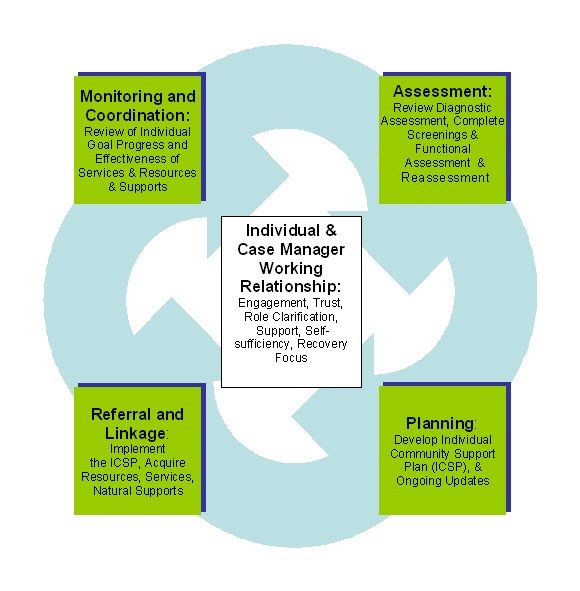
The MH-TCM components often overlap and may be provided concurrently. The member and case manager are constantly doing the following:
- Assessing the member’s needs and goals and impact of mental illness, utilizing the member’s strengths and progress
- Clarifying goal-related plans and steps and updating the ICSP/Individual Family Community Support Plan (IFCSP), thinking of new resources
- Referring and linking to resources/supports/services, coordinating with partners in the member’s plan
- Monitoring the effectiveness of the resources/supports/services being utilized
- Reviewing the need for MH-TCM services
- Discussing the member’s progress toward goals and recovery
Assessment
Adult Mental Health
An adult MH-TCM assessment has the following five parts:
- Review the DA
- Assess member for strengths, resources, supports, needs, functioning, health problems and conditions, safety, vulnerability, and injury risk. Assessment should include family members, significant others, and providers as possible.
- Screen for substance use/abuse
- Review and update documentation of member’s status, cultural considerations, and functional description in all the FA domains specified in Minnesota Statute
It is important that the FA, defined in MN Stat. sec. 245.462, subd. 11a and MN Stat. sec. 245.4871, subd. 18, includes the member’s health care coverage, access to preventative and routine health care, individual participation in recommended health care treatment, and individual health lifestyle.
The case manager must complete the FA within 30 days of the first meeting with the member and at least every 180 days after the development of the ICSP. The FA must be developed with input from the person and with the member’s service providers and significant members of the person’s support network.
Children’s Mental Health
A children’s MH-TCM assessment includes the following:
- Review and assess the diagnostic assessment, CASII, and SDQ as provided by the mental health professional.
- Complete the functional assessment (FA) by assessing, with the child and family receiving CMH – TCM, for strengths, resources, supports, needs, functioning, health problems and conditions, safety, vulnerability and injury risk. Assessment should include family members, significant others and providers identified by the person as being important to their recovery process.
- Review documentation and updating documentation of the person’s status, cultural considerations and functional description in all the FA domains specified in Minnesota statutes.
It is important that the FA, defined in Minnesota statutes, include the person’s health care coverage, access to preventative and routine health care, individual participation in recommended health care treatment, and health and wellness issues important to the person.
The case manager must complete the FA within 30 days of the first meeting with the person and at least every 180 days after the development of the IFCSP. The FA must be developed with input from the person and with the person’s service providers and significant members of the person’s support network.
Planning
A case manager must develop, with the member, the member’s ICSP/IFCSP including the following:
- Goals of member and the specific services
- Activities for accomplishing each goal
- Schedule for each activity
- Frequency of face-to-face contact with case manager
The case manager must complete an ICSP/IFCSP within 30 days of the first meeting with the member, and at least every 180 days after the development of the member’s ICSP/IFCSP. The ICSP/IFCSP must be developed with input from the member, other service providers, and significant members of the member’s support network.
Referral and Linkage
Referral and linkage MH-TCM services are the implementation of parts of the ICSP/IFCSP that involve resource acquisition to help the member obtain planned goals.
A primary focus of referral and linkage is to break down the walls separating members from the community to replace segregation with true community integration. Case managers must be familiar with the community and key contact persons within particular agencies (housing, education, vocational, financial, health care services, and other providers) to assist the member.
Referral and linkage involves interactions with the member to do the following:
- Connect the member with informal natural supports
- Link the member with the local community, resources, and service providers
- Refer the member to available health treatment and rehabilitation services
Monitoring and Coordination
A significant portion of the case manager’s monitoring and coordination activities are done over the phone with other providers, resources, and service representatives. Monitoring and coordination serves four global purposes:
- Ensure service coordination by reviewing programs and services for accountability, verification that everyone is addressing the same purposes stated in the ICS/IFCSP so that the member is not exposed to discontinuous or conflicting interventions and services
- Determine achievement of the goals/objectives in the member’s ICSP/IFCSP to see if goals are being achieved according to the ICSP/IFCSP’s projected timeline(s) and continue to fit the member’s needs
- Determine service and support outcomes through ongoing observations that can trigger reconsideration of the plan and its recommended interventions when the ICSP/IFCSP is not accomplishing its desired effects
- Identify emergence of new needs by staying in touch with the member to identify problems, modify plans, ensure the member has resources to complete goals, and track emerging needs
Additional Services Requirements
Limit on Size of Case Manager’s Caseload
Adult Mental Health
The average caseload size of a full-time equivalent CM must not exceed 30 people on a caseload to one full time equivalency case manager. This standard applies to the average caseload size of case managers across the provider agency. This applies to adult MH-TCM services provided by lead agencies (counties, tribes, and managed care organizations).
Children’s Mental Health
The average caseload size of a full-time equivalent children’s MH-TCM CM must not exceed 15 members to one full time equivalency case manager. This standard applies to the average caseload size of case managers across the provider agency. This applies to children’s MH-TCM services provided by lead agencies (counties, tribes, and managed care organizations).
Face-to-Face Contact between Member and Case Manager
- Monthly face-to-face contact between the member and the CM is the standard. AMH-TCM or CMH-TCM case managers must have monthly contact to claim reimbursement. The case manager must ensure at least one case management core service component is provided (assessment, planning, referral and linkage, and monitoring and coordination).
- Adult MH-TCM only: AMH-TCM case managers may meet with the member or member’s legal representative face-to-face or via interactive television (ITV). The county and contracted AMH-TCM providers may have contact with the member by telephone. Telephone contact may occur for up to two months before ITV or face-to-face contact must be made. It is best practice to see the member every month.
- CMH-TCM case managers may only have face-to-face or ITV contact with the eligible child, their parent, or the child’s legal representative to receive payment. It is best practice to see the child every month. Children who are in foster care must be seen in person. The frequency of face-to-face or ITV contacts with the child must be appropriate to the member’s need and the implementation of the individual family community support plan. A monthly face-to-face visit continues to be required when the youth is in out-of-home placement.
Arrangement of Standardized Assessment by a Physician for Members on Psychotropic Medications
The case manager must arrange for a standardized assessment by a physician of the member’s choice of side effects related to the administration of the member’s psychotropic medications.
Non-Covered Services
MH-TCM services are not:
- Treatment, therapy, or rehabilitation services
- Other types of case management (for example, Community Alternative Care [CAC], Community Alternatives for Disabled Individuals [CADI], Brain Injury [BI], Developmental Disability [DD])
- Legal advocacy
- A DA
- Determining eligibility for MH-TCM
- Administration or management of a member’s medications
- Services that are integral components of another service or direct delivery of an underlying medical, educational, social, or other service
- Transportation services
Documentation
Minnesota must comply with Federal regulations in order to receive Federal Financial Participation (FFP) and documentation is crucial to compliance.
Documentation must support the qualifying MH-TCM services provided to an eligible member by a qualified provider.
All service records must:
- Be legible to the individual providing care
- Contain the member’s name must be on each page of the member’s record
Each entry in the health service record must contain:
- The date on which the entry is made
- The date(s) on which the health service is provided
- The length of time spent with the member if the amount paid for the service depends on time spent
- The signature and title of the person from whom the member received the service
- Reportage of the member’s progress or response to treatment and the changes in the treatment or diagnosis
- When applicable, the countersignature of the vendor or supervisor as required
- Documentation of supervision by the supervisor
The record must state:
- The member’s case history and health condition as determined by the vendor’s examination or assessment
- The results of all diagnostic tests and examinations
- The diagnosis resulting from the examination
The record must contain:
- Reports of consultations that are ordered for the member
- The member’s plan of care (ICSP), ITP, or individual program plan
Member File
The member file includes member information such as: name, address, phone, email, identification (ID) numbers, natural support contacts, other mental health provider contacts, health conditions, health care coverage and providers, other significant contacts (landlord, employer, etc.), emergency contacts, current medications, intake dates, relapse prevention plans, releases of information, referral materials, member rights materials, determination of SPMI, and information supporting the member’s eligibility for MH-TCM.
MH-TCM agencies must follow these additional requirements:
- The member file must include:
- Releases of information
- DAs
- FAs
- Mandated screenings and level of care documentation
- ICSP/IFCSPs
- MH-TCM services provided to member – contact/progress entries
- Entries of any assessment/planning/referral/monitoring/coordination activities that the agency has engaged in on behalf of the member with family members, significant others, other providers of services, representatives of other community resources, and/or the member’s natural supports (with or without member; whether coordination/communication was initiated by case manager or another [e., calls from member family members])
- Documentation must appear in the member’s record when the member’s case/plan/situation is reviewed by the agency team or with a clinical supervisor
The ICSP/IFCSP is the roadmap of MH-TCM services. It is governed by Federal and State regulations. At its heart, the ISCP/IFCSP is a straightforward plan to help the member utilize his/her current strengths and resources and gain access to additional services and resources to help the member accomplish his/her goals.
Adult Mental Health ICSP
The individual community support plan (ICSP) documentation should include:
- A recovery vision and include the member’s voice
- The development of the ICSP consistent with Statute and Rule
- To the extent possible, the member and his/her family, advocates, service providers, and significant others must be involved in all phases of development and implementation of the ICSP
- The ICSP must state the following:
- The goals of each service
- The activities or tasks of the person, CM, and others for accomplishing each goal
- A schedule for each activity or task
- The frequency of face-to-face contacts by the CM based upon assessed need and the implementation of the ICSP
- The ICSP should reflect the prioritization of goals, risk, vulnerability, and needs identified in the assessment process
- The ICSP should identify the natural supports, services, programs, and resources that the member is gaining access to, who and how that access will be gained, and planned monitoring and coordination to assure the progress and value of supports, services, programs, and resources
- A written ICSP needs to be completed within 30 days of beginning MH-TCM services, and a new FA completed at least every 180 days thereafter. ICSP and FA updates may be completed more often and if the member requests this
- The ICSP needs to be written by a mental health professional or signed by the clinical supervisor of the CM
- The members name, date of completion of the ICSP and signatures of the member, case manager and clinical supervisor (optional are signatures of others who participate in the development and implementation of the ICSP)
Children’s Mental Health IFCSP
The individual family community support plan (IFCSP) is a written plan of action developed by a case manager in conjunction with the family and child and based on diagnostic and functional assessments. The IFCSP identifies specific services needed by the child and the child’s family, to do the following:
- Treat the symptoms and dysfunctions determined in the diagnostic assessment
- Relieve conditions leading to emotional disturbance and improve the personal well-being of the child
- Improve family functioning
- Enhance daily living skills
- Improve functioning in education and recreation settings
- Improve interpersonal and family relationships
- Enhance vocational development
- Assist in obtaining transportation, housing, health services, and employment
- State goals and expected outcomes of each service and criteria for evaluating the effectiveness and appropriateness of the services
- Activities for accomplishing each goal
- Schedule for each activity
- Frequency of face-to-face contacts by the case manager, as appropriate to the recipient's need and the implementation of the IFCSP
Note for clarification: There is contradictory language in Statute and Administrative Rule concerning the minimum frequency which FAs and ICSPs must be completed. The Administrative Rule for MH-TCM services notes that the FA and ICSP need to be reviewed and, if necessary, revised at least once every 90 calendar days after the development of the initial plan. Minnesota Statutes use an “at least every 180 days” standard. Documentation of the revision of the FA and ICSP/IFCSP must occur at least every 180 calendar days – Statute supersedes Rule.
Member Contact/Progress Notes
The note should answer primary questions to ensure good communication, planning, and billing support.
- Which of the MH-TCM four core service components (assessment, planning, referral and linkage, monitoring and coordination) was being provided?
- What goals were being addressed?
- What was the service provided – what did the case manager do?
- What was the member’s response to the service?
- What is the plan for the next contact?
- Any significant observation of the member’s situation or condition should also be included (situation/information/condition that is not necessarily related to planned services but that is important or out of the ordinary [e.g., major news in member’s life, changes of behavior]). These will not be present in every contact/note.
Often during a contact, a case manager will be providing more than one case management service component. Each service component should be documented.
Communication with the member’s family members, support system members, other providers, doctors, resource representatives, community representatives (employer, landlord, etc.), whether initiated by the case manager or not, must be documented in the member file.
Documentation is necessary to demonstrate MH-TCM service provision. When possible, concurrent documentation is recommended to promote transparency and expedite completion of documentation.
Documenting Clinical Supervision
Clinical supervision must be documented by the clinical supervisor.
- Complete or cosign all member FAs.
- Complete or cosign all member CASIIs/ECSIIs.
- Complete or cosign all ICSPs or IFCSPs.
- “Case reviews” by the case manager and the clinical supervisor should be summarized and signed in the member file.
- Entries in the member’s record regarding record review and supervisory activities.
Clinical supervision of the case manager that is not specific to an individual member, but rather is for the benefit and professional growth of the case manager or CMA, must be documented in the case manager’s personnel file or related file.
Referrals for MH-TCM services can be made to Social/Human Services in the member’s county of residence:
- Beltrami County: 1-218-333-4223
- Big Stone County: 1-320-839-2555
- Chippewa County: 1-320-369-6401
- Clearwater County: 1-218-694-6164
- Cottonwood (Des Moines Valley Health and Human Services): 1-507-831-1891
- Douglas County: 1-320-762-3805
- Grant County: 1-218-685-8200
- Hubbard County: 1-218-721-1451
- Jackson County (Des Moines Valley Health and Human Services): 1-507-831-1891
- Kandiyohi County: 1-320-231-7800
- Lac qui Parle County: 1-320-598-7594
- Lincoln County (Southwest Health and Human Services): 1-507-537-6713
- Lyon County (Southwest Health and Human Services): 1-507-537-6713
- McLeod County: 1-320-864-3144
- Meeker County: 1-320-693-5300
- Nobles County: 1-507-283-5066
- Pipestone County (Southwest Health and Human Services): 1-507-537-6713
- Pope County: 1-320-634-7755
- Redwood County (Southwest Health and Human Services): 1-507-537-6713
- Renville County: 1-320-523-2202
- Stevens County: 1-320-208-6600
- Swift County: 1-320-843-3160
- Traverse County: 1-320-422-7777
- Yellow Medicine County: 1-320-564-2211
Effective January 1, 2025, MH-TCM does not require authorization for for out-of-network providers.
MH-TCM Billing Procedures
- Bill MH-TCM services online using the 837P claim format.
- Do not enter a treating provider NPI on each service line
- Use only procedure codes and modifiers listed in the following table
- Counties and county-contracted vendors: Bill one claim per month.
- Tribes and Federally Qualified Health Centers (FQHCs): Bill one claim per encounter.
- Enter the DOS. Do not enter a treating provider NPI on each line item.
- Submit appropriate diagnosis code(s) to indicate the patient’s condition with the most detailed level of specificity.
To obtain the monthly MH-TCM reimbursement or tribal encounter rate reimbursement, providers must document at least one of the four reimbursable core component services as having been provided consistent with the ICSP or IFCSP goals and plans, and during a face-to-face contact with the member (or during a qualifying phone contact with the person). Use the core component service terminology: Document that the case manager assessed, planned, referred and linked, or monitored and coordinated with the person. More detail is necessary but it is important to frame the billable services using at least one of these four service components, and directly link the service provided to at least one of the goals identified in the ICSP or IFCSP.
Follow these billing guidelines:
- AMH-TCM and ACT: MHCP will reimburse MH-TCM and ACT provided concurrently only during the month of admission to or discharge from ACT services. To receive MH-TCM reimbursement for the month of admission, the county, tribe, or county vendor must add modifier 99 to the line item and enter the ACT admission date in the “comments” field.
- AMH-TCM and RSC: Relocation service coordination (RSC) is a case management service available to members in a facility (inpatient hospital). RSC and MH-TCM cannot be provided in the same month to the same member. Counties may elect to provide only one of these services.
- AMH-TCM and Telehealth: Providers must complete and submit the Telehealth Provider Assurance Statement (DHS-6806) to MHCP Provider Eligibility and Compliance prior to submitting claims for telehealth. Submit claims for TCM telehealth services in MN-ITS using the place of service (POS) 02 “Telehealth.”
- MH-TCM and ITV: Providers must complete and submit the Targeted Case Management Provider Interactive Video Assurance Statement (DHS-8398-ENG) to deliver and bill for TCM services using interactive video.
- MH-TCM and IMD: MHCP reimbursement for MH-TCM may be available for members covered by major program IM.
- MH-TCM and Diagnostic Assessment: Presumptive Eligibility - MH-TCM is available to members before a diagnostic assessment is completed when all of the following conditions are met:
- The member is referred for and accepts case management services
- At the time of referral, the member refuses to obtain a diagnostic assessment for reasons related to his/her mental illness or a child's parent refuses to obtain a diagnostic assessment for the child
- The case manager determines the member is eligible for MH-TCM services
- The member obtains a new or updated diagnostic assessment, resulting in SMI or SPMI, within four months of the first day MH-TCM services began
| Mental Health Targeted Case Management (MH-TCM) Benefits | |||
| Procedure Code | Modifier | Brief Description | Service Limitations |
| T2023 | HE HA* | Face-to-face contact between case manager, the child (under age 18), and the child’s parent or legal representative | 1 unit per month |
| HE* | Face-to-face or ITV contact between case manager and member age 18 or over | ||
| HE U4* | Telephone contact (member age 18 or over) | ||
*HE: Mental health; HA: Child/adolescent program; U4: Case management via telephone
TCM services delivered via ITV require the appropriate place of service to be listed on the claim. Claims must be submitted using place of service 02 or 10 as follows:
- Place of service 02: ITV contact provided other than the member’s home. The member is not located in their home when receiving TCM service through ITV.
- Place of service 10: ITV contact provided in the member’s home. The member is located in their home when receiving TCM service through ITV.
Telehealth Delivery of Mental Health Services
Telehealth is the delivery of health care services or consultations while the member is at an originating site and the licensed health care provider is at a distant site. Telehealth may be provided by real-time two-way, interactive audio and visual communications, including secure videoconferencing or store-and-forward technology to provide or support health care delivery. The telehealth services facilitate the member’s assessment, diagnosis, consultation, treatment, education, and care management.
PrimeWest Health covers delivery of mental health services through telehealth.
Telehealth does all of the following:
- Delivers mental health services using two-way interactive video that can:
- Extend limited resources
- Expand the geographical area over which a mental health provider can offer direct service
- Save time and energy without compromising quality
- Allows providers and the member greater flexibility and increased access when delivering/receiving services
- Allows members to receive needed services without having to travel long distances
Eligible Members
Members are eligible to receive their mental health services via telehealth when:
- Telehealth is determined medically appropriate
- The member has provided his/her consent before receiving services via telehealth
- The member is present to receive service through the telehealth method
Eligible Providers
Eligible providers are mental health professionals who are qualified under Minnesota Statute 245.462, subd. 18, or mental health practitioners working under the supervision of a mental health professional.
Providers providing telehealth services must do all of the following:
- Conduct a risk analysis
- Develop a risk management plan
- Employ strategies to minimize vulnerabilities in technological equipment and systems
- Create safe and private accommodations for members receiving services by telehealth
- Ensure procedures are in place to prevent system failures that could lead to a breach in privacy or cause exposure of member mental health records to unauthorized persons
- Use high quality interactive video and audio communications systems and equipment
- Be prepared administratively, operationally, and technologically
Interactive telehealth systems must be compliant with Health Insurance Portability and Accountability Act (HIPAA) privacy and security requirements and regulations.
Covered Services
PrimeWest Health covers medically necessary mental health services delivered by a health care provider via telehealth. Services provided via telehealth have the same service thresholds and authorization requirements as services delivered face-to-face. Providers must have documentation of services provided and must have followed all clinical standards to bill for telehealth.
Non-Covered Services
See the Telehealth Services section of the PrimeWest Health Provider Manual for non-covered telehealth services.
Billing
Refer to the following when billing for services provided through telehealth:
- Use the appropriate place of service code for billing services provided through telehealth.
- Place of service 02 (newly redefined): Telehealth provided other than at the patient’s home. The location where health services and health-related services are provided or received through telecommunication technology. The patient is not located in their home when receiving health services or health-related service through telecommunication technology.
- Place of service 10 (new place of service): Telehealth provided in patient’s home. The location where health services and health-related services are provided or received through telecommunication technology. Patient is located in their home (which is a location other than a hospital or other facility where the patient receives care in a private residence) when receiving health services or health-related services through telecommunication technology.
- When reporting a service with place of service 02 or 10, you are certifying that you are rendering services to a patient located in an eligible originating site via an interactive audio and visual telecommunications system.
- Use the place of service code that identifies the location of the member when the service was provided. The servicing facility location or receiving site should be included on the claim along with the service facility NPI. If the servicing facility is a PrimeWest Health network provider, no additional authorization is required.
- PrimeWest Health will reimburse the receiving site/servicing facility a facility charge. Bill Q3014 for the facility charge.
- Use the telehealth modifier 93 for synchronous telehealth service rendered via telephone or other real-time interactive audio-only telecommunications system. PrimeWest Health requires this modifier when audio-only telehealth is used.
All the other telehealth modifiers (GT, GQ, GO, 95) can be used for informational purposes but are not required. The telehealth place of service codes explain that the service is rendered through telehealth. No telehealth modifiers can be used without place of service 02 or 10 or the claim will deny.
Partial Hospitalization Program
Partial hospitalization is a time-limited, structured program of multiple and intensive psychotherapy and other therapeutic services provided by a multidisciplinary team, as defined by Medicare, and provided in an outpatient hospital facility or CMHC that meets Medicare requirements to provide partial hospitalization programs services. The goal of the partial hospitalization program is to resolve or stabilize an acute episode of mental illness.
Eligible Partial Hospitalization Providers
To be a partial hospitalization provider, an outpatient hospital or a CMHC must be certified by Medicare to provide partial hospitalization and receive approval from DHS.
Providers must follow Medicare guidelines for partial hospitalization program content, physician certification requirements, and documentation.
Eligible Members
To receive partial hospitalization program services, a member must meet all of the following criteria:
- Be a PrimeWest Health member
- Be experiencing an acute episode of mental illness that meets the criteria for an inpatient hospital admission
- Have appropriate family or community resources needed to support and enable the member to benefit from less than 24-hour care
- Be referred for partial hospitalization by a physician who certifies the need for partial hospitalization, stating the member would otherwise require inpatient psychiatric care if partial hospitalization were not provided
- Have the ability to participate in treatment
- Have a completed level of care assessment with a Level 4 indication for adults age 18 and over
Partial hospitalization may be beneficial to members transitioning out of inpatient mental health stays or in lieu of inpatient psychiatric.
Notify PrimeWest Health of admissions by calling or faxing the UM department:
Fax: 1-866-431-0804 (toll free)
Phone: 1-866-431-0803 (toll free)
Medical Service Authorization Request form
Partial Hospitalization Covered Services
Partial hospitalization includes, at a minimum, one session of individual, group or family psychotherapy, and two or more other service components.
- Individual and group psychotherapy
- Occupational therapy services are covered if the member requires the skills of a qualified occupational therapist and are performed by or under the supervision of a qualified occupational therapist or by an occupational therapy assistant.
- Services of social workers, trained psychiatric nurses, and other staff trained to work with psychiatric patients.
- Drugs and biologicals furnished to outpatients for therapeutic purposes, but only if they cannot be self-administered.
- Activity therapies, but only those that are individualized and essential for the treatment of the member's condition. The treatment plan must clearly justify the need for each particular therapy utilized and explain how it fits into the member's treatment.
- Family counseling services only where the primary purpose of such counseling is the treatment of the member's condition.
- Member education programs, but only where the educational activities are closely related to the care and treatment of the member.
To be consistent with Medicare-recommended standards, providers must do the following:
- Provide at least four days, but not more than five out of seven calendar days, of partial hospitalization program services;
- Ensure a minimum of 20 service components and a minimum of 20 hours in a seven-calendar-day period; and
- Provide a minimum of five to six hours of services per day for an adult age 18 or over; or
- Provide a minimum of four to five hours of services per day for a child under age 18.
Partial Hospitalization Non-Covered Services
- Meals and transportation
- Activity therapies, group activities, or other services and programs that are primarily recreational or diversional in nature
- Outpatient psychiatric day treatment programs that consist entirely of activity therapies
- Daycare programs
- Psychosocial programs primarily for social or recreational purposes
- Vocational training when the services are related solely to specific employment opportunities, work skills or work settings
Billing
- Use the 837I format to bill for partial hospitalization program services.
- Indicate the patient status information as continuing service; indicating discharge instead of continuing service may deny the claim.
- Enter type of bill (TOB) 13X (outpatient), TOB 76X (CMHC), or TOB 85X (critical access hospital). Use revenue code 0912 or use revenue code 0913, accordingly.
- Use procedure code H0035 or H0035 HA for children/adolescent services.
- Therapy outside the partial hospitalization program is covered only for physician services and medication management:
- Bill using the 837P format
- Bill visits using the appropriate E/M code
- Enter POS code 22 (outpatient hospital) or 53 (CMHC)
- If the purpose of the visit is to provide psychotherapy only or hybrid psychotherapy/E/M services, the appropriate psychotherapy codes require compliance with the authorization requirements.
- Report the attending provider as the physician who has overall responsibility for the member's medical care and treatment
| Partial Hospitalization Services | ||||
| Procedure Code | Modifier | Brief Description | Unit | Service Limitation |
| H0035 |
| Partial hospitalization – age 18 and over | 1 session | 1 session per day |
| H0035 | HA | Partial hospitalization – under age 18 | 1 session | 1 session per day |
Children’s Mental Health Residential Treatment Services
Children’s mental health residential treatment services are a 24-hour-a-day program under the clinical supervision of a mental health professional. Services are provided in a community setting other than an acute care hospital or regional treatment center. In compliance with legislation that passed in 2021, the state of Minnesota has developed another way to access Children’s Residential Facilities services to assist children living with severe emotional disturbance (SED) and their families. This pathway is called the Children’s Mental Health (CMH) Residential Services Path, also referred to as “3rd Path,” which was developed with the goal of providing children and their families an alternative way to gain access to services to meet a child’s individual and specific needs in a children’s residential facility (CRF).
Children’s residential treatment must be designed to do the following:
- Prevent placement in settings that are more intensive, costly, or restrictive than necessary and appropriate to meet the child’s needs
- Help the child improve family living and social interaction skills
- Help the child gain the necessary skills to return to the community
- Stabilize crisis admissions
- Work with families throughout the placement to improve the ability of the families to care for children with SED in the home
Eligible Providers
Providers must be facilities that are licensed by the State of Minnesota to provide children’s mental health residential treatment services and under clinical supervision of a mental health professional.
Eligible Members
To be eligible for this service, a member must meet all of the following criteria:
- Be under age 18
- Be eligible for Medical Assistance (Medicaid) or MinnesotaCare
- Meet the criteria for SED
- Have been determined eligible for residential treatment by the county, managed care organization, or Tribe before placement in the facility. 3rd Path participants do not require Tribe and county determinations.
Members access this service in one of the following ways:
- Via their county of residence (county-initiated path) through a voluntary placement agreement signed by parent or legal guardian.
- The cost of room and board is funded through the county
- The county makes the placement decisions
- The provider must submit the notification, along with proper supporting documentation, to PrimeWest Health through the provider portal. If unable to submit through the portal, the notification may be faxed to PrimeWest Health at 1-866-431-0804.
- Via their county of residence (county-initiated path) with court involvement and the child is screened by the county as needing residential treatment services before placement in a facility.
- The cost of room and board is funded through the county
- The county makes the placement decisions
- The provider must submit the notification, along with proper supporting documentation, to PrimeWest Health through the provider portal. If unable to submit through the portal, the notification may be faxed to PrimeWest Health at 1-866-431-0804.
- Via the 3rd Path (family-initiated path)
- Family selects the level of county or Tribe involvement
- A mental health professional completes a diagnostic assessment that includes the Child and Adolescent Service Intensity Instrument (CASII)
- No court involvement
- PrimeWest Health is responsible for the mental health treatment services.
- Room and board service days that are authorized by PrimeWest Health are billed directly to MHCP.
In order for a member to access children’s mental health residential services via the 3rd Path, the family, a parent, or legal guardian must do the following:
- Determine medical necessity
- The parent or legal guardian obtains a level of care determination and diagnostic assessment from a mental health professional for the member
- The diagnostic assessment must indicate the following:
- That it is medically necessary for the member to receive children’s mental health residential treatment services
- That the diagnostic assessment will include the CASII
- That the mental health professional will evaluate the member’s home, family, school, community situation, and functioning. The CASII is used to assess the member’s status and functionality as well as cultural considerations when determining and assigning an appropriate level of care
- If a diagnostic assessment with the CASII has been completed within the previous 180 days, a new diagnostic assessment does not have to be completed unless the member’s mental health professional believes the member’s condition has changed significantly since the prior report. In that case, a new diagnostic assessment is required.
- After the parent or legal guardian has obtained the diagnostic assessment and CASII from the mental health professional, the parent or legal guardian notifies PrimeWest Health that the member is in need of children’s mental health residential treatment services and that they will be using the service. The parent or legal guardian contacts PrimeWest Health at 1-866-431-0801.
Billing
- Use the 837P claim format.
- Enter a span of dates within a month; for example, if billing for services during May and June, bill May dates on one claim and bill June dates on another claim.
- Enter the POS code 99.
- Enter the number of units (1 unit = 1 day) based on the DOS.
- Enter the facility’s NPI as the rendering/treating provider.
| Children’s Residential Treatment | ||||
| Procedure Code | Modifier | Brief Description | Unit | Limitations |
| H0019 |
| Children’s Residential Treatment (county only) | Per diem | None |
Payment by PrimeWest Health for a member’s residential stay starts at the effective date of the change in enrollment from FFS to PrimeWest Health without regard to whether or not the transition occurs in the middle of the member’s residential stay. In the case of residential stays, member enrollment with PrimeWest Health begins on the actual date of enrollment, even if the person is in a residential setting.
Behavioral Health Home Services
Overview
The term “behavioral health home” services refers to a model of care focused on integration of primary care, mental health services, and social services and supports for adults diagnosed with mental illness or children diagnosed with emotional disturbance. The behavioral health home (BHH) services model of care utilizes a multidisciplinary team to deliver person-centered services designed to support a person in coordinating care and services while reaching his or her health and wellness goals.
Goals of Behavioral Health Home Services
The goals of behavioral health home services are that an individual:
- Has access to and utilizes routine and preventative health care services
- Has consistent treatment of mental health and other co-occurring health conditions
- Gains knowledge of health conditions, effective treatments and practices of self-management of health conditions
- Learns and considers healthy lifestyle routines
- Has access to and uses social and community supports to assist the individual meet his/her health wellness goals
Eligible Providers
To provide behavioral health home services, a clinic or agency must be enrolled as a PrimeWest Health provider and must successfully complete the PrimeWest Health certification process.
Certification Process
To be certified to deliver behavioral health home services, an agency must demonstrate that all locations from which behavioral health home services will be provided are PrimeWest Health enrolled, and that all behavioral health home service teams operated by the agency or entity meet the behavioral health home services certification standards outlined in DHS-6766-ENG. The behavioral health home certification process consists of an online application and a site visit. Detailed information about certification requirements and standards are available on the DHS provider certification web page.
Eligible Members
To be eligible for BHH services, a member must be Medical Assistance (Medicaid)-eligible and have a current diagnosis from a qualified health professional of a condition that meets the definition of mental illness as described in section Minnesota Stat. 245.462, subd. 20, paragraph (a), or emotional disturbance as defined in section Minnesota Stat. 245.4871, subd. 15, clause (2). For BHH services, a “current” diagnosis is considered by DHS to be a diagnosis made within the past 12 months by a qualified professional. A qualified health professional includes the following:
- Physician
- Physician Assistant
- Advanced Practice Registered Nurse
- Licensed Mental Health Professional
The list of allowable mental health diagnostic code ranges under which providers can bill for BHH services can be found in the mental health diagnostic codes section of the DHS provider manual.
Certified BHH services providers must ensure that the following elements are complete prior to determining eligibility for BHH services:
- The BHH services provider confirms that the member has current PrimeWest Health coverage.
- The BHH services provider reviews and explains the Behavioral Health Home (BHH) Services Rights, Responsibilities and Consent form (DHS-4797B-ENG) to the member.
- The provider must document how they reviewed the Behavioral Health Home (BHH) Services Rights, Responsibilities and Consent form with the member and also document the member’s consent to receive BHH services. The member’s consent may be documented either by keeping a copy of the Behavioral Health Home (BHH) Services Rights, Responsibilities and Consent form signed by the member in the provider’s records or by documenting how the provider reviewed the Behavioral Health Home (BHH) Services Rights, Responsibilities and Consent form with the member and then documenting the member’s preference for verbal consent. The BHH services provider should give the member a copy of Behavioral Health Home (BHH) Services Rights, Responsibilities and Consent form for the member’s records. If the member is receiving a duplicative service, the member must decide which service they want to receive.
- The BHH services provider confirms and documents the person has a diagnosis from a qualified health professional within the previous 12 months that indicates the person has a condition that meets the Federal definition of serious mental illness (adults) or emotional disturbance (children).
- Intake for BHH services is considered complete as of the date that all of the above elements have been completed. BHH services providers must determine and document an individual’s eligibility before providing and billing for BHH services.
Diagnostic Assessments
MN Stat. sec. 256B.0757, subd. 4, specifies that eligibility for BHH services must be determined based on a diagnostic assessment (DA) as defined in Minnesota Rules, part 9505.0372, subp. 1, item B or C. The diagnostic assessment must be performed or reviewed by a mental health professional employed by or under contract with the behavioral health home provider.
For purposes of eligibility for BHH services, one of the following types of diagnostic assessment is allowable:
- Standard diagnostic assessment
- Extended diagnostic assessment
- Adult diagnostic assessment update
Assessments must be performed in accordance with requirements outlined in the DHS Provider Manual’s Diagnostic Assessment section.
Covered Services
BHH services providers must have the capacity to deliver the following six core services based on the individual’s needs and in accordance with the BHH Certification Standards (DHS-6766-ENG):
- Care Management
Comprehensive care management is a collaborative process designed to manage medical, social and behavioral health conditions more effectively based on population health data and tailored to the member. - Care Coordination
Care coordination occurs when the BHH services team acts as the central point of contact in the compilation, implementation, and monitoring of the individualized health action plan through appropriate linkages, referrals, coordination, and follow-up to needed services and supports. Specific care coordination activities are conducted with members and their identified supports; medical, behavioral health, and community providers; and across and between care settings. - Health and Wellness
Health and wellness promotion services encourage and support healthy living and motivate members and their identified supports to adopt healthy behaviors and promote better management of their health and wellness. The providers place a strong emphasis on skills development so members and their identified supports can monitor and manage their chronic health conditions to improve health outcomes. - Comprehensive Transitional Care
Comprehensive transitional care activities are specialized care coordination services that focus on the movement of members between different levels of care or settings. Transition services are designed to streamline plans of care and crisis management plans; reduce barriers to timely access; reduce inappropriate hospital, residential treatment, and nursing home admissions; interrupt patterns of frequent emergency department use; and prevent gaps in services which could result in (re)admission to a higher level of care or longer lengths of stay at an unnecessary level of care. - Individual and Family Supports
Individual and family support services are activities, materials, or services aimed to help members reduce barriers to achieving goals, increase health literacy and knowledge about chronic condition(s), increase self-efficacy skills, and improve health outcomes. - Referral to Community Supports
Referral to community and social support services are activities that ensure members have access to resources to address their identified goals and needs. Resources should address social, environmental, and community factors. These factors affect holistic health, including but not limited to, medical and behavioral health care; entitlements and benefits; and respite, housing, transportation, legal, educational, employment, and financial services. The BHH services team will close the loop on all referrals to ensure members are supported in achieving their goals.
Service Delivery Requirements
Service delivery requirements are listed in section six of the BHH certification standards (DHS-6766-ENG). Adherence to the service delivery requirements will be monitored as part of the recertification process.
Initial Engagement and Assessment
BHH services providers must meet and deliver initial engagement and assessment services that meet the requirements of BHH certification standard 6E (DHS-6766). During the initial 90-day engagement period, a staff member of the BHH services team must have contact with the member to do the following:
- Complete the intake process and the brief needs assessment and develop a plan to address immediate needs as appropriate
- Complete the initial health wellness assessment within 60 days after intake
- Develop the health action plan within 90 days after intake
- BHH services providers must update a member’s health action plan at least every six months
Telehealth
If an individual accepts the offer for a face-to-face visit at six months, providers who are eligible to provide services via telehealth may do so. Providers must comply with all MA telehealth requirements for equipment, privacy, and billing to serve individuals receiving BHH services through telehealth. Refer to the Telehealth Services section of the Provider Manual for requirements, billing, and additional information.
Noncovered Services
Members eligible for behavioral health home services are eligible for all MA-covered services. However, payment for duplicative services in the same calendar month is prohibited. The member must choose which available MA-covered service best meets his/her needs.
The following services are considered duplicative of behavioral health home services:
- Adult mental health targeted case management (AMH-TCM)
- Children’s mental health targeted case management (CMH-TCM)
- Assertive community treatment (ACT)
- Vulnerable adult/developmental disability targeted case management (VA/DD-TCM)
- Relocation services coordination targeted case management (RSC-TCM)
- Health care home (HCH) care coordination services
For members who have fee-for-service MA coverage, MHCP pays on the first claim submitted in a calendar month for any one of the duplicative services. Subsequent claims in the same calendar month for one of the identified duplicate services will not be paid. Medical Assistance (Medicaid) managed care organizations (MCOs) are also prohibited from payment of duplicative services in the same calendar month. However, MCOs may develop different mechanisms to avoid duplicate payments, such as a take-back of payment following a reconciliation of monthly claims, or denial of a subsequent duplicate claim in the same calendar month. Providers should contact the MCO directly to learn what procedures the MCO will use to ensure no duplicate payment. BHH MCO Contact Information
Integration of BHH Services and Other MA Covered Services
Behavioral health home services are designed to help connect members to medically appropriate services, and to help members remove barriers that keep them from effectively engaging with medically necessary services. Unless a service has been specifically identified as a duplicative service (see Noncovered Services section), it is permissible for a BHH provider to bill for other MA-covered services delivered to a member who is also receiving BHH services. The BHH services rate was developed as a per member, per month payment to allow the provider flexibility to provide the right service, at the right time, based on the member’s needs and circumstances.
Examples
Behavioral health home provider “A” is also certified to provide ARMHS. A member receiving BHH services has been determined to be eligible for ARMHS. The BHH services provider organization is permitted to bill for both services as long as the provider organization has met the billing requirements for each service.
Behavioral health home provider “B” is also a primary care services provider. A member receiving BHH services has been determined to be in need of asthma education. The BHH provider organization is permitted to bill for both services as long as the provider organization has met the billing requirements for each service.
Billing
The rate for behavioral health home services is a per member, per month payment. Certified behavioral health home services providers are required to carry out a service eligibility determination prior to billing for behavioral health home services.
To receive payment for delivery of behavioral health home services, certified providers must meet the following requirements:
- Have personal contact with the person or the identified support at least once per month. Personal contact may include face-to-face, telephone contact, or interactive video. An email, letter, voicemail, or text message alone does not meet the requirement for monthly personal contact.
- At a minimum, offer a face-to-face visit with the member at least every six months. If the member declines the offer of a face-to-face visit, the visit may be completed by telephone contact or interactive video.
Billing information for procedure codes S0280 and S0281:
| Proc | Mod | Service | Unit | Limitations |
| S0280 | U5 | BHH services care engagement, initial plan | Per member per month (PMPM) | Lifetime limit of six payments in enrollee’s lifetime. No payment if prior payment for duplicative service was made in same calendar month. |
| S0281 | U5 | BHH services ongoing standard care maintenance of plan | PMPM | No payment if prior payment for duplicative service was made in the same calendar month. |
An individual may receive no more than six payments at the enhanced rate per member in the member’s lifetime. Providers should track the number of times S0280 U5 has been claimed. If a member is covered on a fee-for-service basis, any claim for the enhanced payment beyond the allowed six will automatically be denied and converted to the base rate. For members enrolled in PrimeWest Health, the process for tracking the enhanced payment requires PrimeWest Health to review a monthly report produced by DHS to see how many times a provider has billed at the enhanced rate (including payments made by PrimeWest Health, another MCO, or fee-for-service). PrimeWest Health is responsible for taking back any enhanced payment that exceeds the lifetime six month payment limit.
Additional billing information
- The initial plan code (S0280 U5) can be billed at any time and no break is required to bill for the six maximum lifetime services (i.e., code S0280 U5 can be billed for the months of January – June or January, February, and November)
- Code S0281 U5 (maintenance plan) does require that code S0280 U5 (initial plan) be submitted prior to the S0281 U5 submission
- Code S0280 U5 cannot be submitted in the same month as S0281 U5
- To receive payment, the claim for BHH services must use the NPI and address listed on the organization’s BHH services certification approval letter
Treating Provider
For individuals who have fee-for-service MA coverage, most BHH services providers are not required to identify a treating provider. BHH services providers that bill using a billing entity must identify a treating provider. The treating provider must be affiliated with the billing entity and is required to be the integration specialist.
For individuals who are enrolled in an MCO, BHH services providers will need to contact the individual’s MCO to determine what the MCO requires on the claim for BHH services. See the BHH MCO Contact Information for further information.
BHH services providers submitting electronic claims should use the 837P.
BHH services providers should use the diagnostic code(s) that corresponds with the person’s mental health diagnosis that established the person’s eligibility for BHH services.
Managed Care Recipients
Notification
If a person who has been determined eligible for BHH services is enrolled in managed care, the BHH provider must send a copy of the Determination of Eligibility for Behavioral Health Home (BHH) services (DHS-4797-ENG) form to the MCO’s designated contact. BHH providers should consult the BHH MCO Contact Information to obtain the appropriate contact information for the MCO.
Communication and Coordination
BHH services providers are required to communicate and coordinate with MCOs to ensure that services and activities are coordinated to most effectively meet the goals of the person and to ensure that duplication between the MCO and the BHH services provider is avoided. BHH providers and MCOs must adhere to the communication and coordination protocols established in BHH MCO Roles and Responsibilities worksheet. An MCO and a BHH services provider can choose to add requirements for communication or coordination to the BHH Services MCO Roles and Responsibilities worksheet by mutual agreement. If the MCO and the BHH services provider agree to make additions to the worksheet, the MCO and the BHH provider must provide a copy of the updated worksheet and signatures from responsible staff at the MCO and the BHH provider to demonstrate that both entities have agreed to the additional terms specified in the updated worksheet.
Children’s Intensive Behavioral Health Services
Overview
Children’s Intensive Behavioral Health Services (CIBHS) is a bundled service for children who are in a family foster care setting or who are living with their parents or other legal guardians and are at risk of out-of-home placement with a mental illness diagnosis and require intensive intervention without 24-hour medical monitoring as described in MN Stat. 245I.02 or Level of Care Assessment and Necessity of Care Recommendation or Referral. The level of care assessment as defined in MN Stat. 245I.02, subd. 19, and functional assessment as defined in MN Stat. 245I.02, subd. 17, must be updated at least every 180 days or before discharge from the service, whichever comes first. Services include psychotherapy, psychoeducation, clinical consultation, treatment plan development, and crisis planning.
Eligible Providers
CIBHS providers include CIBHS certified agencies and their qualified employees enrolled as MHCP providers.
The following entities may request MHCP certification as an CIBHS provider and obtain a service contract with a county board or Tribe:
- A county-operated entity
- An Indian Health Service facility or Rule 638 Tribal organization under Title 25, or Title 3 of the Indian Self-Determination Act, Public Law 93-638
- A non-county entity
All CIBHS services provided to MHCP enrollees must be by a qualified mental health professional or a clinical trainee working under the supervision of a licensed mental health professional.
Mental health professionals must be certified in one of the following evidence-based practices (EBP):
- Trauma Informed Child Parent Psychotherapy (TI-CPP), or
- Trauma Focused Cognitive Behavioral Therapy (TF-CBT)
To be certified for CIBHS, providers must be able to deliver the following core services:
- Psychotherapy
- Psychoeducation
- Crisis assistance
- Clinical care consultation
- Treatment team planning
Provider Responsibilities
A certified CIBHS provider must provide services to the child at least three days per week, for two hours per encounter, for a total of six hours of in-person treatment. If the mental health professional, member, and family agree, service units may be temporarily reduced for a period of no more than 60 days to meet the needs of the member and family or as part of transition or on a discharge plan to another service or level of care. The reasons for service reduction must be identified, documented, and included in the treatment plan. Billing and payment are prohibited for days on which no services are delivered and documented. Services may be provided to the child, parents, siblings, foster parent, and members of the child’s permanency plan and rendered in the child’s home, daycare, school, or other community-based setting that is specified on the child’s individualized treatment plan (ITP). Providers must provide CIBHS services in a developmentally and culturally appropriate manner and comply with the following requirements:
- Services must be developmentally and culturally appropriate for the child
- Services must be deemed medically necessary as assessed by a level of care screening tool that demonstrates the individual requires intensive intervention without 24-hour medical monitoring, and documented in the diagnostic assessment that CIBHS is medically necessary to address identified symptoms, functional impairments, and clinical needs.
- Each member receiving treatment services must have a standard diagnostic assessment before enrollment unless the member has a previous standard diagnostic assessment (within 180 days) that the member, parent, and mental health professional agree still accurately describes the member’s current mental health functioning.
- Each member must be assessed for a trauma history. The results must be incorporated into the member’s individual treatment plan’s goals and objectives.
- Documentation must be requested for all treatments and assessments the member has received from previous and current mental health, school, and physical health providers. This documentation must be reviewed and incorporated into the diagnostic assessment, team consultation, and treatment planning process.
- Each member must have a crisis assistance plan within 10 days of initiating services and must have access to clinical phone support 24 hours per day, 7 days per week, during the course of treatment. The crisis plan must demonstrate coordination with the local or regional mobile crisis intervention team.
- Each member must have an ITP that is reviewed, evaluated, and signed every 180 days using the team consultation and team treatment planning process. Services must be delivered utilizing a treatment team approach, meaning services must be provided in continual collaboration and consultation with the member’s guardian, child’s medical providers, mental health professionals, educational and social services case managers, and any other professional working with the child.
- Services must be delivered in continual collaboration and consultation with professionals prescribing any psychotropic medications. Members of the treatment team must be aware of the medication regimen and potential side effects.
- Transition planning must begin with the first treatment plan and be addressed throughout treatment to support the child’s permanency plan and post-discharge mental health service needs.
Providers are limited to:
- Mental health professionals as defined in MN Stat. 245I.04, subd. 2.
- Clinical trainees as defined in MN Stat. 245I.04, subd. 5.
CIBHS Certification
Providers must be certified before delivering CIBHS. Review the DHS Children’s Intensive Behavioral Health Services (CIBHS) web page for detailed information.
Providers must participate in an Applicant Orientation Session with DHS staff before submitting an application. Agencies will be expected to provide information regarding agency history, staffing, and current services provided. DHS staff will provide information and orientation to CIBHS services, policies, and procedures. To schedule an orientation, please send an email noting your interest to cibhs.dhs@state.mn.us.
Providers seeking initial certification for CIBHS must use the following documents. If you have any questions, please contact the CIBHS program consultant at cibhs.dhs@state.mn.us.
- Behavioral Health Division Children’s Intensive Behavioral Health Services Program Overview for Providers
- Children’s Intensive Behavioral Health Services Certification Application (DHS-5360)
- Behavioral Health Division Children’s Intensive Behavioral Health Services Application Guide
To be certified, providers must be able to deliver the following core services:
- Psychotherapy
- Psychoeducation
- Crisis assistance
- Clinical care consultation
- Team treatment planning
Recertification
Providers must request recertification by submitting an email to the DHS Behavioral Health Division at CIBHS.DHS@state.mn.us 90 days before expiration of CIBHS certification. All recertifications will include an on-site review to examine policies and procedures and clinical documentation of CIBHS services.
Decertification
The commissioner may intervene at any time and decertify providers with cause. The decertification is subject to appeal to the State.
Eligible Members
To be eligible for CIBHS, members must have an ITP that clearly documents the necessity for the type of mental health service requested, including intensity of treatment and medical necessity. Members must also meet the following requirements:
- Have a documented diagnosis of mental illness
- Be living in a family foster care setting or residing with their parents or other legal guardian’s and considered at risk of out-of-home placement
- Be between birth and age 20
- Have a level of care evaluation indicating that intensive intervention without 24-hour medically monitoring is required to treat the mental illness
Each member receiving treatment services must have a standard diagnostic assessment prior to enrollment unless the member has a previous standard diagnostic assessment (within 180 days) that the member, parent, and mental health professional agree still accurately describes the member’s current mental health functioning.
Covered Services
CIBHS providers must provide or ensure the following services, as prescribed in the child’s ITP:
- Psychotherapy (individual, family, and group)
- Psychoeducation (individual, family, and group)
- Crisis assistance
- Clinical care consultation
- ITP development
For a provider to receive the daily per-member encounter rate, at least one of the core face-to-face services (e.g., psychotherapy, psychoeducation, or crisis assistance) must be provided. If so, clinical care consultation and ITP development may be included as part of the daily per-member encounter. Billing and payment are prohibited for days on which no services are delivered and documented.
All CIBHS services provided to MHCP members must be provided by a qualified mental health professional or a clinical trainee working under the supervision of a licensed mental health professional.
All CIBHS services must be delivered using trauma informed practices. Mental health professionals must be trained, certified, or credentialed in the specific treatment modality employed. Providers should utilize either Trauma Informed Child Parent Psychotherapy (TI-CPP), or Trauma Focused Cognitive Behavioral Therapy (TF-CBT) whenever appropriate. However, other evidence-based practices, best practices, promising practices, or culturally appropriate treatment may be used to meet the specific needs of members and families when approved by DHS.
Noncovered Services
Services that are not covered in CIBHS but may be billed separately include the following:
- Inpatient psychiatric hospital treatment
- Mental health targeted case management
- Partial hospitalization
- Medication management
- Children’s mental health day treatment services
- Crisis response services
- Transportation
Services that are not covered under CIBHS and are not billable while a child is receiving CIBHS services include the following:
- CTSS
- Mental health behavioral aide services
- Home and community-based waiver services
- Mental health residential treatment
- Room and board costs
Authorization
PrimeWest Health does not require authorization for this service.
Billing
- Bill CIBHS services using HCPC code S5145
- Bill using 837P
- There are no spacing requirements between sessions
- Enter the treating provider NPI number on each claim line
| Proc. Code | Brief Description | Unit | Service Limitation |
| S5145 HE | CIBHS (performed by mental health professional) | Per diem |
|
| S5145 HE HN | Intensive treatment in foster care (performed by clinical trainee) | Per diem |
| Other Service | Is service included in CIBHS? | Can service be provided in addition to CIBHS? | Service Limitations |
| MH-TCM | No | Yes | |
| Children’s Mental Health Day Treatment | No | Yes | Day treatment program must request authorization. |
| Children’s Residential Treatment Services | No | No | Cannot be billed separately. |
| Partial Hospitalization | No | Yes | Partial hospitalization thresholds and limitations apply. |
| IRTS | No | Yes | CIBHS and IRTS may be provided concurrently without authorization. |
| CTSS and ARMHS | No | No | Rehabilitative skills training is a not a component of CIBHS services and cannot be billed separately. |
| Mental Health Behavioral Aide Services | No | No | Cannot be billed separately. |
| Crisis Assessment and Intervention (mobile) | No | No | Can be billed separately. |
| Crisis Stabilization – Non-residential | No | No | Cannot be billed separately. |
| Crisis Stabilization – Residential | No | Yes | Service limits apply. |
| Medication Management | No | Yes | May be provided by physician or advance practice registered nurse with mental health certification. |
| Outpatient Psychotherapy | Yes | No | A component of CIBHS. |
| Inpatient Hospitalization | No | Yes | Inpatient hospitalization services are reimbursed separately from CIBHS. |
| Waivered Services | No | No | Cannot be billed separately. |
| Other medical services (e.g., PCA) | No | Yes | Service limits apply to each service. |
PW_11-19_568
Updated_09/10/2026